
Responses to the Problem of Assaults in and Around Bars
Your analysis of your local problem should give you a better understanding of the factors that are contributing to the problem. Once you have analyzed your local problem and established a baseline for measuring effectiveness, you should consider possible responses to address the problem. The following response strategies provide a foundation of ideas for addressing your particular problem. These strategies are drawn from a variety of research studies and police reports. Several of these strategies may apply to your community's particular problem. It is critical that you tailor responses to local circumstances, and that you can justify each response based on reliable analysis. In most cases, an effective strategy will involve implementing several different responses. Law enforcement responses alone are seldom effective in reducing or solving the problem. Do not limit yourself to considering what police can do: carefully consider who else in your community shares responsibility for the problem and can help police better respond to it.
General Requirements of an Effective Strategy
1. Enlisting community support for addressing the problem. Broad-based coalitions that incorporate the interests of the community, the bars, and the government are recommended.[36] A number of communities, including Vancouver (British Columbia) and Edmonton (Alberta) have organized "bar watch" or "pub watch" programs, while bars and police in a number of Australian communities have negotiated voluntary agreements (known as accords) to promote responsible bar management. [37] These programs incorporate the interests of bar owners, community members, and government regulators, including the police. Members meet regularly to discuss incidents that have occurred in the local area, and to craft solutions. While recruiting members can be difficult, the key is to keep all parties motivated and actively involved for extended periods. [38] All parties should come to accept ownership for the problem, and for responses to it. Strong leadership, active police involvement, and adequate funding are essential.§§ See Homel (2001) for a thorough discussion of the various types of community action projects, their core components, and their effectiveness.
2. Implementing multifaceted, comprehensive strategies. Multifaceted, comprehensive strategies are more effective than those that address only one or a few of the conditions that increase the risks of aggression and violence. Any response strategy should address as many known risk factors as possible, rather than focusing on the contributions of alcohol alone. Some of the more critical factors include the practices of serving and patterns of consumption, the physical comfort of the environment, the overall permissiveness of the environment, and the availability of public transportation to disperse crowds once bars have closed.[39] §§§§ The Derbyshire, England, Constabulary (2002) engaged local bar owners in a "Safer Pubs and Clubs" campaign whereby each owner agreed to enact a range of "Safer by…" reforms, such as Safer by Dispersal, Safer by Design, Safer by Glass Management, Safer by Doorwatch, etc. The combination of responses led to significant reductions in violence in the targeted areas and improvements in job satisfaction among staff.
3. Getting cooperation and support from bar owners and managers. It is important to secure the cooperation and involvement of all bars in the area to guard against merely moving the problem somewhere else, and against losing the support of owners who feel unfairly targeted.[40] Bar owners should agree in writing to codes of good practice, and establish ways to enforce them. [41] Rogue bar owners can easily undermine these agreements by refusing to follow the codes of practice. This creates pressure on other operators to do likewise. You should apply basic preventive and enforcement measures to all bars, while applying some special preventive and enforcement measures at high-risk bars. It is critical that you acknowledge the legitimacy of bar owners' profit motive.4. Informally monitoring bar policies and practices. You can use voluntary safety audits and risk assessments to identify high-risk locations and conditions. [42] Monitoring systems should use data to measure effectiveness. Informal groups, rather than government officials, should oversee and monitor voluntary agreements among bars.§ However, informal police audits are an effective means of sharing knowledge and also carry the implied threat of sanctions, which can encourage compliance. For example, police can provide bar owners with information about disorderly events that occur following consumption on their premises. In addition, after an informal audit, police can provide tailored feedback reports using a harm-reduction, rather than a punitive, focus.§§
§ For example, several jurisdictions use self-administered checklists to examine potential problem areas (entry, layout, closing time, rule-setting, etc.). Often working with a consultant, bar owners discuss their areas of vulnerability and craft reforms to minimize risk (Graham 2000; Graham et al. 2004; Toomey et al. 2001).
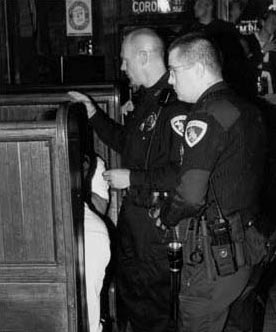
Police inspections of bars and enforcement of liquor laws encourages bar owners to adhere to responsible management practices. Credit: Kip Kellogg
§§§ Madison, Wisconsin adopted a point system in 1986 as the basis for sanctions against liquor licensees to remove some of the arbitrariness of the administrative process, and the police department developed methods for recording and reporting police activities at bars to the liquor-licensing authority. A key feature of the system is that reports of problems by the owners/managers to the police, and cooperation with the police, reflect favorably rather than negatively on the licensee. A police representative serves as a nonvoting member of the alcohol-license review committee. By contrast, the Green Bay (Wisconsin) Police Department (2000) had to change city officials' attitudes toward liquor-license regulation to close or improve control over problem bars.
§§§§ In Sweden, a combination of responsible-beverage-service training and consistent liquor-law enforcement by police led to significant increases in the rate at which servers refused to serve intoxicated patrons (from 5 percent refusals to 70 percent refusals), and a significant decrease (29 percent) in the number of violent crimes occurring in or around participating bars (Wallin, Norstrom, and Andreasson 2003; Wallin, Gripenberg, and Andreasson 2005).
Some communities use nuisance-abatement laws and conditional-use permits (business permits with special requirements and restrictions) to compel bar owners to establish and enforce responsible policies and practices that can reduce aggression and violence in and around the premises.§
§ Fresno, California makes extensive use of conditional-use permits to regulate liquor establishments. Sacramento, California, prepared a Model Conditional-Use Permit Ordinance for Retail Alcohol Outlets (Wittman 1997). The Hayward (California) Police Department helped private residents file a civil lawsuit against a problem bar, ultimately resulting in the revocation of its liquor license (Sampson and Scott 2000).
Specific Responses To Reduce Assaults
You will need to combine two groups of responses in any effective strategy:
- responses to reduce how much alcohol patrons drink, thereby reducing aggression and vulnerability to assault
- responses to make the bar safer, regardless of how much alcohol patrons drink.
Reducing Alcohol Consumption
Training and encouraging bar staff to serve responsibly and monitor patrons' drinking can help reduce the risk of violence in the bar. smartserve.org
§ As of 2000, at least 23 states had server-training legislation. In 11 of these states, the laws provide incentives for establishments that provide training to their employees, while in the remaining 12 states, server training is mandatory (Mosher et al. 2002).
Responsible beverage service programs include training bar staff to adopt responsible serving practices, and encouraging bar owners and managers to adopt responsible business practices and policies. The most common elements of these programs include the following:
6a. Monitoring drinking to prevent drunkenness. In general, servers are not good at determining whether customers are drunk because the signs and signals used in that assessment are largely subjective (slurred speech, clumsiness, mood changes). The best estimator of a customer's blood alcohol content is the number of drinks served, but given the size and layout of many bars, the amount of alcohol consumed is very difficult to track.[47] Further, servers cannot know how much a customer has drunk before arriving, what or if he or she has eaten, or how long he or she intends to stay at the bar—all of which will affect the server's judgments about continued service. [48] Training should focus on the most obvious and reliable indicators of drunkenness and improved communication among multiple servers to enable better monitoring. While it may take a long time for enforcement officials to witness bar staff serving drunken patrons, the benefits appear to be worth the costs.[49] For the most part, it is still too easy for both drunken and underage drinkers to get served in bars. [50]
7. Establishing and enforcing server liability laws. In many jurisdictions, alcohol servers and bar owners can be held legally liable either for the harm drunken patrons cause (through private civil suits) or for merely serving drunken people (through statute enforcement by the police or liquor-license regulators).§ Server liability laws alone have had mixed results as an incentive for bar owners to adopt and enforce responsible (beverage) service policies and practices.[53] In particular, the relatively low enforcement rate, the owner's profit motive, and the server's reliance on tips as income can decrease these laws' deterrent effect.[54]
§ Erenberg and Hacker (1997) report that 36 states have some form of dram-shop liability law, and refer to the Model Alcoholic Beverage Retail Licensee Liability Act of 1985.
8. Reducing the concentration and/or number of bars. There is growing evidence that the concentration of bars in an area is related to that area's crime levels and patterns, although the exact nature of the relationship is not yet clear.[55] We cannot yet say how many bars in a small area are too many, but evidence does suggest there is such a threshold. Police agencies can support efforts to reduce the concentration or number of bars through zoning and liquor-license enforcement.Making Bars Safer
9. Training staff to handle patrons nonviolently. Some assaults in bars have less to do with alcohol and more to do with unprofessional or unskilled staff. There are conflicting views about the effectiveness of employing security staff (bouncers and doormen) as a way to reduce assaults in and around bars.[56] Well-trained bar staff can function as guardians (protecting victims), handlers (modifying behavior of offenders, particularly those who are regular customers), and place managers (exerting social control over people in places). [57] However, they may react ineffectively to incidents or, at worst, may overreact or antagonize customers and precipitate an incident.Skill development programs to reduce aggression are often easier to market to bar owners than interventions focused on serving less alcohol.[58] The programs are most effective when focused on portable skills using real-world scenarios, drawing on participants' experience. The following particular techniques can defuse aggressive incidents:[59]
- Remove the audience (get aggressors away from onlookers)
- Employ calming strategies
- Verbal skills
- Allow the aggressor to talk and express anger
- Use role-appropriate language
- Avoid hostile or angry remarks
- Respond indirectly to hostile questions
- Express an understanding of the aggressor's mood
- Nonverbal skills
- Increase the distance between oneself and the aggressor
- Avoid sustained eye contact with the aggressor
- Move slowly and avoid sudden movements
- Maintain calm, relaxed facial expressions
- Control the vocal signals of anxiety and stress
- Verbal skills
- Employ control strategies
- Clearly establish the situation requirements
- Depersonalize the encounter
- Emphasize one's role requirements
- Encourage the aggressor's decision-making
- Offer the aggressor face-saving possibilities
A number of communities require security staff to be trained, licensed, and registered, a measure several researchers endorse. [60] § The United Kingdom uses "door staff registration schemes" extensively, requiring all door staff at bars to be trained and vetted.§§ The many local variances in policy can be frustrating to those wishing to work in multiple jurisdictions.[61] These schemes are most effective when staff receive individually numbered badges; registering agencies maintain a comprehensive name, photograph, and address register; and bars keep premise-specific staff assignment logs.[62]
§ The San Diego (California) Police Department's In-House Security Training Program offers training courses for instructors from local venues who, once endorsed, teach and certify in-house security personnel. The program includes an evaluation component to determine reductions in the numbers of complaints, disturbances, violent incidents, and drug use; the quality of training content, delivery, and materials; and whether the program contributes to the ability to identify problematic security personnel (San Diego Police Department Vice Unit n.d.).
§§ The United Kingdom's Private Security Act 2001 requires all private-sector security staff to obtain an occupational license before working in the industry. This act supersedes all local door-staff registration schemes (Hobbs et al. 2003).
10. Establishing adequate transportation. Adequate public transportation to and from bars, especially after closing hours, can reduce competition for transportation, more quickly clear the streets of drunken people, and reduce the hazards of drunken driving.[63] § Separating taxi stands and bus stops from each other can reduce the size of groups congregating on the sidewalks.[64]§ Increasing the availability of taxis and buses to patrons leaving nightclubs in Douglas, Isle of Man was an important dimension of a larger successful strategy to reduce violence and disorder around bars ( Isle of Man Constabulary 2005).
11. Relaxing or staggering bar closing times. Allowing bars to determine their own closing times or staggering the mandatory closing times results in fewer drunken people on the streets competing for food, transportation, and attention. [65] In addition, more people are on the streets, though in lower concentrations, for longer periods—a factor that improves natural surveillance and makes people feel safer.§§ However, it is also possible that staggered closing hours will increase barhopping, as patrons roam the streets looking for open bars.§§§ In addition, eliminating mandatory closing times could create an environment where alcohol is almost continuously available and could increase assault rates at venues with extended hours.[66] So, while staggered closing times show promise in reducing assault levels, more evidence of its impact is needed. Changes to operating hours, alone, are unlikely to decrease the assault rates. The change must also be accompanied by high-quality efforts to control, manage, and regulate the properties.[67] If this response is implemented, it should first be done in a controlled pilot effort to gauge the overall effect.§§ The United Kingdom's Licensing Act 2003 eliminated mandatory pub closing hours. The new liquor-licensing legislation gave police more authority to close rowdy pubs, allowed for lengthy bans of troublemakers and habitual drunkards from pubs, and allowed local authorities to impose environmental conditions on liquor licenses. Several organizations had strong concerns about the legislation (Civic Trust and the Institute of Alcohol Studies 2002; Roberts et al. 2002; McNeill 2005). To date, the relaxed closing hours' impact on the assault and disorder rates has not been evaluated.
§§§ A Grand Rapids, Iowa proposal would allow bars to stay open later, although they would still be required to stop serving alcohol at the usual time. The purpose of these extended hours would be to allow customers to "cool down and sober up" before leaving the bar (Ronco and Quisenberry 2005). In Australia, a group of local bars agreed to a "patron lockout" to reduce barhopping. Although bars remained open until 3 or 5 a.m., customers were not allowed to enter or reenter bars after 2 a.m. (University of Ballarat Center for Health Research and Practice 2004).
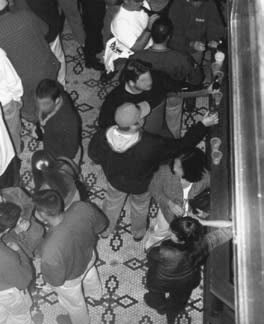
Occupancy limits should be enforced so that bar patrons do not feel crowded. Credit: Kip Kellogg
13. Maintaining an attractive, comfortable, entertaining atmosphere in bars. Attractive, well-maintained bars suggest to patrons that the owners care about their property and will not tolerate disorderly and violent conduct that might destroy it. [69] A comfortable and entertaining atmosphere reduces both frustration and boredom among patrons, which can reduce aggression levels. Lighting should not be so bright that it acts as an irritant, but also not so dim that it can conceal customers' activities.[70] An important environmental consideration is the crowding level. Police in some jurisdictions enforce occupancy limits (primarily adopted for fire safety) as a means to control the bar crowding that can lead to fights. Redesigning a bar's interior to improve traffic flow and prevent congestion can reduce the opportunities for accidental bumps and drink spills that may escalate into fights. [71]
§ The city of Portland, Oregon explained the procedures for banning troublemakers from liquor establishments in a guidebook for liquor establishment owners and managers (Campbell Resources Inc. 1991). The Madison (Wisconsin) Police Department uses what it calls an "Unruly Patron Complaint." They remove unruly customers from bars and serve them a form telling them they are banned from entering the bar again due to their behavior. They file a report and give the bar a copy of the complaint, with the offender's name and information, and a case number. Should the patron return to the bar, the bar staff calls the police, who arrest the patron for trespassing. Madison police have found this tactic especially helpful in bars with a regular clientele who fear losing the privilege of going there. This tactic is also a common feature of "PubWatch" schemes in the United Kingdom (Pratten and Greig 2005).
§§ The Arlington (Texas) Police Department (1997) helped one especially problematic bar develop a computer database to record all people ejected from or arrested at the bar, and to make this information available to door security staff.
Responses With Limited Effectiveness
18. Using extra police patrols in and around bars. Many police departments concentrate on the streets outside bars rather than the conditions inside bars. They do so by providing a heavy police presence outside bars and, in some instances, in the bars themselves, with regular on-duty patrols through the bars or off-duty police officers working there. The main result seems to be an increase in the rates of reported and recorded offenses, if for no other reason than the police witness offenses that might otherwise go unreported.[76] §§§ Heavy police involvement through patrols and enforcement is not essential if there is sufficient community, peer, and regulatory pressure on licensees to manage bars responsibly. The police are neither able, nor fully authorized, to regulate every aspect of bar management, but they can encourage, support, and insist on responsible management policies and practices.§§§ One sensible response related to police enforcement is to pass legislation making public fighting an offense, as was done at the recommendation of the Edmonton (Alberta) Police in 1999. This allows police to arrest offenders even when they cannot establish the elements of assault and battery.
19. Marketing responsible consumption and service practices. Efforts to reduce consumption by educating people about responsible drinking do not appear effective.[77] In general, drinkers do not view messages about responsible drinking as relevant to their own experiences. [78] Media messages to young audiences about the dangers of drinking are counteracted by news about the health benefits of drinking modest amounts of alcohol, and by alcohol industry promotions. While major alcohol manufacturers and distributors have toned down their marketing campaigns in recent years, promoting responsible drinking, local bars have filled the void in the competition to attract patrons. [79] § Police can target their enforcement efforts toward irresponsible bar advertising.§ The North American Partnership for Responsible Hospitality and the National Licensed Beverage Association set standards for responsible beverage service, even though they have little direct influence over individual licensed premises. Sources of U.S. alcohol industry advertising codes include the Beer Institute, the Wine Institute, and the Distilled Spirits Council of the United States. State and local laws, newspaper advertising policies, and college campus advertising policies may also govern alcohol marketing.
20. Prohibiting the sale and consumption of alcohol. Alcohol prohibition can be effective under certain conditions, such as in unique cultural contexts where there is widespread public support for it, or in isolated communities where there are no nearby jurisdictions where one can drink.[80] §§ However, in most communities, prohibition is politically impractical and can create a new set of problems. For example, strict prohibition creates an illegal alcohol market, and violence is often used to enforce that market.[81]§§ Barrow, Alaska, an isolated Arctic community, experienced dramatic decreases in alcohol-related assaults, as well as many other alcohol-related problems, when it banned the sale, possession, and consumption of alcohol (Sampson and Scott 2000). Some cities, such as Chicago, Illinois, have provisions allowing residents to vote to prohibit alcohol sales in specific areas—in effect, to create dry zones within the larger community.


Free Bound Copies of the Problem Guides
You may order free bound copies in any of three ways:
Online: Department of Justice COPS Response Center
Email: askCopsRC@usdoj.gov
Phone: 800-421-6770 or 202-307-1480
Allow several days for delivery.
Email sent. Thank you.
Assaults in and Around Bars 2nd Ed.
Send an e-mail with a link to this guide.
* required
Error sending email. Please review your enteries below.
- To *
Separate multiple addresses with commas (,)
- Your Name *
- Your E-mail *
Copy me
- Note: (200 character limit; no HTML)
Please limit your note to 200 characters.