
Responses to the Problem of Disorder at Budget Motels
Your analysis of your local problem should give you a better understanding of the factors contributing to it. Once you have analyzed your local problem and established a baseline for measuring effectiveness, you should consider possible responses to address the problem.
The following response strategies provide a foundation of ideas for addressing your particular motel-disorder problem. These strategies are drawn from a variety of research studies and police reports. Several of these strategies may apply to your community's problem. It is critical that you tailor responses to local circumstances, and that you can justify each response based on reliable analysis. In most cases, an effective strategy will involve implementing several different responses. Law enforcement responses alone are seldom effective in reducing or solving the problem. Do not limit yourself to considering what police can do: give careful consideration to who else in your community shares responsibility for the problem and can help police better respond to it.
General Principles for an Effective Strategy
1. Enlisting community support to address the problem. Changing the way motels do business requires the support of local elected officials; government agencies that can regulate overnight lodging establishments; business associations, such as the Chamber of Commerce and convention and visitors bureaus; and, to some extent, the motels themselves. These various parties should be provided with detailed information about the nature and extent of motel problems before recommending any changes.† Well-funded regional and national motel chains may try to influence local politicians before they have all the facts, and small-business owners—even ones who manage enterprises that border on the criminal—can be a powerful local constituency for elected officials. Neighboring businesses, residents, and users of the areas near problem motels can help make the case for change.† Taking elected officials and local business leaders on tours of problem motels can be an effective way of alerting them to specific issues.
2. Obtaining cooperation from motel owners and managers. Voluntary compliance with good motel management practices is possible to obtain from a segment of motels, and there are several natural incentives for managers to reduce problems at their properties. Legitimate motel owners have a financial interest in reducing crime and disorder problems—especially those that involve a potential loss of revenue, such as guests who damage rooms or refuse to pay.†† Safe, well-run, attractive motels can charge higher rates and maintain or increase annual revenue. Some managers would genuinely like to reduce the number of problem guests and visitors at their motels, but lack the necessary financial resources or knowledge about effective crime prevention measures at motels. (To download a copy of a management practices checklist you can provide to motel managers, see www.chulavistapd.org/motels.) Independent motels, in particular, may not have the resources to make significant environmental changes, but they can make a number of management changes at little cost. National chains have more resources at their disposal and are highly capable of running safe motels, if they choose to do so. You can prioritize problem motels with uncooperative managers or owners by CSF/room ratios, total number of citizen- and officer-initiated service calls, and community complaints. Uncooperative motels will have different leverage points. National budget chains may want to avoid negative publicity. Absentee motel owners may be persuaded to make changes that will reduce their exposure to liability or the likelihood of significant property damage.† Motel owners or managers involved in criminal activity at their motel can be forced to sell their business or radically change their business practices if they have been charged with or convicted of a crime. However, some motels may change the way they do business onlyunder the threat of nuisance abatement or new local laws governing motel operations.†† At least 35 percent of Chula Vista motel managers indicated they had experienced the following problems in the prior month: theft, guest's refusal to leave, loud party, suspected drug dealing, and vandalism/graffiti (Bichler, Christie, and McCord 2003). Improved management practices can reduce the likelihood such problems will occur.
† Motel managers in Sandy City, Utah, were convinced that it was in their interest to prevent drug dealers from setting up methamphetamine labs in their motel rooms when informed that the cost of cleaning up and rebuilding a motel room after a drug lab explosion could be as high as $25,000 (Thompson 1999).
Regulating Management Practices Through CFS/Room Ratios
The city of Tukwila, Washington, requires motels to implement specific responses based on their yearly CFS/room ratios. All motels fall in one of three tiers established by the city: (1) less than or equal to 0.25 CFS/room/year; (2) 0.26 CFS/room/year to 1.0 CFS/room/year; and (3) more than 1.0 CFS/room/year. Motels and hotels in the tier with the fewest service calls do not have to make any changes. Motels in the middle tier must have a staff member on the property 24 hours a day, maintain a surveillance camera in the lobby at all times, and participate in a crime prevention assessment. Motels in the highest service-call tier must implement the middle-tier requirements, as well as submit employee names to the police department for background checks, train employees in proper management practices, install cameras in parking lots, implement crime-prevention-through- environmental-design recommendations, and make a number of other changes. Since being passed in the summer of 2000, police there report the initiative has reduced service calls by approximately 60 percent at motels with annual CFS/room ratios of more than 1.0.
† All agree that deadbolts, peepholes, door chains, solid doors and frames, and room telephones constitute basic security measures that all motels should have in place. As far as liability goes, the absence of these measures is considered evidence of unsafe lodging. Motels with established crime problems have also been expected to employ adequate numbers of security guards, install closed-circuit television (CCTV) in problem areas, and secure sliding-glass doors with bars (Slepian 2002).
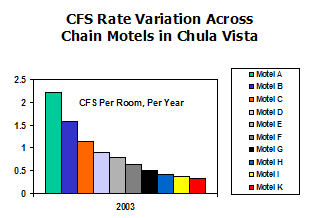
4. Establishing crime-and-disorder performance standards and goals. As noted earlier, CFS/room ratios vary significantly, even among comparable motels in comparable neighborhoods. Motels with low CFS/room ratios set a natural baseline for what can be accomplished at similar properties. Motels should be able to maintain annual CFS/room ratios of less than 1.0††; action should be taken against those that do not keep calls at or below this level. Incentives for reaching performance goals, such as city-sponsored signage, community development funds, or other enticements, may be offered to motels that maintain annual CFS/room ratios of 0.5 or less.††† Both research and successful crime-reduction projects at motels and other residential properties have shown that motel personnel—especially managers and owners—can effectively control crime and disorder on their properties through proper management practices.19 Managers and owners have the greatest ability to ensure that their properties do not attract problem guests and visitors. However, many managers and owners are under the false impression that only police enforcement can reduce the problems at their motels, and rely primarily on local police to keep the order. Police agencies should avoid becoming de facto security services for motels for two reasons: traditional enforcement tactics are not particularly effective at reducing motel problems, and cities should not routinely subsidize the security operations of a for-profit industry. In general, it is important that police let motel managers or owners decide what specific steps to take to meet local standards. If a police agency recommends specific changes at a motel, and those changes do not bring about the desired results, the motel may have grounds to argue against abatement or other enforcement actions designed to reduce problems.20†† In some communities, a ratio of 0.5 may be excessive, however, compared to other motels in the area.
††† Performance standards are not intended to discourage motel staff or others from calling the police in an emergency. Police should conduct a quick door-to-door tenant survey if they suspect a manager is training tenants not to call them. Motel managers facing a performance standard may argue that it is their right to call the police, and they should not be penalized for being proactive. However, if a motel chooses to cater to a high-risk clientele and has a high number of calls for service, the management should completely control access to the property. The management may also need to hire adequate security, both to handle repeat nuisance calls that should not require a police response, and to prevent more-serious incidents from occurring. If a motel cannot afford access-control measures and private security (if necessary), it should stop catering to a high-risk clientele.
Specific Responses to Disorder at Budget Motels
Deterring/Screening Problem Guests and Visitors
5. Requiring all adult guests and visitors† to present government-issued photo ID at the front desk immediately upon arrival. An ID requirement reduces the perception of anonymity at motels, reinforces personal accountability for behavior, and provides police with important information should a crime occur—all reducing the motel's appeal to problem guests and visitors. At minimum, front desk clerks should collect the following information from both guests and visitors:† Like guests, visitors should be directed to the front desk by the security staff or the property design (e.g., fencing that prohibits unimpeded motel access, walkways that lead directly to the front office).
- Full name
- Home address
- Home telephone number
- Date of birth
- Government ID number and ID type
- State and country of ID issuance
- Time of arrival
- Number of assigned or visited room.
Desk clerks at motels with high CFS/room ratios should also collect the following from registered guests:
- Name, address, and phone number of their employer
- Name and telephone number of an emergency contact.21
Clerks should complete the guests' registration cards according to information verbally provided by the guests, then ensure the photo IDs contain the same information. Clerks should also visually verify and record guests' and visitors' license plate numbers, and issue corresponding parking permits that limit stays.22 Staff should record all guest and visitor information on a government-approved registration form readily accessible to police and other city officials who need to review occupancy levels, such as finance department personnel.
6. Requiring that guests and visitors be at least 21 years old to rent or visit a room, unless accompanied by a parent or legal guardian. Minors are at particular risk of sexual assault or statutory rape at motels; age limitations on guests and visitors can help prevent these crimes. Maintaining a strict 21-or-older policy for both guests and visitors can also prevent underage drinking in motel rooms.- No illegal activity (including drug use/sales, prostitution, and underage drinking) is allowed on the premises. If such activity is suspected, the management will notify the police and ask guests to leave the property, without a refund.
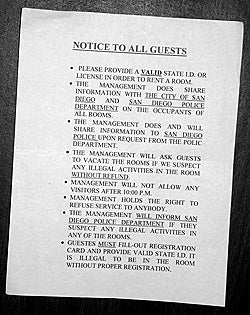
Posted signs, clearly stating the rules of the motel, can dissuade guests from engaging in illegal activities. Credit: Karin Schmerler
- Room doors must be kept closed at all times.
- No loitering is allowed on the premises.
- No public drinking is allowed.
- Playing loud music is not allowed.
- Quiet hours are 10 p.m. to 6 a.m.
- All visitors must check in at the front desk.
- Guest rooms may not be used for private parties.
- Parking passes must be displayed in all vehicles parked in the lot, or they will be towed at the owners' expense.
- The management shares registration information with local police.
† Prostitutes are often well-known to motel clerks, gang members may have gang-related tattoos, and drug dealers may have previously raised suspicion by making numerous brief phone calls from their rooms during prior motel stays. Based on a review of motel arrests, Sandy City officers developed a profile of people buying and selling drugs at the properties. The typical arrestee used methamphetamine, was between the ages of 18 and 35, provided a local address, and paid in cash at low-priced motels or used a fraudulent credit card at moderately priced motels. The arrestees also generally checked into motels in pairs and without luggage, and made and received numerous local phone calls (Thompson 1999).
12. Implementing clear check-in policies, and training clerks in their use. Clerks should provide guests and visitors with a copy of the "house rules." If the motel is experiencing serious problems, clerks should require guests and visitors to read and sign a form. Clerks should also ask guests why they are renting a room, how many visitors they expect, and how long they are staying. If guests indicate they will be staying seven days or more, motel managers should conduct more- extensive screenings, which may involve credit, employment, and prior landlord reference checks.29 Night clerks, who are often recent hires, may need additional training in guest screening and motel security procedures.30Managing Problem Guests and Visitors
14. Assigning potential problem guests to rooms near the front office or with high natural surveillance. Some motel managers routinely rent suspicious guests rooms near the front office, so they can better monitor their behavior. Rooms that face a busy street can also provide natural surveillance of problem guests and their visitors.† Approximately 20 states do not require vehicles to display a front license plate.
17. Inspecting the rooms of guests who refuse maid service or behave suspiciously after check-in. Guests who have no luggage but anticipate an extended stay, bring a lot of luggage into a room for a one-night stay, or make and receive many local phone calls may be involved in producing methamphetamine.34 If motel managers suspect drugs are being produced or sold, or find drug paraphernalia, they should call the police, who can inspect the room for evidence of illicit activity. You should consult with legal counsel about the laws governing police searches of motel rooms in your jurisdiction.Changing the Physical Environment
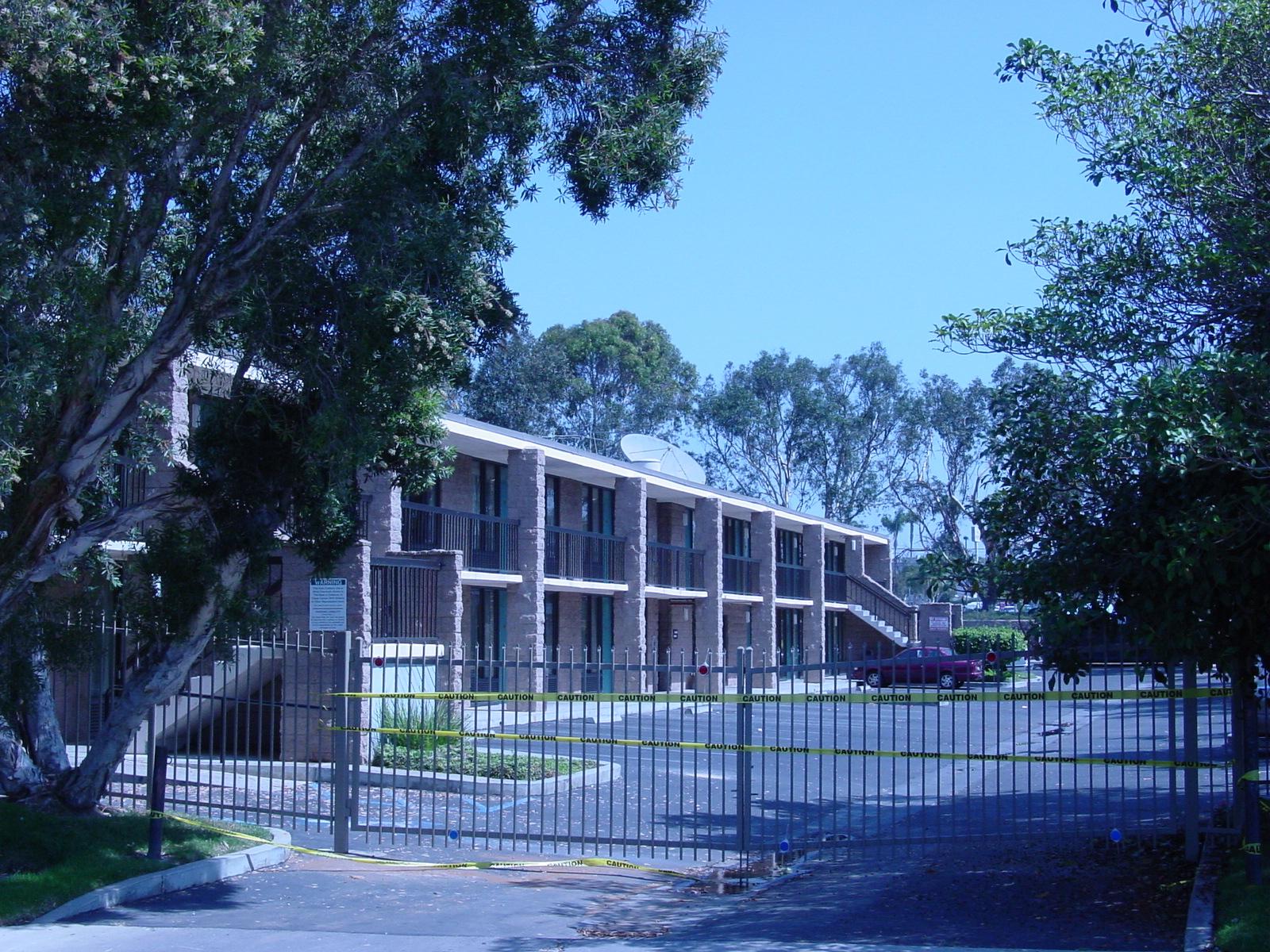
This motel fenced an unnecessary entrance/exit to reduce pull-through traffic. Credit: Karin Schmerler
† The two most frequent problems experienced by Chula Vista motel managers were (1) too many people in a room (65 percent of managers reported experiencing this problem in the previous month), and (2) unauthorized guests/visitors in rooms (57 percent of managers) (Bichler, Christie, and McCord 2003). Controlling direct access to rooms can substantially reduce both problems.
19. Installing and monitoring CCTV. Closed-circuit television (CCTV) cameras at the property entrance(s), in the lobby, in the parking lot, in the pool area, at building entrances and exits, and at other problem locations can help motel staff better monitor the entire property. To address an increase in armed robberies at Marriott's higher-end budget motels (Fairfield Inn, Residence Inn, and Courtyard) in the mid-1990s, Marriott installed a basic CCTV system in the lobby of more than 80 percent of them. Robbery rates at those motels fell 43 percent the first year after they installed CCTV, and an additional 33 percent the first nine months of the next year. Color monitors were found to be most effective. In addition, motels that installed the monitors in locations visible from outside the motel experienced a more dramatic decline in robberies than those that did not. Finally, contrary to Marriott's expectations, legitimate customers did not voice concerns about the monitors.39 For it to be effective and not cause undue liability, CCTV must be monitored, which can be time-consuming and tedious.† A foot-candle is a unit of measurement of light per square foot of surface space. Inexpensive light meters can be used to determine the lighting level at a specific location.
21. Landscaping and maintaining the property in a way that minimizes crime opportunities and maximizes the perception of ownership. Simply planting and maintaining a low-growth flower garden can signal to problem guests that the property is well-cared-for and unlikely to be suitable for illegal activity. Abandoned vehicles, furniture, and appliances, graffiti, and other signs of neglect should quickly be removed. Pay phones used by problem guests should be altered or removed. You should consult someone trained in the principles of crime prevention through environmental design (CPTED)† for specific recommendations.† For more information on CPTED principles, see the International CPTED Association's website, at www.cpted.net/default.html.
22. Establishing redesign and property improvement incentives. Areas slated for redevelopment can be rezoned to encourage property improvements that both reduce crime opportunities and improve aesthetics. For example, in Sarasota, Florida, owners of aging motels and other structures built before the current building code was adopted had little incentive to significantly upgrade their properties, as doing so would require full code compliance. To encourage property improvements, the city exempted motel owners in a specially designated redevelopment zone from meeting the code requirements, as long as the proposed upgrades met the overall goals for the zone: to create a "…safe and attractive environment..."41 Cities can also offer low-interest loans or tax credits for major renovations that would allow motels to increase room rates or incorporate CPTED principles into the property design.Fostering Responsibility Among Motel Owners† and Managers for Maintaining Safe Lodging
† It is important to inform and work with problem-motel owners as well as managers, because managers may not have the authority to make changes that could result in a loss of rental revenue (Clarke and Bichler-Robinson 1998).
†† In a number of states and municipalities, properties where drug dealing or other nuisance behavior, such as prostitution (laws vary), occurs can be closed or otherwise ordered to cease operation.
††† An evaluation of a San Diego effort to reduce drug dealing by contacting property owners found that those who both received a letter from the police about the illegal activity and participated in a follow-up meeting experienced a 60 percent reduction in reported crime (Eck 1998).
†††† Problem motels may more frequently require information on arrests, crimes, and service calls. As part of an intensive effort to reduce problems at a Fresno, California, property, an officer personally contacted the owner and manager each time police made an arrest or executed a search warrant at the property ( Fresno 1998 [Full text ]).
††††† Some courts have held that the burden is on motel management to assess the need for security measures, based on the foreseeability of crime problems at the property. Aspects of foreseeability include the nature and volume of previous crimes at the property, the crime rate of the surrounding neighborhood, guests who commit crime(s), a property design that facilitates crime, the number of calls about suspicious people, and a high visitor-to-guest ratio (Slepian 2002).
24. Requiring that a manager be on the property at all times. Problems at motels occur at all hours; managers must be available at all times to address the concerns that will inevitably arise during nonbusiness hours. Some motel managers live in their motels. As a general proposition, residential property managers are more likely to employ management practices that will reduce crime and maintain order if the property is also their home.42Establishing and Enforcing Regulations and Penalties
27. Limiting occupancy to no more than 28 days in a 90-day period, and evicting problem tenants. A number of jurisdictions have prohibited motels from housing people on a long term basis—typically for more than a month at a time—citing health and safety reasons.† If motels cannot be prohibited from housing long-term residents, they should implement more rigorous screening procedures and operate their businesses as landlords, rather than managers.†† Established motel tenants involved in illegal activity should be evicted under existing landlord-tenant laws.††† The arrest and subsequent eviction of managers and several long-term problem residents of a Fresno motel resulted in a 70 percent decrease in the average number of service calls per month.47† In justifying its 30-day stay limit at motels, Buena Park, California, indicated that the lack of ongoing maintenance and maid service at long-stay motels rapidly creates substandard conditions in most, if not all, of the rooms.
†† For further information about effective rental-property management, see Campbell (2000) [Full text ].
††† An evaluation of effective drug abatement efforts found that problem-tenant eviction enabled a large majority of properties to essentially eliminate drug problems and avoid abatement (Davis and Lurigio 1998)
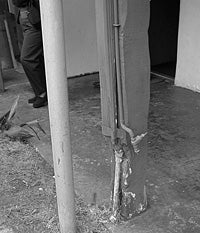
Because many independent motels were built more than 50 years ago and owners tend to limit investment in the properties, a number will exhibit moderate to severe code violations. Credit: Adele Sidock
†††† In California, the Franchise Tax Board can eliminate tax deductions if a property does not comply with housing codes.
29. Implementing licensing requirements for lodging establishments, including minimum security, sanitation, and management standards. In Stockton, California, motels must meet minimum standards to obtain a permit to operate. Among other things, permit applicants must demonstrate that the property fully complies with all applicable building, fire, and health codes; that service calls to the property have not been "excessive," as determined by the police chief; that the premise is governed by a management plan that addresses cleaning schedules and property maintenance; and that the property manager has not been involved in criminal activity for at least five years† and has completed a motel-management training course co-taught by the police, fire, code enforcement, and environmental health departments, and the local hotel/motel association.50,§ During 2002, the program's first year of operation, 12 of the city's 59 motels were shut down because they failed to comply with the new requirements. Oakland, California, requires that all motel rooms be secured with deadbolt locks and meet minimum standards regarding conditions and furnishings, as well as linen and mattress cleanliness.51 Motel practices and standards can also be regulated through conditional-use permits, particularly when motel ownership changes hands.† The CSUSB study of Chula Vista motels found that only 19 percent of motels that were not family-owned conducted criminal records checks on motel employees.
§ For a copy of the Stockton ordinance, see www.stocktongov.com/SMC/Chapter07/Ch07_PartIV_Div02.cfm.
30. Enacting special regulations for adult motels.†† To make it more difficult for prostitutes to operate out of motels, a number of cities have passed laws prohibiting motels from renting rooms on an hourly or half-night basis. Other jurisdictions have established definitions of adult motels to limit where they can be located and to regulate their operations.†† Sugarland, Texas, has defined adult motels as those that (1) offer public accommodations with CCTV, films, videos, slides, or photos characterized by an emphasis on specified sexual activities; (2) and post a sign visible from the street advertising such material; (3) or offer a sleeping room for rent for less than 10 hours; (4) or allow a tenant or occupant of a sleeping room to sub-rent the room for less than 10 hours.
31. Requiring a performance bond††† or other changes at a property in exchange for continued business operation. Oakland police and city officials required a prominent national budget chain to take out a $250,000 performance bond in return for continued operation of a problem motel. The motel had well-documented problems of prostitution and drug sales, and a service-call level substantially above that of neighboring chain motels. Rather than forfeit the $250,000 bond to the city, the motel improved its management practices, hired 24-hour security guards to control access to the property, prohibited visitors between 10 p.m. and 6 a.m., and instituted a series of other management changes. These changes reduced service calls to the property by 59 percent† seven months after the agreement was reached, and pushed the motel's service-call levels down to those of neighboring chain motels, a key stipulation of the agreement. National City officers required a series of changes in return for the continued operation of a motel whose owners had been cited for violating the California state penal code sections that prohibit room rental to known prostitutes.†† Requiring a performance bond or other changes at a property provides a certain degree of leverage with the property owner. In the case of the Oakland airport motel, the adverse publicity of a drug abatement lawsuit provided the necessary leverage for the company to take out the performance bond. In National City, misdemeanor charges that put the owners on probation for one year gave officers the means for requiring management changes.††† A performance bond guarantees that the terms of an agreement will be met or the injured party will be financially compensated.
† This call reduction was achieved with virtually no police enforcement action. Just one search warrant was served, and several arrests made.
†† To prove that the motel was violating the penal code, National City officers paid an hourly rate for rooms and then brought known street prostitutes to the motel, making it clear that they were doing so to have sex in exchange for money. Violation of the penal code provisions enabled officers to obtain a search warrant for the property, which revealed separate bookkeeping practices and tax violations (National City Police Department 2002 [Full text ]).
32. Seeking cost recovery for excessive city time spent at problem motels. If police can establish that they have, out of necessity, spent an inordinate amount of time at problem motels, they can request reimbursement for that time. Oakland police recovered more than $35,000 for time spent surveilling the budget motel that took out the $250,000 performance bond.52††† In 1999, the University of California, Berkeley, estimated it would cost the city of Oakland approximately $18,000 in legal and administrative costs to close a motel under the state drug nuisance-abatement statute, but only an estimated $1,300 to close the motel if it constituted a public nuisance under the same statute (Amato et al. 1999).
†††† Amortization is a means of terminating a nonconforming use by allowing investors to recoup their investment over a reasonable period, which may range from a few months to several years.
††††† Eminent domain is the government's ability to take possession of private property for the public good, usually by providing fair compensation to the owner.
† An imminent hazard is a structure that is at risk of causing immediate or impending harm to the occupants or their property.
†† In weak real-estate markets, for example, a property that is closed or acquired through abatement may have significant tear-down or conversion costs that could inhibit future property development.
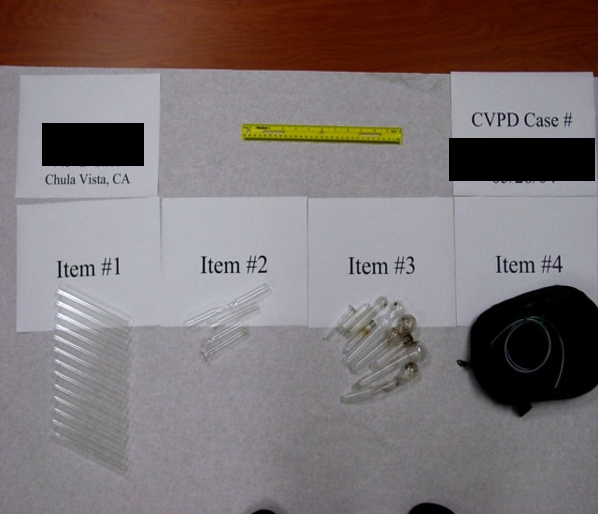
Documenting drug and weapon seizures at motels is crucial to making the case for abatement. Credit: Aaron Anderson
Responses With Limited Effectiveness
35. Continually arresting offenders at problem properties. A number of police departments have made little impact on motel problems using only traditional tactics.56 Albuquerque, New Mexico, police arrested more than 20 people at a particularly problematic motel during the summer of 1997, but by February 1998, they were again making a lot of arrests there, for drugs and prostitution. It was not until the property was abated as a nuisance in 1999 that the problems there declined.57 National City officers found that the impact of "john" stings (arrests of prostitution customers) were short-lived and did not address the underlying cause of the problem: poor property management. They routinely conducted prostitution stings in the area of a problem motel for four years before concluding that these efforts were not effective over the long term.58 In addition, research on the impact of drug enforcement efforts at apartment complexes and drug houses has found little evidence that traditional tactics are effective in these settings.59 At motels with poor guest screening and management, police face a seemingly limitless supply of offenders not deterred by periodic enforcement efforts.† In Mesa, Arizona, where the CFHM concept was developed and implemented in 1997, the majority of motels did not participate in the CFHM program as of July 2001.


Free Bound Copies of the Problem Guides
You may order free bound copies in any of three ways:
Online: Department of Justice COPS Response Center
Email: askCopsRC@usdoj.gov
Phone: 800-421-6770 or 202-307-1480
Allow several days for delivery.
Email sent. Thank you.
Disorder at Budget Motels
Send an e-mail with a link to this guide.
* required
Error sending email. Please review your enteries below.
- To *
Separate multiple addresses with commas (,)
- Your Name *
- Your E-mail *
Copy me
- Note: (200 character limit; no HTML)
Please limit your note to 200 characters.