
UnderstandingYour Local Problem
The information provided above is only a generalized description of retail burglaries. You must combine the basic facts with a more specific understanding of your local problem if you are to develop an effective response. In most cases, your burglary problem is likely to involve a group of stores, such as those in a downtown area or in a particular mall. In other cases, your problem might be related to stores of the same general type (say, pharmacies or building supply stores).† If the problem involves a single store (unless it is a very large store), you might more appropriately deal with it by offering routine crime prevention advice rather than undertaking a full-scale problem-oriented policing project. Your analysis is likely to focus on differential burglary risks among the stores in your group, and the reasons for those differences. Your analysis should address the risks of repeat victimization, as some particularly effective responses are focused on repeat victims. Bear in mind that registers of businesses may use corporate names, which may be different from "doing business as" names. The registers are also frequently outof-date, and you might need to make your own list.
† Each of these variations in retail burglaries deserves its own guide, but the information provided here should be sufficiently broad to provide assistance in all cases.
In general, you should seek to establish what kinds of offenders are involved, what kinds of stores they target, how they gain access to the stores, how they deal with security measures, and, finally, how they dispose of stolen goods. Knowledge of these factors will help you design an effective response to the problem.
Police crime reports or calls-for-service data do not generally distinguish the different kinds of nonresidential burglaries. Retail burglaries are lumped together with burglaries of educational institutions, medical centers, offices, and construction sites. Consequently, gathering information about your local problem can be labor-intensive. It requires a careful review of police records and the identification of retail burglary incidents. Fortunately, the large majority of retail burglaries are reported to police, but it can still be difficult to identify repeat burglaries because locations may not be systematically recorded. For example, the store name might be included in some crime reports, and only the street address in others.
In addition, many important details about the type of business, points of entry and nature of losses may not be included. Thus, you should try to gather systematic information about these details using other data sources. Because gathering and analyzing data can be time-consuming and involve technical problems, you should seek help from your local university, especially one with a criminal justice department. Data collection methods that can provide useful information include the following:
- Interviewing store owners or managers. You can obtain much valuable information by interviewing store owners or managers, using a standard set of questions. You should ask about burglary incidents, burglary consequences, security measures in place at the time of burglary, and measures subsequently introduced. Unless you are dealing with a very large number of stores, you should try to conduct face-to-face interviews, since these will generally yield valuable information not directly covered in the questions. Mail or self-completion surveys suffer from low response rates and missing information.
- Reviewing store records. Some stores, particularly very large or chain stores, keep records of burglaries.
- Reviewing security company records. Large security companies generally maintain records of burglaries on client premises. Apart from asking to review these records, you might interview security personnel familiar with the stores in your group, since they often know whether or not a store is serious about security.
- Conducting site surveys. You should conduct site surveys of stores that have been burgled. These should cover the store's location on the block, the rear entrance(s) of the store, the businesses near the store, the amount of natural surveillance and street lighting the store has, the store's distance from main roads, and other site variables related to burglary risks (see "Targets" under "Asking the Right Questions" below).
- Using computer mapping of incidents. Computer mapping of retail burglaries can reveal risk patterns and suggest possible reasons for those patterns. For example, burglaries may be clustered near a bar area, a drug market or a public transport hub. Or heavy clusters of repeat burglaries may indicate that a prolific burglar lives nearby. Mapping prolific offenders' addresses in relation to incident clusters may also be helpful.
- Interviewing burglary investigators. If burglary investigators are not part of your project team, be sure to interview them. They may have considerable knowledge gained through dealing daily with retail burglary cases.
- Interviewing burglars. Systematic interviews with arrested burglars can provide useful information about methods of burglary and disposal of goods.19 Here, assistance from your local university could be particularly important, because offenders generally talk more openly to researchers.
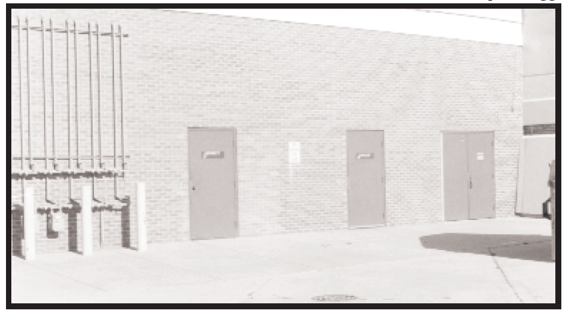
Site surveys of stores should include an assessment of the natural surveillance, lighting and security of the stores' rear entrances. Credit: Kip Kellogg
Asking the Right Questions
The following are some critical questions you should try to answer in analyzing your particular retail burglary problem. Your answers to these and other questions will help you choose the most appropriate set of responses later on.
Offenses
- What is the clearance rate for retail burglaries?
- How often is property recovered?
- What is the ratio of attempted burglaries to completed burglaries?
- What are the usual entry points or methods?
- What proportion of burglaries have been repeat burglaries within the past year?
- What is the typical length of time between repeats?
- How long do burglaries take? How long are burglars in the building/on the property?
- How much is typically lost (dollar value of materials, repair costs, lost business, insurance premium increases)?
- What proportion of burglaries (and attempts) are reported to police?
Offenders
- Are there many different offenders involved, or is a small group of prolific offenders responsible?
- How many of the prolific offenders have records for committing retail burglaries? How many have recently been released from prison?
- How much planning do offenders do?
- Do they work in gangs? How many offenders are in the gangs?
- Do they belong to any particular ethnic, occupational or other group?
- What proportion commit burglaries primarily to support a drug or alcohol habit?
- What proportion are juveniles?
- Do they appear to know the premises burgled? If so, how do they get the information?
- Where are they coming from, and how do they get to the burglary locations? On foot? In vehicles?
- Are they drawn to the area by burglary opportunities, or for some other reason?
- Do they specialize in commercial establishments, or more precisely, retail establishments?
- How do they dispose of stolen goods (exchange them for drugs, sell them at pawnshops or flea markets, sell them to professional fences, etc.)?
Targets
- Which kinds of stores are most at risk of burglary? Which stores are not burgled?
- Which goods are burglars stealing? Are they targeting cash?
- Which stores are being burgled repeatedly? What do they have in common?
- How long have the stores been in business?
- How big are the stores? Are they part of a larger chain? If so, how does the burglary experience vary among stores in the chain? How does it compare with that of similar stores in other chains?
- What time do the stores close? Are there businesses nearby that are open at night and on weekends?
- Is the property isolated? Is lack of natural surveillance a contributory factor?
- What site features facilitate burglary? Corner location? Rear access?
- Is victim carelessness a contributory factor?
- Which structures on the property are most at risk?
- How do burglars typically gain entry?
- How often do they disable alarm systems?
- What security measures have the stores taken to prevent burglary? What special measures have they taken to protect the most valuable merchandise/equipment?
- Do store employees follow correct cash-handling procedures?
- Is there evidence of collusion between staff and burglars?
- Do security guards patrol/check stores after hours? Are they carefully checking the stores' vulnerable areas?
Locations/Times
- When do burglaries usually occur (time of day, day of week, month, season)?
- What is the nature of the surrounding neighborhood?
- Is the problem part of a wider problem of commercial burglary affecting the whole area or jurisdiction?
- Where do events concentrate? Are they clustered near major roads?
Measuring Your Effectiveness
Measurement allows you to determine to what degree your efforts have succeeded, and suggests how you might modify your responses if they are not producing the intended results. You should take measures of your problem before you implement responses, to determine how serious the problem is, and after you implement them, to determine whether they have been effective. All measures should be taken in both the target area and the surrounding area. (For more detailed guidance on measuring effectiveness, see the companion guide to this series, Assessing Responses to Problems.)
The following "outcome" measures can be useful in assessing whether your responses have impacted the retail burglary problem:
- Reductions in reported retail burglaries and related calls for service
- Fewer repeat victims and offenders
- Reductions in burglary-related financial losses and insurance claims
- Reductions in business closures resulting from burglary
- Greater perception of safety among store owners and managers, among staff of other businesses and among residents (if it is a mixed-use area).
In addition, the following "process" measures might provide some indication of the degree to which selected responses are being properly implemented:
- Increased arrests, prosecutions and convictions of retail burglars
- Higher proportion of stores following standard security practices, installing security devices and/or using guard services.


Free Bound Copies of the Problem Guides
You may order free bound copies in any of three ways:
Online: Department of Justice COPS Response Center
Email: askCopsRC@usdoj.gov
Phone: 800-421-6770 or 202-307-1480
Allow several days for delivery.
Email sent. Thank you.
Burglary of Retail Establishments
Send an e-mail with a link to this guide.
* required
Error sending email. Please review your enteries below.
- To *
Separate multiple addresses with commas (,)
- Your Name *
- Your E-mail *
Copy me
- Note: (200 character limit; no HTML)
Please limit your note to 200 characters.