
Illicit Sexual Activity in Public Places
Guide No.33 (2005)
The Problem of Illicit Sexual Activity in Public Places
This guide begins by describing the problem of illicit public sexual activity and the factors that contribute to it. It then identifies a series of questions to help you analyze your local problem. Finally, it reviews responses to the problem, and what is known about them from evaluative research and police practice.
Public sexual activity includes a range of behaviors, such as solitary nude sunbathing, flashing, streaking, solitary or mutual masturbation, fellatio, and vaginal or anal intercourse. While some behaviors do not involve sexual activity per se, they involve sexual content of concern to both the public and the police. These behaviors are consensual, meaning that the person or people involved willingly engage in them.† Both males and females participate in the full range of behaviors, and both opposite-sex and same-sex interactions occur. Jurisdictions vary in the specific criminal charges attached to these behaviors (e.g., indecent exposure, public indecency, lewd conduct).
† "Dogging" is engaging in consensual sexual activity in public to attract an audience; the audience either observes or joins in. See Bryne (2003) and Mendenhall (2003).
There are widely different perspectives on public sexual activity. Some do not believe the behavior constitutes a public safety threat; some view the behavior as a "victimless crime" involving two consenting partners; and some see the behavior as a threat to the community's "moral decency." "Impersonal," "casual," and "anonymous" sexual behaviors have negative connotations to many people, as they stand in contrast to ideals of romantic love, monogamous relationships, and long-term commitments.1 Moral overtones pervade discussions of nudity and sexuality, particularly when they address same- sex interactions. These judgments often underlie the public's concern. Community morals and beliefs about how the law should regulate morality will affect how each community addresses the problem. This guide does not adopt any particular moral perspective; it is intended to inform you about the effectiveness and consequences of various approaches to controlling public sexual activity.
Primarily, such activity constitutes nuisance behavior and does not pose a serious threat to community safety. However, there are many reasons why the police should care about it.
- Public sexual activity can offend inadvertent witnesses.
- Public sexual activity can deter the legitimate use of public spaces.
- Public sexual activity may be related to the spread of sexually transmitted diseases, including HIV/AIDS.
- Discarded used condoms, lubricant containers, and other paraphernalia are unattractive and potentially hazardous.
- Public sexual activity can attract a hostile audience, creating a risk of violent crime such as assault and/or robbery, as well as nonviolent crime such as blackmail.
- Certain types of public sexual activity (e.g., flashing, streaking) are associated with heavy drinking.
The responses to public sexual activity can be fraught with difficulty. Charges of harassment, entrapment, bias and discrimination against homosexuals have historically surrounded efforts to address public sexual activity between men. Therefore, it is vital that you objectively analyze the problem so that you develop fair and effective responses.
Related Problems
Public sexual behaviors, and the factors that contribute to them, occur in several other contexts of concern to the police. These related problems, not directly addressed in this guide, require their own analysis and response:
- Street prostitution, both heterosexual and homosexual
- Minors engaging in sexual activity in schools
- Sex-oriented businesses, such as adult bookstores, movie theaters, and sex clubs
- Alcohol and drug use
Factors Contributing to Illicit Sexual Activity in Public Places
Understanding the factors that contribute to your problem will help you frame your own local analysis questions, determine good effectiveness measures, recognize key intervention points, and select appropriate responses.
Participants
Both men and women engage in public sexual activity. Same-sex participants may constitute the main offenders in some locations, while opposite-sex offenders predominate at others. How researchers and law enforcement personnel have conducted their efforts has largely determined what is known about the participants; regardless, participants vary considerably in terms of age, socioeconomic status, marital status, and occupation. Any patterns, or lack thereof, are consistent across studies of the various types of public sexual behaviors.2
Certain patterns (e.g., opposite-sex coupling at a "lovers' lane") have not been studied empirically, while others (e.g., same-sex contact in public restrooms) have been studied much more extensively. It is important to note that engaging in same-sex activity does not necessarily imply a homosexual identity; in fact, many men who have sex with men in public places are married or otherwise heterosexually involved, and do not consider themselves to be gay.3
When apprehended, many offenders may suffer substantial social repercussions, in addition to any criminal justice-related consequences that may ensue. Threats to their marriages, friendships, jobs, reputations, and social standing often cause them to try to distract attention from their behaviors by showing exaggerated degrees of respectability, such as strong ties to the religious community or passionate condemnation of homosexuality.4The larger the community's moral objections to public sexual activity mean that participants have much to lose if they are discovered.
Locations
The definition of "public" is not always clear. Some consider any place other than a private residence to be public. Others believe that places out of public view, even though they may be in public areas, are private. So-called "quasi-public" places provide some kind of physical barrier (e.g., car, bathroom stall, or bushes) between the participants and others.5 Except for exhibitionists (e.g., flashers or streakers)—those who expressly seek observers—many participants want to remain out of view.
Some activities, such as flashing or mooning, occur in a wide range of locations, while others most commonly occur in locations that specifically facilitate them. Some guidebooks and internet resources identify specific public places where sexual activity occurs.
- Organized public events. Some festivals, parades, and college events have reputations for allowing, if not encouraging, certain types of public sexual behavior. For example, the flashing of breasts and genitals is common during Mardi Gras celebrations (whether in New Orleans or elsewhere).6Annual campus events may include streaking or mooning.7The presence of numerous people engaging in the behavior and the lack of vigorous enforcement of laws or rules prohibiting it facilitate its occurrence.
- "Lovers' lanes." Couples lacking a private venue may engage in sexual behavior in cars parked on secluded streets, in parking lots, or in alleys, or they may go to secluded areas of parks or beaches. Other couples may want to be seen, and thus they go to places that are easily accessible, well marked, and continuously open.8
- Public restrooms. While anecdotal evidence suggests that opposite-sex couples sometimes engage in sexual activity in public restrooms, the majority of research and public concern has focused on same-sex activity at such sites. Public restrooms so employed are often called "tearooms," and the behavior itself is sometimes called "cottaging." Restrooms in public parks, shopping malls, department stores, train and bus stations, and gyms are popular locations for such activity. They are usually easily accessible, their structural features afford some privacy, and their layouts provide an opportunity to spot potential witnesses.9For example, most activity takes place in a stall as far away from the restroom door as possible. If someone enters the restroom, the participants typically stop the activity.10 Selected restrooms are usually isolated and rarely used by those in the area for legitimate purposes (e.g., shopping). This very pretext allows participants to remain in the restroom for some time without seeming suspicious.11 In contrast to gay bars or sex clubs, public restrooms are neutral places, and one's presence there does not automatically indicate a homosexual identity.12
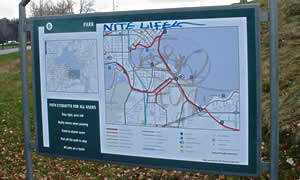
Locations where illicit sexual activity occurs are often advertised locally with graffiti or to a wider audience using the Internet. Credit: David Corbett
- Truck stops and highway rest areas. Truck stops and highway rest areas are also popular locations for same-sex activity.† They are easily accessible by vehicle, and provide a number of legitimate reasons for people's presence.13 The activity itself may take place in a vehicle, a restroom, or a secluded outdoor area. As with those who engage in sexual activity in public restrooms, those who do so at truck stops or rest areas generally don't want to be detected.14
† They are also common locations for both heterosexual and homosexual prostitution.
Season, Time of Day, and Day of Week
The climate likely has an influence on outdoor public sexual activity. Obviously, the colder it is, the less likely the activity. To the extent that public sexual activity may occur at a particular event or as a tradition occurring at a specific time of year (e.g., Mardi Gras, Spring Break), the season also may affect the amount of activity. The time of day's effect on such activity depends on the location's primary legitimate purpose. For example, at truck stops, activity may increase in the late-night and early-morning hours, when truckers have stopped for the night.15 As some department stores and shopping malls are closed on Sundays, no sexual activity occurs in their restrooms then.
Motivations
Although people engage in public sexual activity for various reasons, some common patterns exist among the main types of behavior and location.
Exhibitionism occurs in a wide variety of settings. When taken to an extreme, it suggests the exhibitionist is prone to paraphilia,16 "a pattern of recurring sexually arousing…behavior that involves unusual and esp. socially unacceptable sexual practices..." (Merriam-Webster's Collegiate Dictionary, 11th ed.). Milder forms of exhibitionism, such as nude sunbathing or flashing during Mardi Gras celebrations, often occur because the participant feels anonymous in a large group. Crowds stimulate people to act in ways they would not normally do among their peers or in more regulated situations.17 Drinking alcohol, and the resulting loss of inhibition, is often identified as a contributing factor.18 While perceived anonymity may facilitate the behavior, participants also crave the attention, admiration, and validation they may receive from those who observe them.19
In contrast, some couples—particularly teenagers—engage in sexual activity in public because they have nowhere else to do so. A lack of privacy may also be the reason for male sexual activity in public restrooms. In particular, men with heterosexual identities may want to conceal their behavior from significant others. Their heterosexual identities also deter them from using other, less-public venues such as gay bars or sex clubs.20 Some homosexual men also lack the freedom to pursue same-sex partners privately due to family or peer disapproval.21 A community's condemnation of homosexuality may drive the behavior to remote, although public, locations, particularly among those exploring their sexuality and not yet connected to the gay community.22
Public sexual activity is not always simply a solution for those lacking a private alternative. Those who engage in "dogging" want strangers to watch them. Having an audience heightens their pleasure, and they may feel validated by others' wanting to watch and enjoy their "performance."23 For others, the risk of being caught engaging in public sexual activity serves as an aphrodisiac and increases their overall pleasure.24
Sexual activity in "tearooms," parks, rest areas, and truck stops is usually impersonal and anonymous, and does not lead to complicated entanglements involving commitments, obligations, or expectations from either party.25 Those dissatisfied with their sex lives with their partners may consider engaging in anonymous and impersonal sexual activity as less problematic than having an affair.26 And there's no need to solicit a prostitute, as the sex is free.27 Finally, those engaging in anonymous sexual activity generally needn't worry about assessments of their physical attractiveness or social class, judgments often made in formal dating situations.28
Transactions
Researchers know more about what leads to some forms of public sexual activity than they do about others. Why people sunbathe nude or teenagers park at "lovers' lanes" has not been well researched. In contrast, researchers better understand flashing during Mardi Gras. The widespread occurrence of flashing during the festivities has been attributed to the accumulation of beaded necklaces in return for doing so.29 The "negotiations" regarding the exchange serve to legitimize it.30
With the advent of the Internet, the practice of "dogging" has become more widespread. Those who want to be observed engaging in sexual activity use Internet chat rooms to provide potential audiences with dates, times, and locations.31 People also use chat rooms to offer tips to those interested in watching or participating in public sexual encounters. For example, the patterned use of parked vehicles' turn signals, interior lights, and window openings can serve as signals to interested parties.
Men seeking anonymous sexual contact with men in public restrooms must adhere to a highly structured and sequential pattern of interaction.32 These "scripts" generally involve eye contact, movement, and position in the restroom, and very rarely include any verbal exchange.33 The specific patterns differ, but are just as compulsory, in other settings such as truck stops and rest areas.34 Legitimate park or restroom users may be concerned about being sexually propositioned by other men. However, given the complexity of the behavioral scripts guiding these transactions, mistaken propositions are unlikely.35
Collateral Consequences
Engaging in public sexual activity carries with it many risks, including the following:
- Unwanted exposure. Despite selecting a public location for sexual activity, many participants do not wish to be seen and publicly exposed. Whether through publicity resulting from police contact or through the broadcast of a "Girls Gone Wild" videotape, such exposure can have devastating social consequences.
- Unintended or unwelcome audiences. The very nature of public places means that those engaging in sexual activity there can't control who's in the immediate vicinity. Some people are concerned that young children or others who would find the behavior offensive might unwittingly witness it. In other cases, nude sunbathers or teenagers using a "lovers' lane" may be observed and/or approached by an unwelcome audience. Unwelcome voyeurs and would-be participants pose a risk to those engaged in all forms of public sexual activity.
- Violence. The risk of violence is particularly acute for men engaging in same-sex activity in public. Those who patronize public sex environments commonly feel at risk of victimization by "gay bashers," and some have developed strategies to minimize this risk, including:36
- Refraining from initiating activity, particularly through verbal means
- Carrying a weapon or attention-getting device (e.g., a whistle)
- Patronizing cruising sites with a friend, and periodically checking in with each other
- Limiting activity to familiar places that allow for a quick and easy escape
- HIV/AIDS and other sexually transmitted diseases. Men patronizing public sex locations have long been identified as a population at increased risk of contracting HIV/AIDS and other sexually transmitted diseases. Historically, there have been three main risk-reduction strategies: 1) openly discussing one's sexual history, 2) limiting one's number of sexual partners, and 3) practicing "safe sex." Clearly, the first two are at odds with regularly having anonymous sex.38 Some suggest that heterosexually identified men who engage in same-sex public activity may deny their risk of HIV exposure and disregard important precautions.39 Because these men are not in the traditional target populations for prevention and education efforts, their knowledge of safe-sex practices has been questioned. Yet research has found that men who participate in sexual activity in public restrooms tend to be highly knowledgeable about HIV and its transmission.40 Further, whether participants practice safe sex appears to depend more on the situational dynamics and participants' characteristics than on the location's being public.41 Nevertheless, outreach and education efforts continue to target this population to minimize the overall public health risk.


Free Bound Copies of the Problem Guides
You may order free bound copies in any of three ways:
Online: Department of Justice COPS Response Center
Email: askCopsRC@usdoj.gov
Phone: 800-421-6770 or 202-307-1480
Allow several days for delivery.
Email sent. Thank you.
Illicit Sexual Activity in Public Places
Send an e-mail with a link to this guide.
* required
Error sending email. Please review your enteries below.
- To *
Separate multiple addresses with commas (,)
- Your Name *
- Your E-mail *
Copy me
- Note: (200 character limit; no HTML)
Please limit your note to 200 characters.