
Responses to the Problem of Illicit Sexual Activity in Public Places
Your analysis of your local problem should give you a better understanding of the factors contributing to it. Once you have analyzed your local problem and established a baseline for measuring effectiveness, you should consider possible responses to address the problem.
The following response strategies provide a foundation of ideas for addressing your particular problem. These strategies are drawn from a variety of research studies and police reports. Several of these strategies may apply to your community's problem. It is critical that you tailor responses to local circumstances, and that you can justify each response based on reliable analysis. In most cases, an effective strategy will involve implementing several different responses. Law enforcement responses alone are seldom effective in reducing or solving the problem. Do not limit yourself to considering what police can do; carefully consider whether others in your community share responsibility for the problem and can help police better respond to it.
General Considerations for an Effective Strategy
Most researchers and practitioners agree that focusing solely on arresting those engaging in public sexual activity is unlikely to reduce the overall scope of the problem. In your response strategy, you should acknowledge that it will be difficult to affect people's motivations for engaging in the activity. A balanced approach combining enforcement strategies and those targeting environments that support the behavior is most likely to decrease the prevalence of the activity and the public's concern about it.
Used alone, enforcement efforts are likely to lead to displacement. Although not the most desirable outcome, there is evidence that when displacement does occur, the magnitude of the problem decreases with the move to a new location. New locations are often less desirable for several reasons, including distance and suitability. Further, changes in the times of day or days of week on which the problems occur mean that response affected the problem in some way. When displacement occurs, police can often better manage the problem.
In the past, police have been criticized for using undercover or decoy operations. These operations, particularly when conducted improperly, leave the police vulnerable to entrapment claims. In addition, an exclusive focus on environments in which same-sex interactions occur can result in charges of bias and discrimination. Therefore, you must address the full range of public sexual activity and target particular locations based on objective, justifiable assessments of threats to public safety.
In 2000, the Lambda Legal Defense and Education Fund filed suit against the Los Angeles Police Department for its allegedly discriminatory law enforcement tactics targeting gay men.
If same-sex public interactions are part of your local problem, you should develop partnerships with local leaders of the gay and lesbian community and involve them in problem-solving. Not only can their endorsement go a long way toward addressing charges of bias or discrimination, but local leaders can also publicize the problem among the larger gay population and rally support for the responses.† Similarly, efforts to control public sexual activity may affect local businesses, whose perspectives you should consider when planning your responses.‡
† The Denver Police Department, Equality Colorado (a statewide gay-rights organization), and Cheesman Park West Neighborhood Association formed a coalition to address problems caused by sexual activity in a public park. The partnership helped to "build bridges over the gay community's persistent fear and mistrust of law enforcement" (Luzadder 2000).
‡ For example, Mardi Gras celebrations contribute an estimated $1 billion to the New Orleans economy each year (Filosa 2002).
Finally, some of the responses below suggest some level of tolerance of the behavior—an approach that has had some success in Europe. However, community and political attitudes will make tolerance-based responses either more or less feasible. Therefore, before you design any responses, you must assess how much public sexual activity your community will tolerate. You can initiate candid and specific discussions about the types of activity to target by using videotapes and photographs to document the scope of the problem.§
§ The Santa Ana (California) Police Department used videotape and photographs to document the types of sexual activity occurring in a public park. The visual aids revealed the extent of the problem and were used to advocate special court-imposed probation conditions. They were also used to counter criticism of police efforts, as they showed activity clearly unsuitable for a public park (Santa Ana Police Department 2001).
Specific Responses to Illicit Sexual Activity in Public Places
Enforcement-Based Responses
Enforcement-based responses may be particularly effective when applied to activity such as flashing during annual events, because this conduct is often considered acceptable unless police demonstrate a commitment to controlling it. In particular, regarding annual events, there is reason to believe that the word will quickly spread that the police no longer tolerate such behavior.
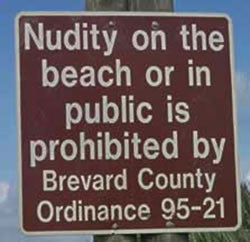
Signs warning against exposing oneself in public serve to increase awareness of acceptable practice. Source: www.mindspring.com/~fnw3/nonudity.jpg

† The San Diego Police Department posted the following notice in conspicuous locations throughout a public park: "Lewd Conduct Laws Strictly Enforced. Lewd Acts in Public Are a Violation of 647(a) PC. All Areas Within This Park Are Public Places. Violators Will Be Arrested" (Hall and Brady 1994). Similarly, in an effort to reduce flashing during Mardi Gras, New Orleans police posted approximately 1,000 posters throughout the French Quarter warning parade watchers that flashing is a crime that carries a $1,000 fine and jail time (Times-Picayune 2000).
2. Issuing warnings. Rather than making an arrest, police can issue warnings to suspected participants in public sexual activity. For example, police can warn women observed flashing their breasts that continuing to do so will result in arrest. Similarly, police can stop and warn men observed cruising known locations for public trysting.‡ Because many people do not want their behavior to be exposed to family and friends, specific deterrence may be effective. If the behavior occurs in a crowd that largely supports the participants (e.g., during Mardi Gras), police should be aware of the potential for conflict and use a non-confrontational approach.42‡ Establishing the legal grounds to stop a vehicle can be problematic because it is difficult to distinguish innocent from suspicious behavior. Departments wishing to use this response should seek legal advice.
In addition, police can contact the registered owners of cars parked in public areas with high sexual activity levels. Letters notifying owners that police observed their car in such an area can also warn of the risk of violence and the health consequences of participating in anonymous, unprotected sexual activity.43 However, because the targeted behaviors are not serious public-safety risks, concerns about this response's potential to deter legitimate patrons from using the areas and about unnecessary invasions of privacy may outweigh the response's potential effectiveness.† The Santa Ana Police Department stationed unmanned, marked police cars throughout a park to give the illusion of constant police presence (Santa Ana Police Department 2001).
4. Establishing highly visible patrols. Although some participants in public sexual activity seek an audience, others want privacy. Uniformed police officers and park rangers in patrol cars, on foot, or on bicycle can deny potential participants privacy for such activity. Opening a police substation (e.g., mobile office) can also effectively increase the level of police activity in a particularly problematic area. However, this is a labor-intensive and thus costly response.Environment-Based Responses
8. Designating geographic boundaries. If the community is willing to tolerate some level of public sexual activity, specific zones can be created that permit users to engage in certain behaviors without risk of arrest. Such zones should be well away from main recreation areas, should be clearly identified with markers and signs, and should include trash cans. This response has been effective with lower-level behaviors such as nude sunbathing, but could plausibly be adapted to other behaviors as well.†† The North Wales Police addressed complaints about indecent exposure by nude sunbathers by clearly designating the boundaries of a nude-sunbathing area, and posting signs reminding sunbathers to stay within the boundaries and to dress fully before returning to public areas (North Wales Police 2002).
9. Improving lighting. Improved lighting in problem areas reduces their attractiveness as trysting locations because the lighting reduces perceived privacy levels. Tamper-resistant, motion-sensing lighting may be useful at restroom entrances and in alleys.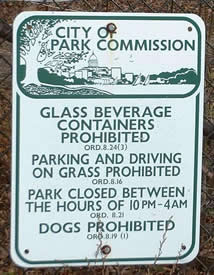
Clearly posted signs indicating rules such as time restrictions on the use of public areas can help reduce unwanted activity. Credit: David Corbett
Publicity-Based Responses
16. Using the media to deter potential offenders from frequenting trysting spots. Print and television media coverage can highlight the community's focus on the problem and stress the consequences for potential offenders, thus serving as a deterrent. Coverage in publications catering to the gay community can also help to discourage use of the problem locations.†† The San Diego Sheriff's Department's partnership with the North County Gay and Lesbian Association led to stories in gay publications that educated readers about the dangers of cruising and discouraged them from using specific locations being targeted by police (Won 1996).
Paradoxically, media coverage may also increase activity levels at the identified locations. For some, the increased attention may heighten their excitement about engaging in illicit sexual behavior.47 For others, the publicity may confirm a location's reputation as a good place to find partners.† The San Diego Police Department made a written request to a variety of websites and guidebooks that listed a targeted property as a popular cruising location. Some organizations complied with their request; others did not (Hall and Brady 1994).
Responses With Limited Effectiveness
18. Using undercover decoys. While using undercover officers to pose as interested parties in illicit same-sex public activity can lead to many arrests, such operations have not had long-term effectiveness in reducing overall activity levels. At best, they temporarily displace the activity to other locations, and the activity usually returns to prior levels once the operations have ceased. Further, given the active role that undercover officers must take to confirm suspects' intentions, the police may be vulnerable to entrapment claims. In addition, many officers are reluctant to serve as decoys because of the customary behavioral scripts they must follow.49 Finally, some may see the serious social consequences of the publicity following an arrest as disproportionate to the severity of the offense.50, ¶

Free Bound Copies of the Problem Guides
You may order free bound copies in any of three ways:
Online: Department of Justice COPS Response Center
Email: askCopsRC@usdoj.gov
Phone: 800-421-6770 or 202-307-1480
Allow several days for delivery.
Email sent. Thank you.
Illicit Sexual Activity in Public Places
Send an e-mail with a link to this guide.
* required
Error sending email. Please review your enteries below.
- To *
Separate multiple addresses with commas (,)
- Your Name *
- Your E-mail *
Copy me
- Note: (200 character limit; no HTML)
Please limit your note to 200 characters.