
Appendix C: Developing a Comprehensive Response to Pedestrian-Vehicle Crashes
This guide has emphasized the interaction of three factors—pedestrians, drivers, and the physical environment—that cause pedestrian-vehicle crashes. This interaction is reflected in the pedestrian-vehicle crash triangle (Figure 1), and in the process of pedestrian-vehicle crashes (Figure 3). The practical implication is that a comprehensive response should address more than one factor: pedestrians, drivers, physical environment, early decisions, and immediate decisions. The following checklist is based on this insight.
This checklist also uses the five main categories of situational crime prevention responses (for more information, see www.popcenter.org): increasing risks, increasing effort, decreasing rewards, decreasing excuses, and decreasing provocations.
- Increasing risks involves making the perceived penalty for misbehavior more likely. For example, increased enforcement of speeding or jaywalking increases the risk of fines for people who do so.
- Increasing effort involves making it harder to engage in troublesome behavior. For example, traffic calming forces drivers to slow down by making it more difficult to speed.
- Decreasing rewards decreases the gain from misbehavior. For example, if pedestrians cross midblock to catch buses, moving bus stops to corners removes the incentive to cross midblock.
- Decreasing excuses involves making it more difficult for people to justify their misbehavior. For example, providing clearly marked crossing points for pedestrians reduces their ability to claim they did not know where to cross.
- Decreasing provocations involves reducing inducements to misbehave. For example, altering crossing-walk timing to facilitate pedestrian movement reduces pedestrians' perceived need to jaywalk.
Combining the factors discussed in this guide with situational prevention techniques reveals 25 intervention categories (see Table 1). A comprehensive response involves using multiple situational approaches against multiple causes. This approach ensures that one intervention's weaknesses are offset by other interventions' strengths.
In the example shown in the table, the response consists of types of four interventions involving pedestrians (immediate decisions), drivers (early decisions), and the physical environment. These four interventions involve four different situational prevention types: increasing risks to drivers, decreasing drivers' excuses for speeding, decreasing pedestrian provocations to jaywalk, and increasing the difficulty of jaywalking. Notice that because speeding enforcement may not be sustainable, the signs remain as a reminder. Even so, in this example, police may have to employ periodic speeding crackdowns.
Lastly, the "Planning Framework for Preventing Pedestrian-Vehicle Crashes" checklist is designed to provide you with a useful planning tool when developing a response. Supervisors can also use it for approving a response before implementation. Finally, you can use it to document the relationships among the interventions you apply.
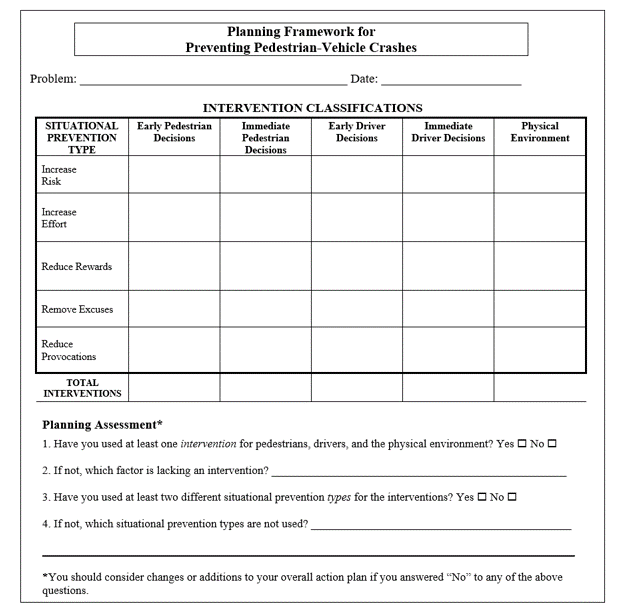
Download a copy of the Planning Framework for Preventing Pedestrian-Vehicle Crashes. [PDF, 4k]


Free Bound Copies of the Problem Guides
You may order free bound copies in any of three ways:
Online: Department of Justice COPS Response Center
Email: askCopsRC@usdoj.gov
Phone: 800-421-6770 or 202-307-1480
Allow several days for delivery.
Email sent. Thank you.
Pedestrian Injuries & Fatalities
Send an e-mail with a link to this guide.
* required
Error sending email. Please review your enteries below.
- To *
Separate multiple addresses with commas (,)
- Your Name *
- Your E-mail *
Copy me
- Note: (200 character limit; no HTML)
Please limit your note to 200 characters.