
Appendix A: Summary of Responses to Prescription Drug Fraud and Misuse
The table below summarizes the responses to prescription fraud, the mechanism by which they are intended to work, the conditions under which they ought to work best, and some factors you should consider before implementing a particular response. It is critical that you tailor responses to local circumstances, and that you can justify each response based on reliable analysis. In most cases, an effective strategy will involve implementing several different responses. Law enforcement responses alone are seldom effective in reducing or solving the problem.
| Increasing the Risk of Detection | ||||
| Response No. | Response | How It Works | Works Best If... | Considerations |
| 1 | Informing doctors and pharmacists of and about fraudulent activity | Sharing information on offenders and scams through bulletins and mass communication increases the risk of apprehension, thereby deterring potential offenders | ....the information is shared quickly throughout the jurisdiction | A means of networking/communication that reaches the most people possible (e.g., faxes or the Internet) should be used |
| 2 | Improving pharmacists' screening of prescriptions and patients | Pharmacists act as "gatekeepers" by checking ID, verifying doctor information, and detecting suspicious behavior | ....pharmacists are consistent in screening and report fraudulent activity to police | Takes time, effort, and experience, both for pharmacists and police |
| 3 | Educating the public about prescription fraud and misuse | Increasing awareness of prescription misuse and fraud through local and national efforts allows more people to identify friends and family members engaged in fraudulent activity | ....informational campaigns are multidisciplinary and target specific populations | Initiatives should provide statistics and other specific information (e.g., if the target group is youth, use youth-related data); can be resource-intensive |
| Increasing the Effort Required to Commit Prescription Fraud | ||||
| Response No. | Response | How It Works | Works Best If... | Considerations |
| 4 | Verifying prescriptions | Pharmacists do callbacks on phoned-in prescriptions and check doctors' information, maintain a file of doctors, and dispense only a limited dosage until they can verify prescriptions | ....pharmacists are consistent in the verification process, refuse to fill unverifiable prescriptions, and report suspicious activity to police | Takes time, effort, and resources |
| 5 | Employing security measures | Strategies include using tamper-resistant prescription pads, increasing the precautions the practitioner's receptionist and answering service take, checking photo ID, and keeping prescription pads in a secure place, all increasing the difficulty for would-be offenders | ....all security measures are consistently used, and fraud is not being committed internally (by employees of the doctor's office) | Tamper-resistant pads can be costly; checking ID can be time consuming; measures are ineffective against internal fraud |
| 6 | Prescribing drugs electronically (e-prescribing) | Direct transmission of prescriptions (via computer) from prescribers to pharmacists eliminates the problems of false phoned-in prescriptions, forged and altered prescriptions, and stolen prescription pads | ....all pharmacists and prescribers in the jurisdiction are doing so | Cost of setting up systems and maintaining system security; getting buy-in from doctors and pharmacists; once implemented, very cost-effective and time-efficient |
| 7 | Enacting or changing prescription fraud laws | Specific, targeted laws make it easier to prosecute and convict offenders | ....used in conjunction with other prevention and education efforts | Can be time- and resource-intensive; does not address the underlying problem |
| 8 | Promoting safe storage and disposal | Reduces easy availability of prescription drugs that can be misused | ....drug companies and health professionals also educate consumers through labeling, prescribing, and dispensing the drugs | Consistent education and marketing of disposal procedures is needed; take-back programs need to be flexible and easy for participants |
| 9 | Maintaining a Prescription Monitoring Program and Cross-State Data Exchange | Tracking and monitoring prescription drugs aids in identifying patterns of problem behavior | ....the program covers the drugs most often misused, and data are used proactively | Patient confidentiality may be breached; effect limited to drugs covered; program administration can be costly |
| Reducing Rewards to Offenders | ||||
| Response No. | Response | How It Works | Works Best If... | Considerations |
| 10 | Curbing distribution | Limiting the dosage or distribution of a drug reduces the opportunity for offenders to easily obtain large quantities of it | ....focused on a particular problem drug or target group/region | Some patients need higher dosages or more frequent refills and must be accommodated |
| 11 | Re-formulating drugs | The drug is manufactured using a misuse-deterrent formulation, either a pharmacological or physical barrier, to reduce the drug's intoxicating effects | ....focused on a particular problem drug or target group/region | Drug companies may need to be held accountable to manufacture the drugs with misuse-potential in mind |
| Removing Excuses | ||||
| Response No. | Response | How It Works | Works Best If... | Considerations |
| 12 | Facilitating compliance with the law | Programs such as drug treatment/ rehabilitation, Narcotics Anonymous, and Drug Court help to prevent repeat offenses | ....used in conjunction with one another, there are consequences for nonparticipation, and offenders want to change | Resources are needed to ensure attendance and compliance with program rules |
| Responses with Limited Effectiveness | ||||
| 13 | Conducting enforcement crackdowns | Increases likelihood of detection and punishment | ....the effort can be sustained for multiple people or pharmacies over an extended period | Extensive resources are required (and not generally available); without prevention measures in place, illegal activity will resume in the long term |
| 14 | Creating a pharmacy-based prescription database | Pharmacies are able to verify patient information and monitor the number of prescriptions previously issued | ....multiple—or all—pharmacies in the jurisdiction share the database | Cost of, and cooperation required for, implementing a networked system; patient confidentiality may be breached |
| 15 | Monitoring Internet sites | Regulatory and enforcement agencies identify and monitor websites that sell prescription drugs, both in the U.S. and internationally | ....policies and regulations are implemented and enforced | Non-U.S. countries have different drug and Internet sales regulations; ease and invisibility of creating Internet companies undermines effectiveness |
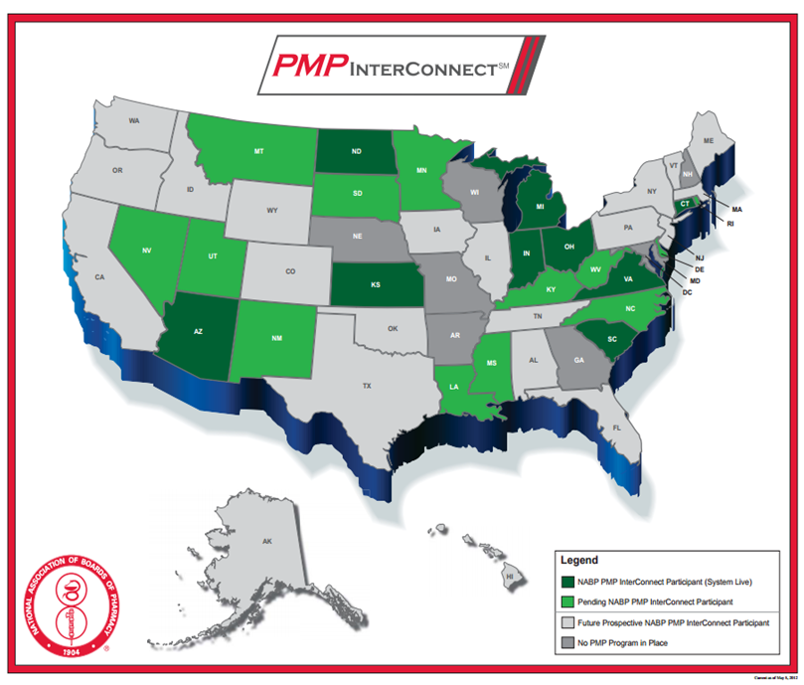
Source: Pfraud_AppB-map.tif. www.nabp.net/programs/assets/PMPInterconnectMap.pdf


Free Bound Copies of the Problem Guides
You may order free bound copies in any of three ways:
Online: Department of Justice COPS Response Center
Email: askCopsRC@usdoj.gov
Phone: 800-421-6770 or 202-307-1480
Allow several days for delivery.
Email sent. Thank you.
Prescription Fraud
Send an e-mail with a link to this guide.
* required
Error sending email. Please review your enteries below.
- To *
Separate multiple addresses with commas (,)
- Your Name *
- Your E-mail *
Copy me
- Note: (200 character limit; no HTML)
Please limit your note to 200 characters.