
Responses to the Problem of Rave Parties
Your analysis of your local problem should give you a better understanding of the factors contributing to it. Once you have analyzed your local problem and established a baseline for measuring effectiveness, you should consider possible responses to address the problem.
The following response strategies provide a foundation of ideas for addressing your particular problem. These strategies are drawn from a variety of research studies and police reports. Several of these strategies may apply to your community's problem. It is critical that you tailor responses to local circumstances, and that you can justify each response based on reliable analysis. In most cases, an effective strategy will involve implementing several different responses. Law enforcement responses alone are seldom effective in reducing or solving the problem. Do not limit yourself to considering what police can do: give careful consideration to who else in your community shares responsibility for the problem and can help police better respond to it. Also, give careful consideration to involving others in developing responses, especially people immersed in the rave culture.
General Considerations for an Effective Strategy
There are two general approaches to addressing rave party problems. One is prohibition—strictly enforcing all drug laws and banning raves (either directly or through intensive regulation). The other is harm reduction—acknowledging that some illegal drug use and raves are inevitable, and trying to minimize the harms that can occur to drug users and ravers.† Many jurisdictions blend enforcement with harm reduction approaches. Whatever approach you ultimately adopt, it should at least be coherent and consistent. For example, if you choose to emphasize harm reduction, it would be inconsistent to then use rave operators' adoption of harm reduction strategies, such as hiring private emergency medical staff, stocking bottled water or establishing rest areas ("chill out" areas), as evidence that they are condoning and promoting illicit drug use. Conversely, if you adopt a strict drug prohibition approach, it would be inconsistent to permit, for example, anonymous drug testing at raves.
† For arguments favoring harm reduction policies, see Parker, Aldridge and Measham (1998); Measham, Aldridge and Parker (2001); Jenkins (1999); Spruit (1999); Branigan and Wellings (1999); Adlaf and Smart (1997); Weir (2000) [Full text]; Toronto Dance Safety Committee (2000) [Full text]; and Akram and Galt (1999).
Local public and political attitudes, as well as police policies regarding similar problems, will influence the general stance your agency takes. It is important to consider how the public, and the various communities within it, will perceive the police response to rave party problems, particularly as that response is compared with police responses to similar problems. In some communities, the police have been criticized for taking a different stance on enforcement at raves, which are predominantly attended by white youth, than they have been perceived to take at events that are predominantly attended by minority youth.
To some extent, police and other regulators are forced to choose between the lesser of the harms arising from raves held in licensed venues and those held in unlicensed, clandestine venues.† (This has some similarities to the public policy choices governing indoor vs. outdoor prostitution.) Shutting down all rave clubs would probably move raves and their associated problems back to outdoor, unlicensed and clandestine locations. Perhaps the biggest drawback to moving raves to indoor licensed venues is that it increasingly makes alcohol more available to ravers, increasing the medical risks from combining alcohol and rave-related drugs.
† British police and legislative policies have been effective in moving raves to licensed indoor venues (Critcher 2000).
Specific Responses To Address Rave Party Problems
1. Regulating rave venues to ensure basic health and safety measures are in place. The basic measures widely deemed necessary for ravers' health and safety are:- Keeping the venue well-ventilated and controlling heat and humidity
- Providing a rest area where ravers can rest and cool off
- Having trained emergency medical staff readily accessible to ravers, especially for drug-related ailments
- Making drinking water readily available to ravers (sometimes requiring that it be provided for free)
- Hiring properly trained and screened private security staff, primarily to search ravers for illegal drugs and to monitor drug sales and use inside the venue
- Providing reliable and credible information to ravers about the effects of rave-related drugs and harm prevention measures (see response 6 below)
- Posting and advertising policies prohibiting illegal drugs in the venue
- Ensuring there is adequate transportation to and from venues, especially for those who might be impaired by drugs and alcohol
- Keeping ravers away from hazardous areas (such as off of loudspeakers that might topple over)
- Keeping noise levels outside the venue tolerable and providing earplugs for ravers. 48
Some venues, in cooperation with police, have placed socalled "amnesty boxes" at the entrances to rave venues. Ravers are encouraged to put any weapons and illegal drugs in these secured boxes, without threat of arrest. Security staff also put any contraband they find in the boxes. Police later seize the contents.52
In some jurisdictions, these sorts of measures are required by local law; elsewhere, they are merely promoted as good practice. Either way, police should work closely with venue management to identify emerging problems, develop mutually agreed-upon responses, and determine the relative responsibilities and commitments of venue management and police.53
Where adequate regulations already are in place, police and other agencies may merely need to give special attention to enforcing those regulations. Where they do not exist, police and others may need to develop and advocate new regulations.
2. Encouraging and supporting property owners in exercising control over raves. For raves held in leased properties other than licensed nightclubs, police can encourage and support property owners in their efforts to control those raves. Some owners may not appreciate what raves are when they agree to lease their properties and, accordingly, may not insist on certain lease provisions that would minimize the nuisances and harms that arise from improperly run raves. Charlotte, North Carolina, police report success working with owners to restrict and regulate raves.54† The New Orleans case ended when the defendants accepted a plea bargain, leaving room for debate as to whether the strategy was successful overall. See National Drug Intelligence Center (2001) for tips on preparing similar cases. [Full text]
6. Educating ravers about the risks of drug use and overexertion. Researchers have generally concluded that ravers do make rational choices about illegal drug use, even if their choices do not always turn out well.60 If true, then providing potential drug users with accurate, credible information about the consequences of using various drugs can help them manage their risks and reduce the likelihood that they will suffer serious and permanent harm from taking drugs.61 Public health officials, police and nonprofit organizations are increasingly distributing information to ravers about the risks of rave-related drug use and overexertion from dancing.62 Although few of these education campaigns have been carefully evaluated, most observers stress the importance of providing accurate, specific and credible information.63 When it comes to the complex neurochemical effects of drug use, having only a little knowledge can be dangerous. Popular wisdom about raverelated drugs and raves is often wrong. Most ravers, however, are interested in getting reliable information.64Education campaigns typically include data on the effects of rave-related drugs, precautions about health and safety, and information about possible legal consequences for drug use. Nonjudgmentally conveying information about rave-related drugs and tailoring messages to the specific target audience can enhance credibility with ravers. Information targeted at younger ravers with less drug experience should take a somewhat different tone than that targeted at older, more drug-experienced ravers.65 Messages that promote total abstinence from illegal drugs and peer-pressure resistance are unlikely to be effective with older, more drug-experienced ravers. Information targeted at males should take a different tone than that targeted at females, since males are more reluctant to take measures to protect themselves from the risks of rave-related drugs.66 In a rave-related drug education campaign in London, information that was prominently displayed in the public transportation system did not provoke a negative public reaction, as was expected.67 Education campaigns might also try to reach younger ravers' parents, who might be unaware of the risks of raves.
Ravers should be advised to wear loose-fitting clothing, drink plenty of water if they are sweating, and take breaks from dancing to rest and cool off. Rave-related drug users should also eat salty foods to prevent hyponatraemia. In addition, they should save small amounts of the drugs they use in the event they need to be tested during emergency medical treatment (obviously, though, saving illegal drugs also increases the risk of arrest). They should stay close to their friends and have a plan for safe transportation to and from the event.68
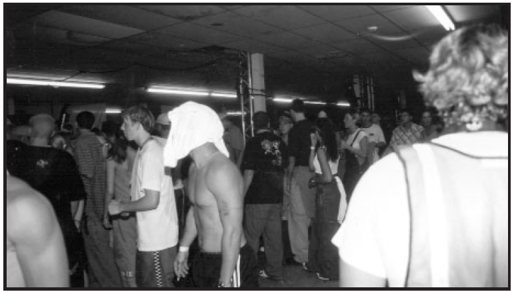
Ravers usually wear little or loose-fitting clothing to try to keep cool: prolonged dancing and taking ecstasy raises body temperatures significantly. Credit: Bob Morris
Warning the general public about the harms caused by new drugs can have the unintended effect of advertising the drugs and inadvertently encouraging previously uninformed people to experiment with them.69 For this reason, more-targeted education campaigns aimed at known or higher-risk users like ravers may be preferable to wider public education campaigns.
Responses With Limited Effectiveness
7. Banning all raves. Given the popularity of rave culture and raves, it is highly unlikely that absolute bans on raves will either stop them or stop the use of rave-related drugs. The most likely effect of a total ban is that raves will move to unlicensed, clandestine locations where it is more difficult to implement harm reduction strategies.

Free Bound Copies of the Problem Guides
You may order free bound copies in any of three ways:
Online: Department of Justice COPS Response Center
Email: askCopsRC@usdoj.gov
Phone: 800-421-6770 or 202-307-1480
Allow several days for delivery.
Email sent. Thank you.
Rave Parties
Send an e-mail with a link to this guide.
* required
Error sending email. Please review your enteries below.
- To *
Separate multiple addresses with commas (,)
- Your Name *
- Your E-mail *
Copy me
- Note: (200 character limit; no HTML)
Please limit your note to 200 characters.