
Responses to the Problem of Robbery of Convenience Stores
Analysis of your local problem should give you a better understanding of the factors contributing to it. Once you have analyzed your local problem and established a baseline for measuring effectiveness, you should then consider possible responses to address the problem.
The following response strategies provide a foundation of ideas for addressing your particular problem. These strategies are drawn from a variety of research studies and police reports. Several of these strategies may apply to your community's problem. It is critical that you tailor responses to local circumstances, and that you can justify each response based on reliable analysis. In most cases, an effective strategy will involve implementing several different responses. Law enforcement responses alone are seldom effective in reducing or solving the problem. Do not limit yourself to considering what police can do: give careful consideration to who else in your community shares responsibility for the problem and can help police better respond to it. The responsibility of responding, in some cases, may need to be shifted toward those who have the capacity to implement more effective responses. (For more detailed information on shifting and sharing responsibility, see Response Guide No. 3, Shifting and Sharing Responsibility for Public Safety Problems).
General Considerations for an Effective Response Strategy
1. Understanding the ownership, management structure, and operations of local convenience stores. To build and sustain a working relationship with the stores in your locality, you must have this understanding. Chain stores may have in-house security departments and specific protocols for crime prevention. This may enhance a cooperative effort to prevent robberies, but individual store managers may not have the authority to directly implement certain measures. Single-owner establishments will be generally unrestricted in their potential responses or partnership with the police, but will have fewer resources to devote to security and crime prevention. The convenience store industry as a whole may not support all police recommendations for security measures.Understanding the operations, community context, and interpersonal dynamics of these businesses allows you to more effectively implement the specific responses below. For example, a sole owner who has used a weapon to scare a would-be robber may require a different approach and response than the store that employs 18-year-olds with little experience for late-night shifts.
2. Collaborating with private security. Creating structures and programs that encourage routine collaboration between police and private security can facilitate convenience store robbery prevention.57, § Police might coordinate or facilitate convenience stores' adoption of specialized robbery prevention concepts and programs. For example, police might promote the application of the principles and methods of crime prevention through environmental design, which aims to reduce crime by controlling the retail business environment through natural surveillance, access control, and boundary definition.58, §§ Although implementing the specific measures would primarily be the retailer's responsibility (see retailer responses below), models such as this can be integrated into a local police or private security crime prevention strategy.§ See Problem-Solving Tools Guide No. 5, Partnering With Businesses to Address Public Safety Problems and such Problem-Specific Guides as Shoplifting and Robbery of ATMs for further information on police-private security collaboration.
§§ See the Problem-Solving Tools guide on Using Crime Prevention Through Environmental Design in Problem-Solving for further information.
3. Targeting repeat victims. Certain convenience stores in your locality are more likely to be robbed than others.§ When the concentration of crimes at a few places is relatively stable over time, it is likely that something about those few places facilitates crimes and something about most places that prevents crimes.59 A study of police responses to armed robbery by the U.K. Home Office found that there is a period of time after an incident (up to three months) when the target is most vulnerable to a repeat attack. Swift analysis and follow-up to robberies is important to limit or minimize the chance of repeat robberies, and responding to repeat victimization is effective in a number of ways. These include identifying the vulnerabilities of a given target, thereby assisting in the protection of likely targets from future robberies.60, §§§ This is the so-called "80/20" rule: that crime tends to be heavily concentrated in a relatively small percentage of places, against a relatively small percentage of victims, and by a relatively small percentage of offenders. See Crime Analysis for Problem-Solvers (Clarke and Eck 2005).
§§ A given store's vulnerability can unfortunately result from media accounts of a successful robbery, absent any publicity of increased security measures. Incarcerated robbers believe that a victimized business will not install preventive measures (Gill and Pease 1998).
4. Reevaluating responses consistently. Responses to convenience store robberies may not always withstand changing times and circumstances. One study of convenience store robberies in Tallahassee was reexamined to identify changes, if any, in a number of environmental and other factors that influenced their robberies. The follow-up study found that several high robbery-risk stores had experienced declines, and some low-risk stores had considerable increases. The researchers concluded that "robbery prevention strategies lose their effectiveness over time and must be constantly upgraded."61 You should review robbery prevention strategies periodically, modifying them as appropriate to respond to offenders who consistently test the limits of measures in place.Specific Responses To Reduce Convenience Store Robbery
Retailer Responses
The following responses are rooted in situational crime prevention.62, § These responses are voluntary in some jurisdictions and mandated by law in others. Legislation requiring the implementation of security measures may affect the likelihood of convenience store robberies.§§ 7-Eleven, Inc. implemented many of these measures, maintaining that their implementation contributed to a 70 percent reduction in robberies over 20 years.63 Local governments should ensure that their licensing and permitting regulations and procedures do not discourage sensible crime prevention measures.§§§
§ For further information on situational crime prevention techniques, see www.popcenter.org/25techniques.htm.
§§ In April 1998, OSHA issued its Recommendations for Workplace Violence Prevention Programs in Late-Night Retail Establishments, marking the first time it explicitly sanctioned specific retail crime prevention measures. Additional information on OSHA recommendations [PDF].
§§§ In a study of convenience stores in Austin, Texas, it was found that the process of installing brighter or additional lighting in store lots could be burdensome. It involves hiring an electrical technician, preparing estimates, and obtaining a permit (LaVigne 1994 [PDF]).
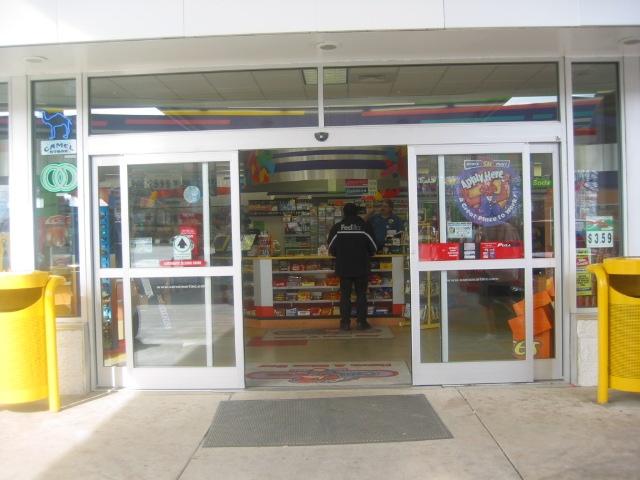
An unobstructed view of the entrance and interior of the store provides natural surveillance that increases the risk of apprehension for the offender. Credit: Nancy Leach
§ The Starbucks chain implemented a security model that includes moving the store safe to the street-front sales area, taking advantage of natural surveillance from the glass windows (D'Addario 2001).
6. Having multiple employees on duty during high-risk periods. The state of Florida, in its Convenience Business Security Act of 1992, has mandated businesses that remain open between 11 p.m. and 5 a.m. to use at least one of the following security measures: two or more employees, bullet-resistant safety enclosures, a security guard, or a pass-through window to conduct business. Since implementation, convenience store robbery rates in Florida have dropped significantly.65 New Mexico's Environmental Improvement Board also passed regulations for stores open between 5 p.m. and 5 a.m. These include either keeping two employees on duty, or using alternative precautions (like bullet-resistant glass) to protect the employee.§ Aside from expense, such a measure's effectiveness has been questioned in a number of studies. For instance, environmental changes may have influenced the studies with a positive finding.66 Also debated is the concern that multiple clerks could put more staff in danger in the event of a robbery. Mandating additional staffing is controversial, and careful consideration by public policymakers, as well as business leaders, must be made to weigh its potential for robbery deterrence against its financial impact.§ A state industry association has appealed the regulations, maintaining that they may be too expensive for businesses (Neary 2004).
7. Controlling access. This element accounts for the number of entrances, the door type(s) and placement(s), and the internal environment's design. A consistent finding of studies that interview convenience store robbers is that escape routes are a key factor to their target selection. Eliminating or at least limiting potential escape routes by using fencing or landscaping is highly recommended. 7-Eleven, Inc. found that it could effectively use fences to block alleys that would lead to crowded neighborhoods, and bushes to limit other footpaths that might provide an easy getaway.67 Avoiding the use of concealed access or escape routes is also recommended. This measure increases the potential offenders' effort.§ Offender interviews have found that their decisions on choosing a target are strongly influenced by the proximity of the store to major and minor roads, and the proximity to a police station, among others (Wellford, MacDonald, and Weiss 1997 [PDF]).
9. Promoting legitimate activity. Activities designed to increase the presence of legitimate customers and encourage good customer behavior also increase the risk to offenders by essentially extending guardianship of the location. Offering free coffee, for instance, could be used to invite legitimate late-night traffic.68, § This is chiefly important for convenience stores that do not have the increased traffic and visibility of those with gas pumps. Conversely, discouraging stores from attracting disreputable customers—for example, by selling products commonly used in the illegal drug trade—can reduce the routine presence of potential offenders in the store.§ Some convenience stores offer free coffee or food to police officers to encourage them to stop in more often, but many police departments prohibit officers from accepting such offers.
10. Training employees. Small operations may benefit greatly from training and advice offered by the police. Management of larger stores should offer training programs for new employees.§ Training should include how to behave during a robbery and how to avoid violence. By encouraging simple practices in demeanor—greeting customers and establishing eye contact—clerks can learn to "put robbers on stage."69 One comprehensive study of convenience store robberies concludes that "the behavior of clerks may be the most significant factor in determining the extent of injury that results during these robberies."70§ 7-Eleven's training is offered to all employees in a two-day session incorporating presentations, a handbook, and role-playing exercises. Issues covered include robbery deterrence, violence avoidance, loitering, physical assault, gang activity, and general emergency procedures (Lins and Erickson 1998).
11. Maintaining store appearance. The general appearance of a store indicates the employees' vigilance. A clean and well-kept store usually means clerks spend time away from the cash registers; a store appearing dirty and disorganized is more likely to be robbed.71§ As mentioned previously, some offenders are not dissuaded by the prospect of small amounts of cash. With the popularity of crack cocaine, a cheap drug of choice, offenders are willing to take risks for even small sums (Bellamy 1996).
In addition, the use of cash-control units (also known as drop safes) can allow secure management of the cash on hand. The units have a safe for clerks to deposit cash periodically, with access controlled by keys and/or personal identification numbers (PINs). The unit opens or dispenses cash on a delay, which is likely to deter an anxious robber.74 It is possible that the lack of availability of cash might result in robbers' shifting their focus to the taking of merchandise, but if robbers are looking for quick cash such displacement would be unlikely.
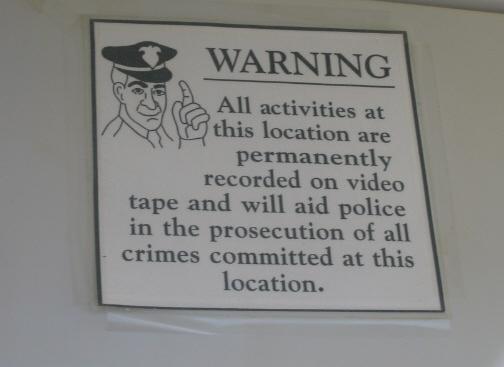
The presence of video monitors has been found to have some deterrent affect by increasing the robbers risk of identification. Credit: Nancy Leach
§ For a further assessment of the effectiveness of CCTV, see Response Guide No.4, Video Surveillance of Public Places.
§§ Reports from the Hillsborough County, Florida, Sheriff's Office indicated an almost 90 percent clearance rate for stores equipped with hidden 35 mm cameras (Bellamy 1996).
Police Responses
14. Providing robbery prevention and awareness training. Police are in a prime position to guide businesses in crime prevention. They are typically the first point of contact after a robbery, and can be particularly helpful to small businesses that may have limited access to other programs and that rely more heavily on police to guide their response. Police can be particularly helpful in training employees to be smart observers and, if necessary, effective witnesses. Suggestions on protocol such as maintaining eye contact with customers (robbers do not want to be identified) and moving away from the sales counter when no one is waiting (robbers will perceive that it will take them longer to demand money from the register) are examples of training tips offered.§ Tools such as a height strip can be distributed to mount to the door, giving the employee a means to estimate the height of a fleeing robber.§§§ A police department in Edmonton, Alberta, developed a Robbery Awareness Education Kit to introduce training to retailers (Alberta Minister's Committee to Promote Health and Safety 2000 [PDF]).
§§ The San Bernardino, California, police offer a four-hour training class to businesses on crime prevention. In addition to distributing tools like the height strip, the class also identifies other information retailers should collect during a crime (Berry 2004).
15. Inspecting convenience stores for compliance with robbery prevention measures. Obviously, robbery prevention recommendations are effective only if properly implemented. Police might assume responsibility for regularly inspecting convenience stores to determine whether they have adopted either mandatory or voluntary robbery prevention measures. In response to an increased trend in robberies, the San Bernardino Police Department implemented the Crime-Free Business Program in 2004. Police community service officers perform periodic inspections of convenience stores and other businesses and evaluate the businesses for their use of crime prevention measures in 28 categories.§ Although this particular program and compliance with the inspections are voluntary, the city has seen a reduction in commercial robberies.78§ Scored categories include such items as visibility into the store, adequate entrance lighting, prominent "No Loitering" signs, and low shelf height.
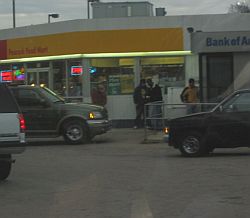
Enforcing prohibitions against loitering outside convenience stores reduces opportunities for potential robbers to watch the routines of store clerks and customers. Credit: Nancy Leach
Responses With Limited Effectiveness
17. Conducting robbery stakeouts. Robbery stakeouts have police lie in wait to trap an offender, hiding in a convenience store's back room or closet. Police departments would need to have considerable resources to be able to sustain the number of officers needed to await possible robberies in various locations over a long time. Moreover, the resultant armed confrontations would heighten risks for police officers and store employees.§ "People are present" factors include perceived police presence in the area and the proximity (of the store location) to a police station. These ranked as moderately important by the offenders, while window locations, time, lighting, and cashier locations ranked at the bottom of the scale (Petrosino and Brensilber 2003).
20. Establishing satellite facilities. This takes police presence a step further by making police a more permanent fixture inside convenience stores. This response is more resource-sensitive than most and may not be financially feasible for some police agencies or otherwise justifiable given competing demands for police presence elsewhere in communities.7-Eleven, Inc. has established a particular program for its stores called the Police Community Network Centers (PCNCs). They work with local police departments to install either a workstation inside the stores or an office or trailer adjacent to it. It is clearly identified, and includes a dedicated telephone, workspace and storage, and display areas for crime prevention literature.85, §
§ 7-Eleven, Inc. reports that it has received "rave reviews from police organizations and city governments that have participated in the program." There are currently more than 200 PCNCs in 100 cities in 18 states (7-Eleven, Inc. n.d.).


Free Bound Copies of the Problem Guides
You may order free bound copies in any of three ways:
Online: Department of Justice COPS Response Center
Email: askCopsRC@usdoj.gov
Phone: 800-421-6770 or 202-307-1480
Allow several days for delivery.
Email sent. Thank you.
Robbery of Convenience Stores
Send an e-mail with a link to this guide.
* required
Error sending email. Please review your enteries below.
- To *
Separate multiple addresses with commas (,)
- Your Name *
- Your E-mail *
Copy me
- Note: (200 character limit; no HTML)
Please limit your note to 200 characters.