
Responses to the Problem of Shoplifting
Once you have analyzed your local problem and established a baseline for measuring effectiveness, you should consider possible responses to address the problem. It is critical that you tailor responses to local circumstances, and that you can justify each response based on reliable analysis. In most cases, an effective strategy will involve implementing several different responses. Law enforcement responses alone are seldom effective in reducing or solving the problem. Do not limit yourself to considering what police can do: give careful consideration to others in your community who share responsibility for the problem and can help police better respond to it.
The response strategies discussed below are drawn from research studies and police reports. This section reviews what is known about the effectiveness of these responses in dealing with shoplifting. Unfortunately, the information is severely limited because few of the common preventive practices have been evaluated. Retailers have been reluctant to undertake the necessary studies, and to share the results of any studies they do complete. Government has funded little research in this field, generally regarding it as the private sector's domain.
In the absence of research, you cannot assume that retailers have learned through long experience what does and does not work. For example, hiring store detectives is a staple response to shoplifting, but as will be seen below, their effectiveness is questionable. Hiring them usually seems to be an economic choice dictated by the need to do something about shoplifting.
General Considerations for an Effective Response Strategy
Police can do little on their own to prevent shoplifting, and you will have to persuade the retailers themselves to act. You may have to explain why police can achieve little through more patrols, and why heavier court sentences are of limited value. You may want to explain how the store's goods and sales practices may be contributing to the problem. You may have to convince retailers that they cannot ignore the problem, due to the costs to the community and, in the long run, the stores themselves. Finally, you will have to offer them guidance on preventive measures they can take to reduce the problem.
It is important that shoplifting responses be selective and based on a thorough understanding of the risks. For example, the highest-risk goods should be given the greatest protection, and dealing with organized shoplifters will demand a wider set of measures than those needed for petty shoplifting. You must therefore think carefully about the nature of the risk, which varies greatly with the kinds of offenders, the nature of the store, and the goods offered. These factors also determine the nature of the remedies. The security approach required for a self-service supermarket is quite different from that required for a jewelry store. Department stores with huge turnovers of expensive goods can afford to spend much more on security than small retailers can. In all cases, you must appreciate stores' need to make a profit. This determines selling practices and how much money is available for preventing shoplifting.
Even when shops can afford more for security, they are likely to resist this expenditure. In making your case, you may need to do the following:
- Calculate the likely cost of measures, such as installing CCTV or hiring security guards
- Convince owners that they can recoup the cost of increased security through reduced losses associated with shoplifting—item replacement, profit, and lawsuit costs
- Enlist the support of the chamber of commerce and other business organizations to persuade owners to improve security, or to brief the local media on the problem and proposed solutions
Specific Responses to Reduce Shoplifting
Effective shoplifting prevention depends on well-rounded strategies encompassing good retailing practices, appropriate staffing, carefully articulated shoplifting policies, and selective technology use. The measures in the final group are particularly addressed to defeating organized shoplifters, which responses are over and above those for defeating petty shoplifting.
For All Shoplifting
Retailing Practice
Good management is the first line of defense against shoplifting. Managers must ensure that stores are properly laid out, have adequate inventory controls, and follow standard security practices.
1. Improving store layout and displays. Store layout and displays must make it easier for staff to exercise effective surveillance. This includes the following:
- Reducing the number of exits, blind corners, and recesses
- Carefully placing mirrors
- Providing good, even lighting
- Eliminating clutter and obstructions
- Placing goods away from entrances and exits
- Creating clear sight lines in aisles and reducing the height of displays
- Reducing crowding near displays of high-risk items
- Moving hot products into higher-security zones with more staff surveillance
- Speeding up checkout to reduce congestion and waiting, which provide the opportunity for concealment

Properly placed mirrors like this "fish-eye" mirror, allow staff to keep watch over customers and goods that might otherwise be hidden from view. Credit: Kip Kellogg
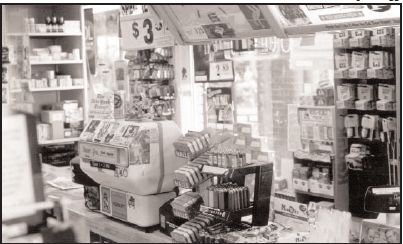
Cluttered merchandise displays make it harder for staff to monitor shoplifting. Credit: Kip Kellogg
2. Tightening stock controls. Inventory-control procedures should permit shoplifting trends to be detected, and shoplifting to be distinguished from employee theft. Unfortunately, very few retailers have such controls in place, but the more widespread use of merchandise bar coding and point-of-sales technology at checkout is resulting in significant improvements in stock control. These improvements can be expected to increase with further technological developments.
3. Upgrading retail security. Standard security must make shoplifting more difficult. This may include the following:
- Restricting the number of unaccompanied minors allowed in small neighborhood stores
- Establishing clear rules for use of changing rooms in clothing stores
- Placing retail associates in changing-room stations
- Displaying only the cassette, CD, and DVD cases in music and video stores (and only one shoe per pair in shoe shops)
- Keeping high-value items in locked displays, or securing them through cable locks and security hangers
- Encouraging shoppers to use supermarket-type baskets for purchases (which removes the excuse for putting things in their own bags or pockets) or providing them with secure lockers for their bags
- Sealing bags of legitimate purchases to reduce impulse stealing
- Giving receipts and, where there is a high shoplifting risk, checking them against goods on exit
- Requiring proof of purchase for refunds
"The simple step of approaching a customer and asking if they need help finding anything tends to inhibit criminal behavior among those who prefer to remain unseen and unheard." – Brad Brekke, Vice President of Assets Protection, Target
4. Posting warning notices on high-risk merchandise. Many stores display signs reminding customers that shoplifting is a crime, and warning that shoplifters will be prosecuted, but it is doubtful that such warnings have more than a marginal deterrent effect on a few susceptible people. One early study showed that when specific merchandise was prominently marked with large red stars as being frequently taken by shoplifters, shoplifting was virtually eliminated. A more recent study showed that this deterrent effect was greater for items next to the items marked with a sign that read "Attention Shoppers! Items Marked with a RED RIBBON are Frequently Shoplifted!"21
Staffing
5. Hiring more and better-trained sales staff. Stores should hire sufficient numbers of staff to properly oversee goods and customers, especially at high-risk periods for shoplifting. Stores should train staff to be attentive to customers and alert for thieves, and should also train them in procedures for dealing with shoplifting incidents. For instance, in order to sustain a prosecution, it is usually necessary to prove that the goods were not only taken away, but that there was intent to avoid payment. It is therefore always advisable to wait until the suspect has left the shop before apprehending them or they may claim they intended to pay before leaving.
6. Hiring security guards. Little is known from research about the effectiveness of uniformed security guards in any environment—and retail is no exception. Only one small study has been published, and it suggested that security guards had less value than electronic article surveillance (EAS) or store redesign in decreasing the theft risk; however, the study's small sample limits the findings' reliability.22
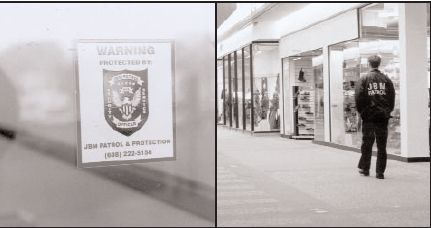
Security guards who move around, creating an active, visible presence, are likely to be more effective at preventing shoplifting. Credit: Kip Kellogg
7. Hiring loss prevention and asset protection teams. Most large retailers invest in loss prevention and asset protection teams that investigate theft within the stores once it occurs. They perform various functions, such as checking receipts when customers walk out, and monitoring the surveillance systems inside a store to identify and stop shoplifters.23
Retailers in South Africa contracted with third-party companies ("Hot Product Controllers") to help stop the shoplifting of products that accounted for 80 percent of the shrinkage within their stores. These contractors focused on five key areas, which included securing delivery, fast tracking, securing storage, conducting daily counts, and conducting shelf replenishment. Their efforts resulted in a 61 percent reduction in shrinkage in all hot products, with the greatest reductions achieved in sugar and razor blades.24
Shoplifting Policies
Many stores routinely refer apprehended shoplifters to the police. For persistent offenders, this is clearly necessary. In the case of more opportunistic shoplifters, many of whom show shock at getting caught, it is doubtful that police arrest has any additional deterrent value.† An inflexible policy of referring shoplifters to the police could result in reduced staff enthusiasm for apprehending them, and stores are probably best served by a flexible shoplifting policy that includes formal and informal avenues and, perhaps, civil recovery.
† Sherman and Gartin (1986), in a randomized experiment, found that recidivism rates did not differ for two large groups of apprehended shoplifters: those released and those arrested.
Belief in the value of prosecution is strong among many retailers and the general public and there is little chance the police will be relieved of this burden.† Consequently, the arrest process should be made more efficient. Ways of doing so fall outside this guide's scope, but some police forces have developed systems whereby private security officers are authorized and trained to write criminal summonses themselves (after first checking with the police by phone for outstanding warrants and arrest histories). This obviates the need for patrol officers to process arrests, but still gets the cases into the formal criminal process.
† Not only is shoplifter prosecution of doubtful preventive value, but also, practice in this area is fraught with difficulties: Merchants may see the police as being at their beck and call; private security staff may expect the police to take cases that are not "good," or that reflect a lack of discretion (e.g., a 12-year-old stealing a candy bar); and there are issues regarding obtaining proper evidence, identifying alleged offenders, using force, targeting minorities, imposing burdens on the criminal justice system, using statutes or ordinances/summonses or physical arrests, etc.
8. Using civil recovery. In nearly every state, retailers can use civil law to collect restitution from shoplifters, and many retailers take advantage of this.25 Civil recovery is designed to operate quickly, with little recourse to the courts. Civil recovery offers the retailer the benefit of recovering more than just the retail cost of the item stolen, requires a lesser degree of proof, spares the thief an arrest and conviction record, and relieves the burden on the criminal justice system.
9. Using informal police sanctions. In some jurisdictions first offenders are given the option, as an alternative to prosecution, of participating in programs in which they are instructed about shoplifting's harms. If the offender completes the program the initial charge is dismissed and, sometimes, upon petition, can be erased from the records, so that the person does not have a "criminal" record.‡ In Britain, similar police programs are called "cautioning." One program introduced by the Thames Valley Police combines counseling modules and a formal caution, and claims to have substantially reduced re-offending among juvenile shoplifters. Counseling modules include meetings with store managers, sessions with youth workers about available leisure activities, and group work to learn about resisting peer pressure to offend.26
‡ As an alternative to prosecution, police sometimes also refer first offenders to structured programs like the Stop Shoplifting Education Program, operated by the Better Business Bureau of WNY, Inc. (1993), which claims to reduce recidivism. In addition, stores themselves sometimes run first-offender warning programs, without extensive police involvement. Stores might check with police to determine whether the offender has been charged before and, if not, issue their own warning, without having an arrest made.
Technology
10. Installing and monitoring CCTV. Improvements in quality and reductions in cost have resulted in the widespread use of CCTV to prevent shoplifting. Few evaluations have been published, though one careful study of 15 clothing stores in England found that CCTV's value was directly related to the system's sophistication. Effectiveness was quite marked in the first few months after installation, but declined rapidly thereafter, which the researchers explained by arguing that "would-be offenders became progressively inured or desensitized to CCTV's deterrent potential."27
Little is known about CCTV's value in other kinds of stores, and there is "a raft of unanswered questions about its impact. These questions relate to the following:
- The detection of offenders
- The deterrence of would-be offenders, and possible displacement of criminal activities elsewhere
- The relative value of video recordings and real-time images
- The ability of operators to monitor and make sense of multiple images
- The impact on customers (who may be reassured, even when there are no measurable benefits)
- The effect on shop staff (who may become less vigilant about crime following its installation)"28
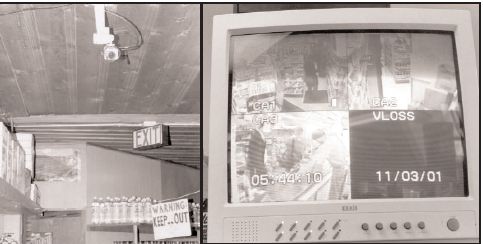
Surveillance cameras and CCTV are increasingly used to prevent shoplifting, but more study is needed to determine their effects. Credit: Kip Kellogg
11. Using electronic article surveillance. Electronic article surveillance (EAS) is often known as electronic tagging. Exit gates detect tags that have not been removed or deactivated, and sound an alarm. The tags have been made progressively smaller and the detectors have become more reliable. Increasingly, tags are now being included in the goods' packaging at manufacture (source tagging), which reduces the cost.29 Despite their widespread use, few evaluations have been published of EAS systems.30 The most comprehensive of these evaluations used comparisons between stores with and without EAS systems, and before-and-after studies, in a variety of retail settings. The authors concluded that EAS could reduce shoplifting and total inventory shortage from 35 to 75 percent.31 The considerable costs of buying and running EAS systems must be set against these benefits and the fact that sophisticated offenders are knowledgeable about ways to defeat EAS systems.
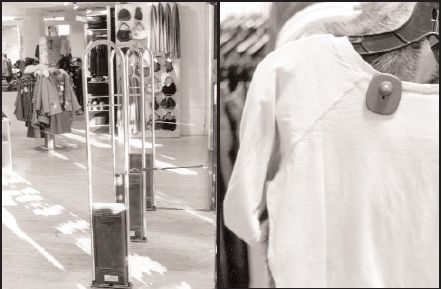
Electronic tags affixed to goods activate alarms when passed through exit gates. Electronic tagging has demonstrated effectiveness in preventing shoplifting, although knowledgeable offenders can sometimes defeat the systems. Credit: Kip Kellogg
12. Attaching ink tags to merchandise. Ink tags attached to clothing are quite different from electronic tags. Rather than sounding an alarm when removed from the store, and thus increasing the offender's risk of getting caught, ink tags remove the rewards of theft by ruining the garments to which they are affixed when the thief tries to detach them. To date, only one rigorous evaluation has been reported: it concluded that ink tags might be more effective than EAS when used in the same retail environments.32 Devices are now available that combine both electronic and ink tags' advantages, but with the inevitable disadvantage of increased costs. Other devices not containing ink are also available, such as small clamps that cannot be removed from items such as jewelry or eyeglasses.
13. Using advanced surveillance electronic systems. These systems come in a number of varieties including the following:
- Video Investigator® can monitor shoppers' movements and detect unusual activity, such as removing multiple items of the same type from a particular shelf. The software alerts the monitoring room operators and security guards with a chime or a flashing screen.33
- ShelfAlert® is an on-shelf security rack that can alert the monitoring center when too many products are taken off the shelf at the same time. The store can set the number of items that will trigger the alert.34
- LaneHawk® can spot packages hidden on rungs underneath the carts. Cameras mounted in cashier stands scan these racks. If an item matches an image in a database, the system computes the product price and automatically adds it to the customer's bill.35
- RFID (radio frequency identification) technology is increasingly being used to track items within stores, as well as check inventory levels. RFID tags, which can be as small as a pinhead, transmit signals that can travel up to 300 ft. The tags can be read even when concealed within an item.36 This allows items to be tracked as they travel through the store. As in the case of Video Investigator and ShelfAlert, RFID tags can serve as alert systems when large numbers of items are removed from the shelves.
For Organized Shoplifting
14. Establishing early warning systems. Merchants in some areas have found it useful to establish a same-day early warning system whereby they notify one another about the presence of mobile gangs of organized shoplifters, but there have been no formal evaluations of this practice. Although local police are mainly alerted to organized shoplifting incidents through retail investigators, they can also identify suspicious activities, for example, by the discovery of large quantities of retail merchandise during routine calls or traffic stops.
15. Forming task forces with other law enforcement agencies. Organized-theft groups rarely operate within one jurisdiction, and it is important that local police forge partnerships with state and federal law enforcement agencies. Several such partnerships have proven effective in dismantling some of the largest professional shoplifting groups in the country. Operation Greenquest was established by the U.S. Customs Service to target thieves who financed Al Quaeda and other terrorist groups.37 Operation Blackbird, mounted by a task force comprising investigators from local, state, and federal agencies formed by the Pasadena, California, Police Department, uncovered some large organized crime shoplifting operations.38
16. Forming partnerships and working with retailers and manufacturers.† Many partnerships have been established among law enforcement agencies, retailers, retail associations, and manufacturers. Successful partnerships of these kinds with local stores have been undertaken by the police in Charlotte-Mecklenburg, North Carolina;39 Mesa, Arizona; Colorado Springs, Colorado;40 Portsmouth, England;41 and Boise, Idaho.42 In Boise, for example, a growing organized shoplifting problem was addressed in 2005 by the establishment of the Organized Retail Crime Interdiction Team. This took a number of preventive initiatives that included updating stakeholders on recent trends through regular monthly meetings, using email and text messaging to maintain an efficient intelligence flow between retailers and police, and responding immediately to in-progress incidents. These actions led quite quickly to a significant reduction in organized shoplifting incidents.
† See Problem-Solving Tools Guide No. 5, Partnering with Businesses to Address Public Safety Problems, for further information.
Notable partnerships that encompass wider areas and a larger number of entities include the following:
- The Law Enforcement Retail Partnership Network (LERPnet) was established in 2007 by the National Retail Federation in partnership with the FBI, the Food Marketing Institute, and the Retail Industry Leaders Association. LERPnet is a web-based repository that allows retailers to share information with each other and with police about shoplifting incidents.43
- The ORC Pilot Program was launched by U.S. Immigration and Customs Enforcement in four cities with known organized retail crime activity: Houston, Los Angeles, Miami, and New York City. The program developed a database with retail industry contacts and a threat-assessment to help determine the extent of organized retail crime. It also explored how organized shoplifting groups exploit vulnerabilities in the banking system to launder profits. The pilot program resulted in multiple arrests and convictions, leading to the seizure of nearly $4.9 million in cash, property, and money instruments. It has now been expanded into an ongoing national initiative known as SEARCH (Seizing Earnings and Assets from Retail Heists).
- In 2008, eBay® launched the PROACT (Partnering with Retailers Offensively to Attack Crime and Theft) program which aimed to combat stolen goods sales on its web site. Based on information received from regulatory and law enforcement agencies, the site created filters to search for prohibited goods up for auction. eBay also cooperated with police in monitoring and reporting suspicious activity on its web site. Other web sites, which are also potential outlets for stolen merchandise, such as Amazon.com®, Overstock.com®, and Craigslist, might usefully be drawn into such partnerships.44
17. Monitoring stores' goods suppliers. Retailers might inadvertently buy goods that have been stolen by organized shoplifters unless they carefully monitor their suppliers.45
Some store buyers might also be bribed by these suppliers to buy stolen goods. To reduce these risks, the retailer's loss prevention team can conduct unannounced visits to the suppliers' warehouse(s) to look for clues suggesting that the goods may be illegitimate. These include the products' condition and the overall warehouse condition, as well as the presence of (a) cleaning stations and chemicals, (b) security tags and labels on the floors or in the trash cans, and (c) repackaging stations. Talking to other retailers who obtain their goods from the same suppliers might also prove useful. In addition, buyers should be trained to identify and report possible suspicious transactions, and they should be encouraged to report to police when a deal is "too good to be true."
18. Using social networking sites to gather information about shoplifting incidents. A 2011 survey of retailers found that about 70 percent of them use Facebook, Twitter, LinkedIn®, Craigslist, Myspace, Google, Foursquare, Pipl, Carnivore Lite, YouTube, and Flickr® to gather information about shoplifting from their stores. Using these networking sites they identify perpetrators, investigate connections between perpetrators and company employees, and identify premises where the stolen goods may be stored or sold. Retailers report "huge success" using Facebook to gather intelligence about past events and planned activities.46 When "view only" is selected, no direct contact is made with the subjects, thereby allowing the investigators to gather this information without their knowledge. Police, therefore, can use these social networking sites to gather similar information.
Responses with Limited Effectiveness
19. Hiring store detectives. Some stores rely on store detectives, despite research that suggests they may have only a limited impact on shoplifting. When researchers have followed random samples of people entering stores, few of those they have observed shoplifting have also been seen by the store detectives.47 A study in a large London music store, with four store detectives on duty at any one time, suggested that the store would need to hire 17 times this number to be able to catch all the shoplifters likely to enter the store—clearly not an economic proposition.48 Most stores do not advertise store detectives' presence, but some do. Advertising their presence may provide a greater deterrent, but it may also mean that shoplifters exercise greater caution. No research has evaluated these possibilities.
While it must be assumed that store detectives have some deterrent value, it is possible that they lower other staff's vigilance. It is also important that store detectives spend as much time as possible on the shop floor, and not have their time consumed in court attendance or police liaison work.
20. Arresting and prosecuting shoplifters. There is little hard evidence that apprehending, arresting, and prosecuting shoplifters results in reduced shoplifting by those arrested or by others who learn about the arrests. Studies of criminal sanctioning have consistently failed to show any clear deterrent effects. In regard to shoplifting, the chances of getting caught are so low, and the risks of severe punishment so small, that most researchers believe offenders pay little attention to the possible costs.49
21. Using shaming punishments for first-time offenders. Many retailers, especially those in California, Alabama, Georgia, Tennessee, and Texas, have increasingly used "shaming" as an alternative to prosecution resulting in jail time, fines, or other traditional penalties. Convicted shoplifters are ordered (sometimes by judges after consulting with the store's management) to wear a sign and go about in public declaring their crimes. Little is known about the effectiveness of shaming.
22. Banning known shoplifters.A related practice entails banning offenders from, and posting their pictures in, stores. Little is known about the effectiveness of this practice, but if it publicizes shoplifters' identity, it might have some limited value. However, where courts have not convicted those identified, both the merchants and the police engaged in the practice are vulnerable to criticism and legal challenge.
23. Launching public information campaigns. Some communities have launched media campaigns to inform the public about the shoplifting's harms, encourage people to report it, and increase knowledge about the consequences of apprehension. Posters, pamphlets, classes, and public service announcements have all been used to get the message across.50, † Evaluations of these programs have produced little evidence that they reduce shoplifting.51
† See Response Guide No. 5, Crime Prevention Publicity Campaigns, for further information.


Free Bound Copies of the Problem Guides
You may order free bound copies in any of three ways:
Online: Department of Justice COPS Response Center
Email: askCopsRC@usdoj.gov
Phone: 800-421-6770 or 202-307-1480
Allow several days for delivery.
Email sent. Thank you.
Shoplifting
Send an e-mail with a link to this guide.
* required
Error sending email. Please review your enteries below.
- To *
Separate multiple addresses with commas (,)
- Your Name *
- Your E-mail *
Copy me
- Note: (200 character limit; no HTML)
Please limit your note to 200 characters.