
Responses to the Problem of Speeding in Residential Areas
Your analysis of your local problem should give you a better understanding of the factors contributing to it. Once you have analyzed your local problem and established a baseline for measuring effectiveness, you should consider possible responses to address the problem.
The following response strategies provide a foundation of ideas for addressing your particular problem. These strategies are drawn from a variety of research studies and police reports. Several of these strategies may apply to your community's problem. It is critical that you tailor responses to local circumstances, and that you can justify each response based on reliable analysis. In most cases, an effective strategy will involve implementing several different responses.
Law enforcement responses alone are seldom effective in reducing or solving the problem. Do not limit yourself to considering what police can do: carefully consider whether others in your community share responsibility for the problem and can help police better respond to it. The responsibility of responding, in some cases, may need to be shifted toward those who have the capacity to implement more-effective responses. (For more-detailed information on shifting and sharing responsibility, see Response Guide No. 3, Shifting and Sharing Responsibility for Public Safety Problems).
Engineering Responses
1. Using traffic calming. Traffic-calming describes a wide range of road and environmental design changes that either make it more difficult for a vehicle to speed or make drivers believe they should slow down for safety.17, § The measures are also intended to make roads easier and safer for pedestrians and bicyclists to use. Traffic-calming measures are particularly effective at reducing speeds in residential areas.18 Common traffic-calming measures are divided into three main categories: vertical deflections, horizontal deflections and horizontal narrowing:
1a. Vertical Deflection
Speed humps. Speed (or road) humps are different from speed bumps. Speed humps are about 12 feet wide and 2 to 3 inches high, and can be crossed safely at 20 to 30 mph. Properly designed, they can accommodate large vehicles such as fire trucks. Speed bumps are shorter and narrower, and can be crossed safely only at lower speeds. They can damage large vehicles. They are more appropriately installed in parking lots than on roads.§§
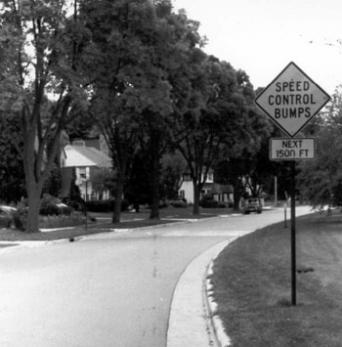
Although the street sign describes them as "street bumps," these "speed humps" can be crossed safely by cars traveling 20 to 30 mph. Credit: Kip Kellogg
Speed tables. Speed tables are similar to speed humps, but are usually long enough for the entire wheelbase of a passenger car to rest on top of the flat, top section. They are often made with brick or other textured materials to draw attention to them or improve their appearance.
Raised crosswalks. These are speed tables placed at crosswalks and outfitted with crosswalk markers to improve pedestrian visibility to motorists.
Speed cushions. Speed cushions are narrow, rectangular humps that are placed close enough to reduce the speed of passenger vehicles, but that allow vehicles with wide tracks, such as emergency vehicles and buses, to straddle them and not affect their speed.
Raised intersections. These are similar to raised crosswalks, but cover the entire intersection, identifying it as a pedestrian zone.
Textured pavements. Pavements made from brick or cobblestone can be used for entire street blocks and can substantially reduce vehicle speeds.
1b. Horizontal Deflection
Traffic circles. Traffic circles are raised islands placed at intersections where traffic volume is not a concern.
Roundabouts.§§§ Roundabouts are similar to traffic circles but are used in areas where traffic volume is also a consideration.
Chicanes. Chicanes are traffic deflections that narrow or redirect the road.
Realigned intersections. Realigning intersections involves putting bends and curves in the road at "T" intersections to help reduce speeds.
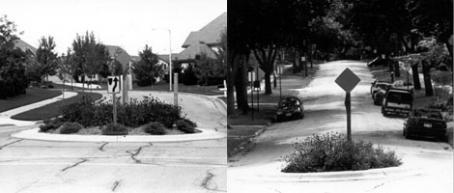
Traffic circles, of varying sizes, reduce speeds and crashes in residential areas. Credit: Kip Kellogg
1c. Horizontal Narrowing
Neckdowns. Neckdowns are built-out curbs at intersections that reduce the width of the road and the distance needed for pedestrians to cross.
Center islands. These are raised islands in the centerline of a road. They can be installed as gateways to residential neighborhoods.
Chokers. These are mid-block build-outs (sidewalk-area extensions into the road).
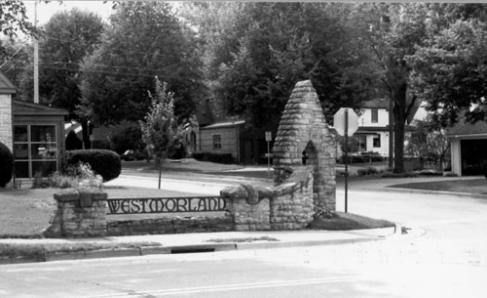
Neighborhood gateways remind drivers that they are entering residential areas where lower speeds are appropriate. Credit: Kip Kellogg
Other strategies include:
- Marking the road to create the illusion that it is narrowing
- Planting trees and other foliage along roadsides
- Permitting parking on both sides of residential streets§§§§
- Timing traffic signals for vehicles traveling the desired speed
- Erecting mid-block barriers that create two cul-de-sacs
Traffic-calming measures can be expensive, however, so you must determine their cost-effectiveness over the long term. Traffic-calming measures work best if they are understood and accepted by the public, take into account the special requirements of emergency response vehicles and are reinforced with adequate levels of police enforcement.19 Properly designed, traffic-calming measures can also reduce noise levels by reducing vehicle acceleration. Without traffic-calming measures, it is difficult for police to reduce average vehicle speeds below 25 mph.20
§ The U.S. Transportation Department prepares traffic-advisory leaflets that provide illustrations and technical details about many road design features. There are also a number of useful web-based summaries and descriptions of traffic-calming measures: see, for example, the Federal Highway Administration, at www.fhwa.dot.gov/environment/tcalm/, and the Los Angeles County Public Works Department's neighborhood traffic-management-plan toolbox, at http://ladpw.org/TNL/NTMP/.
§§ Some jurisdictions have experimented with placing optical illusions of speed bumps, potholes or other obstructions on the road. These devices tend to have at least a short-term effect of reducing speeds until drivers realize they are illusions. There is an obvious risk that drivers might subsequently come to believe that real obstacles are illusions and fail to slow down when they should.
§§§ It is essential that vehicles traveling in the roundabouts have the right-of-way, rather than those entering the roundabouts, for them to be effective in reducing crashes (National Highway Traffic Safety Administration 1999).
§§§§ The speed reductions achieved by permitting parking must be offset against the increased risk to pedestrians who dart into the road from between parked vehicles.
2. Posting warning signs and signals. Painting speed limits or "SLOW" on the road surface, in combination with posting roadside signs, can help reduce speeds.21 Transverse pavement markings create the illusion of high speed, and when placed ahead of traffic hazards, have been shown to cause drivers to slow down.22 Strobe-light signals, flashing signals and warning signs painted in eye-catching fluorescent colors can improve drivers' awareness of special hazards and reduced speed limits.23 Where there are many other signs and sights competing for drivers' attention, it is hard to get drivers to notice speed warnings. Warning signs and signals are more effective if they convey why drivers should slow down (e.g., curve ahead, school zone, road construction).24 Other signs, such as those that warn of children in the area, are not known to effectively reduce speeds.25
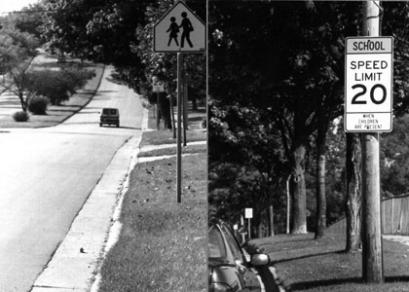
Warning signs such as these pedestrian-crossing and school-zone signs remind drivers to slow down. Credit: Kip Kellogg
3. Blending motor and non-motor vehicle uses of public space through urban design. In some communities, urban planners are rethinking the conventional separation of driving and nondriving uses of public space. They are removing standard barriers, signs and road markings that delineate where vehicles, bicycles and pedestrians belong, replacing them with gateways, new surface materials and street furniture, such as benches, short posts or pillars, streetlamps, waste bins, fountains, and bus stops. This reduces the traditional separation between motorists, bicyclists and pedestrians by eliminating wide, straight routes and blurring the lines between public and private space. The results are greatly reduced speeds because motorists recognize that they are sharing the space with non-motorized users and therefore must be more cautious.26 First pioneered by the Dutch, these designs are being used successfully in the United States in Seattle; Portland and Eugene, Oregon; and West Palm Beach and Sarasota, Florida.
Education Responses
The goal of education responses is to make speeding socially unacceptable. But given the current acceptability of speeding, there is the potential for a negative backlash against anti-speeding campaigns.27
4. Conducting anti-speeding public awareness campaigns. Anti-speeding public awareness campaigns have been recommended, even though their effects may not be immediate and substantial; they can help change the social acceptability of speeding and alter drivers' beliefs that they are better and safer than other drivers. 28 Public awareness campaigns need not be overtly accusatory, but should convey facts about the dangers and consequences of speeding so as to debunk common myths about speed and driving. Because many drivers say they speed merely to keep up with traffic, encouraging voluntary compliance with speed limits can help slow down those drivers who consciously or subconsciously follow other drivers' lead.
Targeted information campaigns can be even more effective than publicly broadcast campaigns. Police can issue warnings and requests directly to groups of chronic speeders if they can identify them. For example, Raleigh, North Carolina, police determined that students' parents were the most common speeders near schools: police set up warning signs in the school zones, published speeding education information in the school newsletters, and distributed warning and education information to parents stopped for speeding and those dropping off their children at school, resulting in a doubling of the percentage of drivers obeying the speed limit.29
A twist on the conventional public awareness campaign that discourages speeding is a campaign that encourages obeying the speed limit. In some campaigns of this sort, police have achieved positive results by stopping drivers and thanking them for obeying the speed limit; in others, signs have been posted indicating the percentage of drivers obeying the speed limit.30
An interesting method for making the public aware of the hazards of speeding in school zones comes from Lithuania. There, drivers are required to keep their headlights on at all times during the first week school is in session as a reminder to one another to drive carefully where children are present.
Some public awareness campaigns are professionally developed, using television, radio and billboards. These campaigns typically convey official, government-sanctioned messages about speeding risks. Anti-speeding campaigns developed at the grass-roots level are potentially even more effective than official campaigns. Using simple lawn signs, speed display boards, warning letters, or personal appeals to speeders who have been stopped, these campaigns can convey more heartfelt messages to speeders about the risks they create.
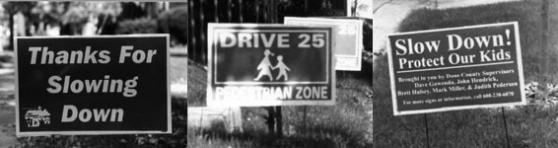
Grass-roots anti-speeding signs convey more heartfelt messages to speeders. Credit: Kip Kellogg
5. Informing complainants about actual speeds. Complainants do not always estimate vehicle speeds accurately. Vehicle speed almost always seems faster to a stationary pedestrian than to a moving motorist. Where you suspect that complainants' concerns may be exaggerated, you might have a police officer monitor speeds with complainants present. Some complainants may be surprised to learn that vehicles are in fact traveling the speed limit. This does not necessarily mean that speeds are appropriate for the conditions, but at a minimum it helps complainants better understand what responses might be most appropriate to remedy the problem.
6. Providing realistic driver training. Realistic driver training similar to what police officers receive can help drivers better appreciate speed's effects on their ability to control a vehicle.31 Proper, realistic training courses require skilled instructors, special safety equipment and protected driving areas.
Enforcement Responses
7.Enforcing speeding laws. Long-term changes in drivers' attitudes toward speeding depend on drivers' perceived risk of being stopped.32 However, a considerable investment of resources is required to significantly increase the risk of getting caught.33 The public generally supports speed enforcement, especially in residential areas and other areas where there are children.34 Speed enforcement works best if
- Drivers believe it will occur
- It has meaningful costs to offenders
- Police apply it generally, rather than at specific times and locations
- Drivers are not tipped off by cues as to when it is or is not happening35
With respect to the last condition above, you must balance making the public aware of the enforcement campaign against allowing drivers to anticipate precisely where and when officers are conducting enforcement. For example, you might consider advertising on the radio that the police will be enforcing speeding laws on particular roads on particular days, but not give visual cues to drivers of the exact location of the speed detection devices and officers. This will enhance the deterrent effect for drivers listening to the radio, without reducing the deterrent effect for those who are not. You should vary the enforcement times and locations enough so that drivers do not become confident that they can avoid detection. Advance publicity of enforcement campaigns also increases public support for enforcement by establishing a sense of fairness to drivers. Explaining why police have targeted particular locations for enforcement (e.g., there's a high rate of crashes or citizen complaints) also increases public support.§ You should conduct enforcement both at problem locations and at randomly selected locations to maximize deterrence.§§ Stationary marked police vehicles are more effective than moving marked police vehicles in reducing speed.36
§ The Silverthorne, Colorado, Police Department surveyed the community to determine the thresholds at which the public believed the police should issue speeding citations at specific locations. The police issued the survey results to drivers stopped for speeding, thereby enhancing police authority to enforce speeding laws and minimizing citizen complaints about speed enforcement.
§§ An Australian study concluded that posting police officers in marked police vehicles on randomly selected stretches of road at random times generally is a cost-effective way to maximize deterrence and reduce traffic crashes (Leggett 1997).
Police enforcement is expensive to maintain consistently, and it quickly loses its effect where the enforcement effort is not visible to drivers.37 Intensive speed enforcement also loses its effectiveness because of the typical incentive system for traffic officers—they are rewarded for issuing citations rather than for maintaining reduced average speeds. Consequently, as soon as the enforcement effort has the positive effect of reducing speeds, there are fewer violations and traffic officers move on to other locations, after which speeds quickly resume their pre-enforcement levels.38
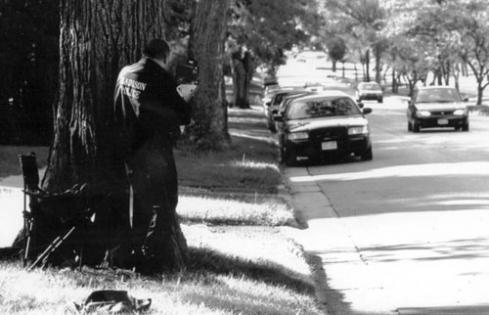
Drivers should not be able to easily detect when and where police are enforcing speed limits. Credit: Kip Kellogg
8. Enforcing speeding laws with speed cameras. Speed cameras, also referred to as photo radar, are cost-effective in reducing speeds, crashes, injuries, and fatalities, particularly when detected violations are prosecuted.39 Police determined that speed cameras, used in conjunction with other responses, have proved effective in reducing the percentage of speeders, vehicle crashes, injuries, and fatalities in Victoria, Australia.40 There, police mounted speed cameras either in unmarked police vehicles or on tripods along the roadside, without advance warnings to drivers about the cameras' location. The police could move the cameras around so drivers could not predict where they placed them. Speed-camera use can be effective in residential neighborhoods as well as on major arteries and highways.41 Some drivers slow down when approaching speed cameras, but quickly speed up once they pass.42 This can be countered by hiding the cameras better and otherwise preventing drivers from knowing exactly where they are. In some jurisdictions, the relatively inexpensive protective boxes in which speed cameras are placed are mounted in many locations, leaving drivers uncertain as to which boxes actually contain cameras at any particular time.
The public has generally accepted the use of speed cameras, especially in high-risk zones, although there are some strong objections to the invasion of privacy and preferences for personal interactions with enforcers.43 Some jurisdictions have experienced significant vandalism to speed cameras.44 The United Kingdom first authorized speed cameras by law in 1991; now, all British police forces use them. Norway has used them effectively since 1988.45 Not all U.S. jurisdictions have specifically authorized speed cameras for prosecution, and some states and municipalities have specifically rejected proposals for their use. You should first gauge public support for speed cameras before formally attempting to use them. In addition, some issues exist regarding the fees companies that install and operate speed cameras charge, and how the jurisdiction uses revenue generated from fines.
The first generation of speed cameras required that someone take film from the cameras, to be processed. More-advanced technology allows for more-efficient remote-image processing.46
9. Using speed display boards. Speed display boards measure oncoming vehicles' speeds and prominently display the speeds to drivers. Research has shown that speed display boards reduce speeds and crashes, seem at least as effective as speed cameras and are more cost-effective.47 Speed display boards are particularly effective with drivers who do not pay attention to their speed. Large, changeable-message signs that combine site-specific messages with speed displays have effectively reduced speeds by as much as nine mph in and around school speed zones.48 They are more effective when supplemented with police enforcement—in this combination, the effect can last several weeks after they are removed. Unattended display boards, however, are vulnerable to vandalism.
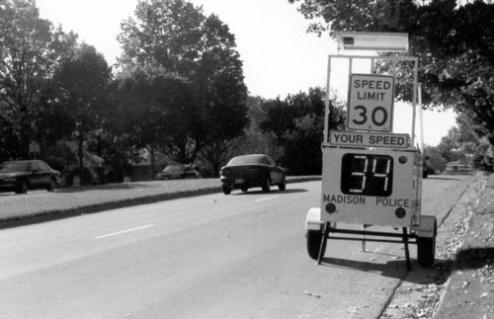
Speed display boards are a cost-effective way to reduce speeds. Credit: Kip Kellogg
10. Arresting the worst offenders. As one method for changing public attitudes toward speeding, some police agencies have amended their policies and arrested serious offenders (those driving much higher than the speed limit) rather than merely releasing them with a citation. The intent is to convey a strong message that driving well over the speed limit is a seriously dangerous offense and not a harmless technical infraction.§ This response may require special legislation and policies.
§ The Glendale, Arizona, Police Department (1998) used this response as part of a comprehensive strategy to reduce speeding. State law specifically authorized the police department's custodial arrest policy.
11. Having citizen volunteers monitor speeding. Some police agencies have recruited and trained citizen volunteers to operate speed detection devices in residential areas.49 The volunteers record the vehicle speeds and license plate numbers and turn them over to the police. Police then send official warning letters to the registered vehicle owners. Other police agencies, such as the Madison, Wisconsin, Police Department, have had citizens join police officers on traffic stops to explain the community's concerns about speeding to drivers.
Responses With Limited Effectiveness
12. Reducing speed limits. Speed limits alone have little effect on actual vehicle speeds. Reducing posted speed limits will typically decrease actual average vehicle speeds by only one-fourth of the reduction.50 So, for example, reducing the posted speed limit from 30 to 25 mph will reduce actual average vehicle speeds by only a little more than one mph. When police set speed limits lower than what most drivers consider safe (typically, the 85th percentile), the net effect is to cause many drivers to ignore those speed limits, as well as other posted speed limits;51 if police enforcement of the reduced limits fails to establish a credible deterrent, drivers may increasingly lose respect for all speed limits. In some jurisdictions, a posted speed limit lower than the 85th-percentile speed may constitute a legal defense to enforcement. Researchers should conduct careful speed studies before police change speed limits. Similar roads should have similar speed limits so drivers do not come to believe that police arbitrarily set speed limits.52, §§
§§ The Wisconsin Transportation Information Center (1999) published a guide for setting speed limits on local roads. Although it specifically refers to Wisconsin, much of the information applies to any jurisdiction.
Traffic and road engineers may inadvertently increase vehicle speeds when they build extra safety margins into the road design and speed limit.53 For example, if they want vehicles to travel 25 mph along a particular road, they might set the speed limit at 25 mph, but design the road using accepted guidelines for 30-mph travel, thinking this will provide an extra safety margin. However, the accepted guidelines already have a safety margin factored into them, resulting in a double safety margin that actually makes the road seem travel-safe at 35 to 40 mph. Because most drivers travel at what they perceive as safe speeds rather than the posted speed limit, they will end up driving 10 to 15 mph faster than the engineers originally intended. This unintended effect reflects an underlying tension in road safety—a desire on the one hand to build roads that encourage drivers to drive at slower, safer speeds, and a desire on the other hand to make roads safe enough for drivers who choose to drive faster. Road and traffic engineers have often tried to resolve this tension by making roads wider, straighter and more obstruction-free. More recent trends have turned in the opposite direction, to get drivers to slow down.
13. Increasing fines and penalties. Higher fines and penalties, beyond the threshold that offenders consider meaningful, do not continue to reduce speeds.54
14. Erecting stop signs. Many aggrieved citizens believe that erecting stop signs along residential roads will force drivers to slow down. They pressure elected officials and traffic engineers to erect new stop signs. However, the unintended effects may be that drivers speed up mid-block to make up for lost time, thereby keeping average speeds high, increasing acceleration noise and decreasing fuel efficiency.55
15. Installing speed bumps or rumble strips. Speed bumps, as opposed to speed humps, do not effectively reduce speeds, and can prove hazardous.56 Rumble strips—intermittent series of bumps across the road—do not reduce speeds directly; they serve merely to warn drivers of a hazard ahead.57
16. Reengineering vehicles. New vehicle technology holds some potential to control speeding, but most features are not yet standard or widely accepted by the public.58 Speed limiters prevent a vehicle from going faster than a set speed. Speed limiters can be programmed to receive electronic signals from transmitters along the road and adjust maximum speeds automatically. So-called smart cards can electronically record a vehicle's speed and automatically report it to police. Electronic speed indicators, reading electronic roadside signals, warn drivers they are speeding, or speed indicators in the vehicle electronically trigger roadside warning signals.
There is currently available more practical and increasingly popular in-vehicle technology that records speeds and other data for later or real-time monitoring by drivers' guardians, commonly teenage drivers' parents. Prosecutors might also consider such technology as a conditional sentence for convicted chronic speeders.


Free Bound Copies of the Problem Guides
You may order free bound copies in any of three ways:
Online: Department of Justice COPS Response Center
Email: askCopsRC@usdoj.gov
Phone: 800-421-6770 or 202-307-1480
Allow several days for delivery.
Email sent. Thank you.
Speeding in Residential Areas 2nd Ed.
Send an e-mail with a link to this guide.
* required
Error sending email. Please review your enteries below.
- To *
Separate multiple addresses with commas (,)
- Your Name *
- Your E-mail *
Copy me
- Note: (200 character limit; no HTML)
Please limit your note to 200 characters.