
Understanding Your Local Problem
The information provided above is a generalized description of street robbery. To understand your local street robbery problem, you must combine this general knowledge with facts that illuminate your local conditions. Carefully analyzing your local problem will help you design an effective response strategy that fits your specific needs. However, the fewer robberies you have to analyze, the more difficult it will be to diagnose your problem.
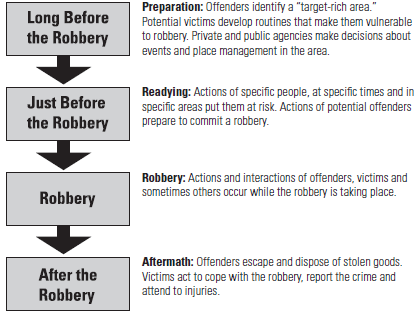
The first step in this process is identifying the specific form of street robbery affecting your community. Having identified a specific form of street robbery, the next step is analyzing its process. The process might vary from robbery problem to robbery problem. A useful approach is to divide the robbery process into four time blocks:
- Events occurring long before the robbery
- Events occurring just before the robbery
- Events occurring during the robbery
- Events occurring after the robbery
Figure 3 34 summarizes the process and defines the types of actions that take place at each stage. The two examples that follow make use of this process and show the differences between two types of robberies.
Figure 3. Robbery process.
Building a detailed street robbery profile could help develop a more useful process-analysis. Using alternatives to official crime statistics, like victim surveys, could prove useful. For instance, problem-solvers in England used a management information system (MIS) to identify robbery patterns in four key areas: crime locations/peak times, victim information, offender information, and property information. The MIS revealed that robbery risk was greatest for Gloucester residents aged 14 to 25 between 12 p.m. (noon) and 12 a.m. (midnight).35 This detailed street robbery profile helps local agencies focus prevention efforts on certain groups during certain times. An alternative for those agencies that lack a crime analyst or large budget is to use a computer with Internet access. One way to visually display your local robbery hot spots is to use free Internet mapping sites.§
§ A note of caution: Some websites offering free mapping software or maps may have outdated information or have a higher rate of error than other websites offering different mapping programs.
Table 2. Street Robbery Process by Time Blocks.
| Time Frame | Victim (Student) | Offender | Location |
|---|---|---|---|
Long Before | A student (victim) moves into a new dorm room located in an unfamiliar neighborhood. | An offender needs cash. He identifies an area around the university as having many potential robbery victims and good escape routes. | A university campus |
Just Before | The student explores the new area off campus and wanders too far away (into an unknown area). The student pulls out a cell phone to call the dorm for directions back. | The offender spots a well-dressed pedestrian, alone, who appears to have money and starts to follow the pedestrian. The possible victim seems to be lost, and the offender sees the victim pull out a cell phone. | An area surrounding the campus, unknown to the student |
During | The victim complies with the offender's demands. | The offender uses the confrontation method to steal money and property from the victim. | An area surrounding the campus |
After | The victim is unsure of the location, has no cell phone and is not familiar with how to get help or report the crime. The victim doesn't report the crime or reports it long after it occurs. | The offender slips down a side street and follows an escape route. | The location will vary |
Table adapted from Tilley et al. 2004
Table 3. Street Robbery Process by Time Blocks.
| Time Frame | Victim (Commuter) | Offender | Location |
|---|---|---|---|
Long Before | A commuter (victim) prepares to leave work for the day. | An offender needs cash. He knows commuters with valuables are getting on and off the subway. The offender can easily pick a target while legitimately hanging out at the station. | A public transportation system |
Just Before | The commuter arrives at the subway station while listening to an MP3 player. | The offender notices a potential victim distracted by a personal music device. | The subway platform |
During | The victim loses the MP3 player to the offender, who uses the snatch-theft method. | The offender snatches and runs with the stolen goods. | The subway platform as the victim is boarding the train |
After | The victim notifies the authorities about the crime. | The offender tries to sell the MP3 player to a local pawnshop. | The next subway stop |
Table adapted from Tilley et al. 2004
Stakeholders
Understanding the process of specific types of street robbery not only aids prevention, but also helps identify stakeholders who have an interest in the problem. In addition to criminal justice agencies, including police, courts and corrections, the following groups have an interest in the street robbery problem, and you should consult them when gathering information about the problem and responding to it.
- Transportation and parks departments:
- Street robberies could reduce the use of public transportation and parks as people become afraid of robbery.
- These departments could provide useful information for analyzing the problem, beyond using official police data alone.
- Schools:
- Schools have an interest in protecting their students' safety. Students who feel unsafe may avoid going to school.
- Local schools could help your agency identify at-risk students.
- Schools are critical to developing and running robbery education/awareness campaigns if your community's children and teens are a high-risk group.
- Universities:
- Universities have an interest in protecting their students' safety and are required by law to disclose campus crime information.§
- University administrators may have information about robberies not reported to police.
- Student organizations on college campuses have an interest in getting students involved in their own safety.
- Local business associations:
- Business districts have a stake in robbery prevention because they rely on a reputation of safety to stay profitable. They also have an interest in their employees' safety. Businesses in areas perceived to be unsafe might have trouble recruiting new employees.
- Business associations might have information about robbery concerns not reported to police and about businesses that are at special risk to attract robbers (e.g., those known to allow night cash deposits).
- Other business association stakeholders could also include real estate agencies and associations, especially those that specialize in low-cost rentals.
- Community/neighborhood associations:
- These groups have an interest because their members are potential victims.
- These groups could use their local knowledge to identify potential offenders, locations and other problem and potential contributing factors.
- Commerce or visitor's centers:
- Robbery problems in business and tourist locations make it difficult for these groups to promote commerce and tourism.
- Center staff may be able to provide information about tourist robberies reported to them, but perhaps not to police, and information about popular tourist locations and routes.
- Insurance companies:
- Because insurance companies have a financial stake in claims for items lost through robbery, they might be apt to help develop and fund prevention efforts.
- Insurance companies may also have information about property loss and injury treatment claims, the causes of which the victims might not have reported to police.
- Product manufacturers:
- Manufacturers of CRAVED items have an interest in not having their products associated with robbery in the public's mind. However, they might be reluctant to work with police because they do not want customers to think using their products increases robbery risk. Nevertheless, you could persuade these companies to include "safety" information in packaging or to design products to prevent robbery. If manufacturers market CRAVED items correctly, consumers may be more willing to buy those that are "theft-resistant" or marked with "new safety features."
- Manufacturers also have insights as to how they could design their products to discourage robbery.
- Local hospitals:
- Hospitals have an interest in reducing injuries from robberies.
- Hospital staff might have information about robbery-related injuries not reported to police.
- Other local government agencies (e.g., city planning departments, city councils, public health departments, and social services providers):
- Such agencies could provide data for analyzing the problem or plan and implement responses—including those too costly for local neighborhood or resident groups.
Asking the Right Questions
Ask the following questions to gain a better understanding of your community's street robbery problem. The answers to these questions will help you develop an effective response that reduces the frequency of street robberies.
Incidents
- How many street robberies occur in your jurisdiction or area of interest?
- What percent of attempted street robberies are reported to the police, and why were those incidents not completed (e.g., did a passerby interrupt the incident)?
- Is the number of street robberies increasing or decreasing?
- What percent of street robberies involve the use of weapons?
- Are there different types of street robbery attacks (confrontations, blitzes, cons, or snatch-thefts) reported in your jurisdiction? Do these types of attacks vary by circumstances, times, types of victims, or locations?
Offenders
- What are street robbers' characteristics (e.g., age, gender and/or race)?
- Are offenders local residents, or from out of town? Where, in relation to the robbery sites, do offenders live? How do they get to their target locations?
- Are offenders members of a group, or do they work alone?
- What percent of street robberies do repeat offenders commit?
- What percent of offenders are on probation or parole at the time of their most recent robbery?
- Are offenders on drugs or alcohol at the time of the robbery?
- What types of items do robbers take (e.g., drugs, cash, credit cards, and electronic items)?
- Where do street robbers sell their stolen goods, and to whom?
Victims
- Are there noticeable demographic patterns among street robbery victims (e.g., age, sex, education level, and occupation)?
- Are there repeat robbery victims (e.g., people who work late at night)?
- Are repeat victims different from one-time victims?
- What are the victims doing right before the robbery (e.g., talking on a cell phone, listening to music, putting money away, or asking for directions)? Are they distracted due to intoxication?
- Where are victims traveling to and from when they are robbed, (e.g., a workplace, school, bar, or special event)?
- Do victims live near where offenders rob them?
- What percent of victims resists, and how do they do so? How serious are the injuries, if there are any?
- Under what circumstances are robberies thwarted either just before or during the attack?
- Are victims visibly carrying cash or CRAVED items?
- What items do robbers take from the victims?
- Do street robbers follow victims from another location, an ATM or a bus or train station?
Locations/Times
- Where do most street robberies occur? Are there clear street-robbery hot spots?
- Are robbery locations and hot spots associated with particular transportation routes, businesses, events, or other physical or social characteristics?
- When do robberies occur most frequently (e.g., day or night, day of week, and time of year)?
- Are there common safety features at high-robbery locations (e.g., proper lighting, clear visibility, surveillance cameras, and help phones)?
- Are weather conditions important? For instance, do more street robberies occur at bus stops that provide overhead cover in the winter than occur there in warmer months?
Routines
- Are street robberies common during particular special events?
- Do robberies increase around holidays?
- Are robberies associated with any annual routines?
- Are robberies associated with any daily routines?
- Are there disruptions to routines that increase or decrease street robberies?
Current and Previous Responses
- What anti-street robbery strategies have worked in the past in your community? What strategies have failed?
- What agencies have been involved in previous responses? What did they do?
- How do police typically handle street robberies (e.g., investigation)?
- Do police have a special unit designed to handle street robberies?
- What happens to street robbers after arrest (e.g., prosecution and/or sentencing)?
Measuring Your Effectiveness
Measurement allows you to determine how well your efforts have succeeded, and suggests how you might modify your responses if they are not producing the intended results. You should take measures of your problem before you implement responses, to determine how serious the problem is, and after you implement them, to determine whether they have been effective. You should take all measures in both the target area and the surrounding area (for more-detailed guidance on measuring effectiveness, see Problem-Solving Tool Guide No. 1, Assessing Responses to Problems). Evaluators need not have a great deal of expertise or technology. Even a small agency can use Google Maps, for example, to pinpoint and count area robberies. Larger agencies should have crime analysts to do this.
Your agency should evaluate a response on its impact on the actual problem (i.e., its so-called outcome measures). The following are potentially useful measures of the effectiveness of responses to street robbery:
- Reduced overall number of street robberies in your community
- Reduced number of robberies at hot spots
- Reduced number of calls for police service for robberies
- Reduced number and severity of injuries incurred during robberies
- Reduced cash and property losses
Offenders might change when, where and how they rob in response to prevention efforts. Anticipating possible forms and directions of crime displacement, however, can limit its occurrence. Though displacement should always be a concern, its occurrence is not inevitable, and it is often incomplete when it does occur. In addition, your response might create a diffusion of crime prevention benefits.36 For instance, reducing robberies in a hot spot might also contribute to a robbery reduction in nearby areas. (For more-detailed information on crime displacement and diffusion, see Problem-Solving Tool Guide No. 10, Analyzing Crime Displacement and Diffusion. For additional information on accounting for displacement and diffusion when assessing responses, see Problem-Solving Tool Guide No. 1, Assessing Responses to Problems). Finally, it is important to remember that the goal is to reduce robberies. Measures like arrest numbers or robbery clearances tell us only what the police did, not what they have accomplished.


Free Bound Copies of the Problem Guides
You may order free bound copies in any of three ways:
Online: Department of Justice COPS Response Center
Email: askCopsRC@usdoj.gov
Phone: 800-421-6770 or 202-307-1480
Allow several days for delivery.
Email sent. Thank you.
Street Robbery
Send an e-mail with a link to this guide.
* required
Error sending email. Please review your enteries below.
- To *
Separate multiple addresses with commas (,)
- Your Name *
- Your E-mail *
Copy me
- Note: (200 character limit; no HTML)
Please limit your note to 200 characters.