
Underage Drinking
Guide No. 27 (2006)
by Kelly Dedel
Translation(s): Consumo de Alcohol en Menores de Edad (Español)PDF
The Problem of Underage Drinking
This guide begins by describing the problem of underage drinking†, and reviewing factors that contribute to it. It then identifies a series of questions to help you analyze your local underage drinking problem. Finally, it reviews responses to the problem, and what is known about them from evaluative research and police practice.
† There are many labels used to describe underage drinking and its negative consequences. These include "binge drinking," "high-risk drinking," "heaving drinking," and "risky drinking," among others. Controversy about proper terminology comes from disagreement about how to quantify the amount of alcohol consumed and the time period in which it is consumed, and to what extent these measurements account for physical characteristics of the drinker (e.g., weight, gender) that are related to the effects of alcohol.
Young people use alcohol more than any other drug, including tobacco.1 Underage drinking—that is, drinking under the age of 21—is prohibited throughout the United States. Despite a historical lack of vigorous enforcement, minimum-drinking-age laws have been very effective in reducing many of the harms associated with underage drinking,2 such as traffic fatalities and alcohol-related injuries, as well as assaults and other crimes. There is significant potential for further harm reduction if additional strategies targeting the factors underlying the problem are implemented.‡
‡ There are several national efforts to combat the problem: see the Office of Juvenile Justice and Delinquency Prevention's "Enforcing the Underage Drinking Laws" program (www.ncjrs.org/html/ojjdp/compendium/2001/contents.html), [PDF] the Pacific Institute of Research and Evaluation website (www.udetc.org), and the Robert Wood Johnson Foundation's "A Matter of Degree" program designed to discourage drinking on college campuses(www.ama-assn.org/ama/pub/category/3558.html).
Virtually all high school students and most college students are under 21. However, most drink alcohol at least occasionally, and many drink frequently and heavily.§ They can get alcohol for free or at low prices, which contributes to their drinking at levels that significantly increase their risk of negative alcohol-related consequences.3 The proportion of underage youth who drink has not changed significantly over the past decade in the United States.4 Indeed, if anything, they are starting to drink at a younger age, and their drinking patterns are becoming more extreme.5
§ Recent surveys of U.S. high school and college students showed that one-half to three-quarters of high school students had tried alcohol (Johnston, OMalley, and Bachman 2002) [Full text] and two out of every three underage college students surveyed had drunk alcohol in the past 30 days (Wechsler 2001). [Full text]
Underage drinkers experience a wide range of alcohol-related health, social, criminal justice, and academic problems. They do not all experience the same level of problems—those who drink more, and drink more often, suffer a greater number of negative consequences. However, negative consequences occur across a wide range of consumption levels and frequencies.
Young drinkers report a range of negative effects from alcohol, all of which can lead to troubled interactions with others, particularly police officers or other responsible adults who try to intervene.6 These include the following:
- Overconfidence and recklessness. Excessive drinking may cause people to act in ways they would normally consider unwise or inappropriate.
- Lack of awareness. As people become intoxicated, they may not be fully aware of what is happening, and may not be able to figure out how to react to situations appropriately.
- Aggression. Drinkers may misread cues from other people as being offensive, and react violently.
- Loss of control. Drinkers' motor skills may become impaired, and drinkers may also lose control of their emotions.
These effects often lead young drinkers to come into contact with police, either as offenders or as victims. Youths who drink heavily are more likely to carry handguns than those who do not drink.7 Alcohol use contributes to property damage, rape, and other violent crime on college campuses,8 and about half of college crime victims have been drinking before the crime occurs.9 A significant proportion of young drivers killed in car accidents are intoxicated when the crash occurs.10
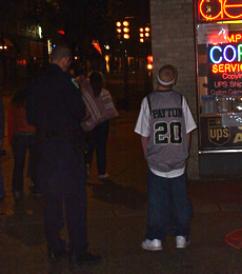
Despite widespread use, relatively few underage drinkers experience any legal or school-based consequences for their behavior. Credit: David Corbett
Further, underage college students who drink heavily are more likely to miss class, fall behind in school, sustain an injury, have unplanned or unprotected sex, drive after drinking, or have contact with campus police.11, † Students also experience "secondhand" effects of others' alcohol misuse, such as having their sleep or study time interrupted; having to take care of an intoxicated friend; being insulted or humiliated by drinkers; receiving unwanted sexual advances; getting in serious arguments; having their personal property damaged; being assaulted, sexually or otherwise; and being raped by an acquaintance.12 There are also a number of physical and mental health-related consequences of alcohol use, which are detailed elsewhere.‡
† While a number of studies reveal a correlation between alcohol consumption and negative or high-risk behavior (e.g., violent behavior, unprotected sexual activity), this relationship does not necessarily mean that alcohol causes these behaviors. Instead, there may be situational or personality factors underlying both the drinking and the high-risk behavior. For more information, see Gottfredson and Hirschi (1990).
‡ For example, see National Institute on Alcohol Abuse and Alcoholism (2000) [Full text], and Institute of Alcohol Studies (2003). [Full text]
Very few college students experience any college-based disciplinary action as a result of their drinking, despite widespread use and serious consequences for the individuals, their peers, and their communities.13 The past decade has witnessed increased concern about and creativity in confronting the issue, and both adults and youths support measures to prevent underage drinking. Given the issue's complexity, it is important to understand how the problem takes shape in your community. Analyzing the factors that contribute to your local underage drinking problem will help you to select the most effective responses.
Related Problems
Underage drinking is associated with a number of other problems not directly addressed in this guide, but many are covered in other guides in this series. These related problems require their own analyses and responses:
- Drunken driving
- Speeding in residential areas
- Cruising
- Disorderly conduct in public places
- Assaults in and around bars
- Acquaintance rape
- House parties
- Rave parties
- Vandalism
- Noise complaints in residential areas
Factors Contributing to Underage Drinking
Understanding the factors that contribute to your problem will help you frame your own local analysis questions, determine good effectiveness measures, recognize key intervention points, and select appropriate responses.
Why Underage People Drink
Some researchers have found that drinking, particularly among underage college students, "is often so routine that people find it difficult to explain why they do it."14 However, there are several common themes that appear to underlie underage drinking. Many see drinking as a "rite of passage," or a fundamental part of adolescence and college life. Young people develop beliefs about the acceptability of underage drinking from their peers, parents, and other agents of informal social control.15 Many young people believe that drinking will make it easier to be part of a group, reduce tension, relieve stress, help them to forget their worries, increase their sexual attractiveness, or make them more socially confident.16 People who attribute such benefits to alcohol are more likely to drink than people who believe drinking has more negative consequences (e.g., loss of control, legal troubles, health problems).17
Young people often go out intending to get drunk, and may try to intensify their drunkenness by drinking a lot very quickly or drinking especially strong liquor. However, many young people unintentionally get drunk when they misjudge their limits.18
Many young people do not drink at all, or drink at minimal levels. Their decision not to drink or to drink in moderation appears to result from a combination of factors:19
- Attachment. Young people with strong ties to family, friends, and significant others tend to drink less. They have close emotional ties with others, and care about others' expectations and opinions regarding their behavior.
- Commitment. Young people who invest significant amounts of time, energy, and resources in conventional activities such as studying, working, taking part in organized religion, and/or participating in clubs or athletics tend to drink less than students who are not so invested, perhaps because they have less time available for alcohol-focused activities.
- Belief. Young people who accept conventional values, obey society's rules, and respect authority tend to drink less than those who do not.
In addition, much research suggests that young people—college students in particular—drink because they assume everyone else does.20 Students consistently overestimate the amount that other students drink and the proportion of their fellow students who are heavy drinkers.21 Given that adolescents and young adults are susceptible to peer pressure and want to conform, it is likely that their perceptions of others' alcohol use influence their own drinking, whether or not their perceptions are correct.
Environmental Reasons for Underage Drinking
Underage drinking occurs in an environment saturated by alcohol advertising on television, on billboards, at sporting and music events, and in national and local newspapers. The alcohol industry spends far more to promote its products than is spent on public messages encouraging responsible drinking.22 This media saturation may promote, facilitate, and perpetuate heavy drinking among young people. In addition, many products (e.g., alcopops, wine coolers) have hip, colorful, youth-oriented packaging and are likely to appeal mainly to young people.
In addition, young people, particularly those in college, are surrounded by outlets (e.g., grocery and convenience stores) that sell alcohol to be consumed elsewhere, or "off premises," as well as "on-premises" outlets such as bars and restaurants. High concentrations of alcohol outlets are associated with higher rates of heavy drinking and drinking-related problems among college students.23
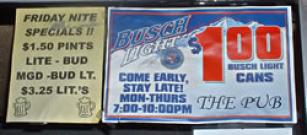
Drink specials encourage heavy drinking among all customers, some of whom may be underage. Credit: David Corbett
Alcohol outlets and advertisers team up to provide an additional incentive for underage drinking: price promotions and drink specials. In general, lower prices result in higher consumption levels across all age levels.24 Price promotions offer discounts for high-volume purchases, such as kegs and cases of beer. College campuses near retailers that sell large volumes of low-price alcohol have higher rates of binge drinking than those campuses near outlets that do not sell discount alcohol.25
Many bars and restaurants have discount prices (e.g., during happy hour) and drink specials (e.g., two for one, ladies drink free) that encourage heavy drinking among all customers, some of whom may be underage.
Many high school and college students say that they attend parties or go out drinking because "there is nothing else to do." Like older adults, adolescents and young adults enjoy socializing and need a variety of avenues to interact with peers, make new friends, and pursue romantic relationships. In the absence of alcohol-free places to socialize, young people go to parties where alcohol is present, and may succumb to peer pressure to drink.
How Underage Drinkers Obtain Alcohol
Underage drinkers obtain alcohol from two main sources: third parties, such as legal-age friends, siblings, and strangers; and commercial outlets, such as stores, bars, and restaurants (often by using a fake ID).26
Home is the primary source of alcohol among the youngest drinkers.27 Some youth take alcohol from their parents' liquor cabinets without their parents' knowledge. Some parents supply their underage children with alcohol at special events such as graduations, weddings, or holiday parties.
Underage drinkers sometimes ask strangers to buy alcohol for them, often in exchange for a fee or a portion of the alcohol purchased. This practice is called "shoulder tapping"—underage youth wait outside a store and tap a stranger on the shoulder to make the request.28
Most underage drinkers report it is "very easy" to obtain alcohol; about one in four underage college students report that they can buy alcohol without age verification, or with a fake ID.29 Studies of alcohol purchases across the country reveal that, depending on the location and the environmental context, 40 to 90 percent of retail outlets have sold alcohol to underage buyers.30
In some cases, retailers do not ask for ID. In others, underage drinkers present an ID card that has been altered to indicate they are of legal drinking age, or an ID card that belongs to someone who is of legal drinking age. The underage drinker may resemble the person in the photograph, or may substitute his or her own picture and relaminate the card. People can purchase fake IDs on the Internet, buy them directly from counterfeiters, or use fraudulent documents to get a driver's license. Recent advancements in technology have made the counterfeiting of state-issued ID cards easier, using a scanner and a color printer.31 Use of fake IDs is more common in urban areas and in states without consistent enforcement of underage purchase laws.32 Furthermore, young people are more likely to obtain and use a fake ID if they think their peers support the practice.33
Where Underage Drinking Occurs
Underage people drink at a variety of locations, including the following:
- Parties in private residences. Large numbers of young people may gather in a home, often while the parents are away, or in a college student's off-campus residence. Parties in residential areas often generate complaints from neighbors who are disturbed by noise, improper parking, property damage, and littering. Such parties are of particular concern to police because they often include large numbers of underage drinkers and large quantities of alcohol. If the hosts charge an entry fee, they are essentially selling alcohol without a license, often to guests who are not of legal drinking age. House parties are popular among both high school and college students, as well as underage nonstudents. College students who live off campus are more likely to attend house parties than those who live on campus, and underage drinkers are more likely to gain access to alcohol at house parties than in bars or restaurants.34
- Parties at outdoor venues such as beaches, parks, fields, or parking lots. The remoteness of these locations may reduce the chances that residents will be bothered, but also usually means that partygoers will have to drive home after drinking. These parties, like those in private residences, rarely provide nonalcoholic beverages or food to mitigate alcohol's intoxicating effects.
- College campuses. Many colleges and universities have on-campus bars and pubs, and social and athletic events at which alcohol sales are permitted. Of particular note is the high rate of underage and binge drinking that occurs at fraternity houses. Over the years, fraternity membership has become closely associated with heavy drinking, as part of social events, pledging, and initiations.35 Most students who join fraternities expect that alcohol will be central to their experience, despite the fact that most are underage.36 The high levels of drinking associated with fraternities are hazardous not only to members, but also to the large number of underage college or high school guests who regularly attend fraternity parties. Breaking up these parties and identifying the responsible adult can be particularly difficult for police.37
- Bars and restaurants. Older underage drinkers are more likely to drink in bars and restaurants.38 Their close proximity to campus and advertised drink promotions make these venues an attractive choice for off-campus underage drinking. Many colleges have out-of-state students, requiring doormen or bartenders to judge the authenticity of driver's licenses with which they might not be familiar.
- Special events. Many colleges and communities have special events that seem to encourage widespread, heavy drinking, such as homecoming, graduation, pre- or post-semester parties, Halloween, Mardi Gras, and athletic events. Partly due to the large number of people present, and the failure of event planners to create specific "over 21 only" areas, underage people may have little difficulty getting alcohol through third-party purchases and drinking it unnoticed. In some cases, supervising adults both expect and tolerate underage drinking.
Spring break is a college ritual associated with excessive drinking and other high-risk, extreme behavior. One study of students visiting a Florida beach community during spring break found that 75 percent of the males reported being intoxicated at least once per day, while 40 percent of females reported the same.39 More than 50 percent of the men and more than 40 percent of the women reported drinking until they got sick or until they passed out at least once during the weeklong period. Given that people usually vomit when their body's blood alcohol content (BAC) reaches approximately 0.16, and lose consciousness at a BAC of approximately 0.30, it is clear that many students on spring break are drinking at unsafe levels.40
In addition, high school and college students often play any of hundreds of drinking games.41 These games encourage heavy drinking, and the resulting inability to follow game rules leads to even more drinking.


Free Bound Copies of the Problem Guides
You may order free bound copies in any of three ways:
Online: Department of Justice COPS Response Center
Email: askCopsRC@usdoj.gov
Phone: 800-421-6770 or 202-307-1480
Allow several days for delivery.
Email sent. Thank you.
Underage Drinking
Send an e-mail with a link to this guide.
* required
Error sending email. Please review your enteries below.
- To *
Separate multiple addresses with commas (,)
- Your Name *
- Your E-mail *
Copy me
- Note: (200 character limit; no HTML)
Please limit your note to 200 characters.