

Center for Problem-Oriented Policing
Recommended Readings
Background Reading on POP and Its Implementation
Problem-Oriented Policing: Successful Case Studies

by Michael S. Scott and Ronald V. Clarke (eds.) (Routledge, 2020)
This book explores a wide range of problems that fall under five general categories: gang violence; violence against women; vulnerable people; disorderly places; and theft, robbery, and burglary. The case studies tell stories of how police, in collaboration with others, successfully tackled real-world policing problems fairly and effectively.
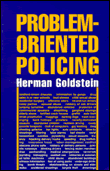
Problem-Oriented Policing
by Herman Goldstein (McGraw-Hill, 1990, and Temple University Press, 1990)
Explains the principles and methods of problem-oriented policing, provides examples of it in practice, and discusses how a police agency can implement the concept.
View table of contents, authors preface and introductory chapter
On Problem-Oriented Policing: The Stockholm Lecture
by Herman Goldstein (Crime Science, 2018)
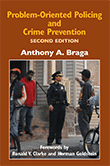
Problem-Oriented Policing and Crime Prevention, 2nd Edition
by Anthony A. Braga (2008). Monsey, NY: Criminal Justice Press
This book provides a thorough review of significant policing research, with a focus on the applicability of those findings to problem-oriented policing. The three parts of the problem analysis triangle are addressed separately, with one chapter concerning problem places, another high-activity offenders, and a third repeat victims. The issue of how police departments can facilitate problem-oriented policing is explored in a chapter that discusses improving crime analysis, measuring performance, and securing productive partnerships.
Not Rocket Science? Problem-Solving and Crime Reduction
by Tim Read and Nick Tilley (Home Office Crime Reduction Research Series, 2000)
Identifies and describes the factors that make problem-solving effective or ineffective as it is being practiced in police forces in England and Wales.
Problem-Oriented Policing: Reflections on the First 20 Years
by Michael S. Scott (U.S. Department of Justice, Office of Community Oriented Policing Services, 2000)
Describes how the most critical elements of Herman Goldstein's problem-oriented policing model have developed in practice over its 20-year history, and proposes future directions for problem-oriented policing.
- Summary only PDF
- Full report PDF
Improving Policing: A Problem-Oriented Approach
by Herman Goldstein. Crime & Delinquency 1979 25: 236-258
If the police are to realize a greater return on the investment made in improving their operations, and if they are to mature as a profession, they must concern them selves more directly with the end product of their efforts.
 Problem-Solving: Problem-Oriented Policing in Newport News
by John E. Eck and William Spelman (Police Executive Research Forum, 1987)
Explains the rationale behind problem-oriented policing and the problem-solving process, and provides examples of effective problem-solving in one agency.
Problem Analysis in Policing
By Rachel Boba, PhD, Director, Crime Mapping Laboratory, Police Foundation (March 2003)
This report introduces and defines problem analysis and provides guidance on how problem analysis can be integrated and institutionalized into modern policing practices.
Problem-Oriented Policing and the Potential Contribution of Criminology
By Ronald V. Clarke. U.S. Dept. of Justice, award number: 95-IJ-CX-0021(June 2002)
This report examines the similarities and differences between situational crime prevention and problem-oriented policing, and clarifies the distinction between community policing and problem oriented policing.
Tackling Crime and Other Public-Safety Problems: Case Studies in Problem-Solving
by Rana Sampson and Michael S. Scott (U.S. Department of Justice, Office of Community Oriented Policing Services, 2000)
Presents case studies of effective police problem-solving of 18 types of crime and disorder problems.