
Responses to the Problem of Prescription Drug Fraud and Misuse
Your analysis of your local prescription fraud and misuse problem should give you a better understanding of the factors contributing to it. Once you have analyzed your local problem and established a baseline for measuring effectiveness, you should consider possible responses to address the problem.
The following response strategies provide a foundation of ideas for addressing your particular prescription fraud and misuse problem. These strategies are drawn from a variety of research studies and police experiences. Several of these strategies may apply to your community's problem.
It is critical that you tailor responses to local and state circumstances, and that you can justify each response based on reliable analysis. In most cases, an effective strategy will involve implementing several different responses. Law enforcement responses alone are seldom effective in reducing or solving the problem.
Do not limit yourself to considering what police can do: carefully consider others in your community who share responsibility for the problem and can help police better respond to it. In some cases the responsibility of responding may need to be shifted toward those who have the capacity to implement more effective responses. For more detailed information on shifting and sharing responsibility, see Response Guide No. 3, Shifting and Sharing Responsibility for Public Safety Problems.
For further information on managing the implementation of response strategies, see Problem-Solving Tools Guide No. 7, Implementing Responses to Problems.
Unfortunately, there is limited information about the effectiveness of many of the strategies presented below because few of the strategies have been evaluated. The government has provided some funding to police to reduce prescription fraud, but to date there have been no national evaluations of task force or state and local police efforts to combat this problem. Although the government has funded state prescription monitoring programs and general awareness campaigns, with the exception of Utah's educational campaign as part of their Prescription Pain Medication Program, only prescription monitoring programs have been empirically evaluated.62
General Requirements for an Effective Strategy
Police have a limited role in changing the fact that some people will find a way to misuse and become addicted to prescription drugs, but you can use various strategies, in concert with other stakeholders, to reduce and prevent prescription fraud and misuse in your jurisdiction.
Because the prescription fraud and misuse problem crosses several disciplines, addressing it must be a coordinated effort at all stages. The stakeholders described in the previous section are among the most critical in controlling prescription fraud and misuse. Sharing information among agencies about prescription drug use implicates healthcare privacy, so stakeholders should be aware of the federal Health Insurance Portability and Accountability Act (HIPAA) and comparable state laws.†
- Law enforcement agencies may perform a number of roles. Many states and local jurisdictions have specialized personnel, units, or task forces to implement prescription fraud prevention strategies. Although there has been an increase in knowledge among specialized groups, most police officers still need specialized training on: controlled and non-controlled substances and the drug scheduling system that pharmacists use; state criminal laws and pharmacy regulations; types of forged and altered prescriptions; typical diversion tactics; and prescription fraud prevention techniques. You should also educate prescribers about the various prescription fraud tactics and the extent of your local problem. The National Association of Drug Diversion Investigators has a variety of resources for police.
- Healthcare providers should register with their prescription drug monitoring program (PMP) and consult it as part of their practice; prescribe medication only when necessary and only in amounts necessary; give instructions on returning leftover medications; identify misuse and addiction; and provide resources to help patients handle addiction problems. They also should report all thefts of prescription pads to police and local pharmacies. Moreover, they should advise patients of the dangers of procuring prescription medications through the Internet, which can lead to misuse and addiction.‡
- Pharmacists should provide clear information to users about how to take their prescribed drug; give instructions about safe disposal and return of leftover medications; be able to recognize fraudulent prescriptions; inform police about problem people and prescriptions; and follow through with investigations and court proceedings. In an informational brochure for pharmacists, the DEA recommends using common sense, sound professional practice, and proper dispensing procedures and controls (see text box). Others have also created guidelines to help pharmacists recognize misuse and fraud.63
- Parents and educators have a key role in educating children on the dangers of prescription drug use. Given the increasing prevalence of youth abusing prescription drugs and the fact that many youth obtain drugs through friends and family members, parents also need to secure their legally prescribed drugs. Teachers can also convey these messages, as can police, who can visit the schools and underscore the fact that prescription drug misuse is illegal and dangerous.§
† Some guidance on HIPAA can be found at the U.S. Department of Health & Human Services, Office for Civil Rights website.
‡ The U.S. Substance Abuse and Mental Health Services Administration (2009) created an informational brochure for healthcare practitioners that gives specific guidance and outlines the responsibilities for preventing prescription drug abuse and diversion. Canada's Ministry of Health produced an Abuse and Diversion Guide. Although some aspects are unique to Canadian laws, there is a variety of material applicable to any health professional.
§ The U.S. Substance Abuse and Mental Health Services Administration (2009) produced a brochure designed to educate students about the dangers of prescription drug misuse. PEERx is a National Institute on Drug Abuse website for teens that may be used as part of comprehensive efforts. A number of local efforts have also produced videos to educate youth about the harms and consequences of prescription drug misuse: two examples are the Reno (Nevada) Police Department (2010) and the Middlesex County, Massachusetts, District Attorney (2004).
States are responsible for enacting laws that govern the prescribing and dispensing of prescription drugs, licensing drug prescribers, investigating complaints, and imposing sanctions for violations of state medical practice laws. States also regulate pharmacy practice and license pharmacists and pharmacies, ensure compliance with state and federal laws, and require the maintenance of prescription records.
A number of local, state, and federal efforts to discuss the problem of prescription fraud and misuse, make recommendations, and create plans have emerged over the last decade. These include: the Orange County, California, Health Care Agency study (2009); the California State Task Force on Prescription Drug Misuse (2009), the Ohio Prescription Drug Abuse Task Force (2010); the Massachusetts OxyContin and Other Drug Abuse Commission (2006); and the National Center on Addiction and Substance Abuse study (2005). In 2011, the Executive Office of the President issued a Prescription Drug Abuse Prevention Plan to reduce prescription drug misuse through education, monitoring, proper disposal, and enforcement. Many of these plans and recommendations have excellent ideas, but very little documentation exists on their implementation and effectiveness.
Fraudulent Prescription Prevention Techniques64
1. Know the prescriber and his or her signature.2. Know the prescriber's Drug Enforcement Agency (DEA) number.
3. Know the patient (or get a profile if you do not).
4. Check the date on the prescription. Ensure it has been presented within a reasonable time.
5. Telephone the prescriber for verification or clarification if you have any questions. The patient should give a plausible reason for any discrepancy before you dispense the drug.
6. If you are in doubt, request proper identification; doing so increases an offender's risk of getting caught.
7. If you believe a prescription is forged or altered, do not dispense it—call the local police.
8. If you believe that you have discovered a pattern of prescription misuses, contact the state pharmacy board or the DEA.
Specific Responses to Prescription Drug Fraud and Misuse
Increasing the Risk of Detection
1. Informing doctors and pharmacists of and about fraudulent activity. Many police agencies, task forces, and pharmacy associations deem it effective to share information on prescription fraud scams and offenders through bulletins and mass communication. If prospective scam targets (e.g., the emergency room doctor who is about to be the third person in one day to see John Doe about his bad back, or the pharmacist who does not know about the stolen prescription pad) are informed, the offender's risk of being detected greatly increases.‡ See Response Guide No. 5, Crime Prevention Publicity Campaigns, for further information.
In 2000, the Community Antidrug Coalitions of America developed and distributed prescription drug misuse messages, materials, and methods to better educate the public, education departments, healthcare providers, and community-based organizations.§ The FDA and SAMHSA launched a prescription misuse prevention education effort in 2003. More recently, there were two statewide efforts: in 2008, Utah launched "Use Only as Directed," which targeted prescription overdose deaths, and, in 2010, Ohio created "Prescription for Prevention: Stop the Epidemic."§ Coalition organizations included the American Pharmaceutical Association, Pharmaceutical Research and Manufacturers of America, American Academy of Family Physicians, AARP, National Council on Patient Information and Education, National Community Pharmacists Association, and National Chain Drug Store Association.
Campaigns such as these let offenders know that police and the health field are paying attention and that they are at risk of being detected. In addition, such campaigns can help enlist offenders' friends and relatives to provide informal guardianship by better detecting suspicious activity and providing help before the problem escalates.
Although a few of the larger pharmaceutical companies have recently partnered with police to curtail prescription fraud and misuse, it is most important that they continue to educate people about taking drugs safely under a doctor's care.†
† For example, Purdue Pharma (the maker of OxyContin) has sponsored meetings with DEA and FDA officials, hired police officers to educate company personnel and serve as liaisons, and analyzed demographic data about geographic areas of abuse to help predict where the next problem will be and focus their efforts accordingly. Through informational forums, Abbott Laboratories (the maker of Vicodin) instructs prescribers and pharmacists about the potential for Vicodin abuse.
Purdue Pharma's 10-Point Plan to Reduce Prescription Drug Abuse and Diversion
1. Educate healthcare professionals about the problem.2. Create tamper-resistant prescription pads.
3. Implement programs such as Painfully Obvious, a prescription drug abuse awareness and education initiative for middle and high school students.
4. Provide opioid therapy documentation kits to physicians for pain assessment.
5. Distribute educational brochures about the problem.
6. Implement prescription monitoring programs.
7. Establish educational programs with the law enforcement community.
8. Conduct research on abuse, diversion, and addiction.
9. Work with the DEA to curtain cross-border smuggling.
10. Develop abuse-resistant drugs.
Source: Eworldwire.com.
Increasing the Effort Required to Commit Prescription Drug Fraud
4. Verifying prescriptions. Pharmacists should try to verify every prescription. This includes making callbacks on all phoned-in prescriptions and checking doctors' names, phone numbers, and DEA numbers. They should also keep a file of doctors in their jurisdiction, with contact information and signatures. Finally, if they cannot immediately verify a prescription, they should dispense only 24 hours' worth of medication, until they are able to make the verification.
5. Employing security measures. Health profession stakeholders can use several strategies to control prescription fraud, including the following:
5a. Using tamper-resistant prescription pads. Such pads should include some or all of the following features: serial numbers, prescriber information, watermarks, intricate lines, and/or heat- or light-sensitive messages. Each feature increases the effort needed to copy or alter a prescription. Several states have found secure prescription forms to be an effective deterrent to prescription forgery and counterfeiting.66 New York State estimated a $75 million annual savings on private sector insurance fraud with the implementation of secure forms.67
5b.Increasing precautions taken by the practitioner's receptionist and answering service. One practice is to use a security code to prevent people from impersonating the practitioner in an attempt to fraudulently authorize a new prescription or refill. Another is to refrain from sharing the practitioner's DEA number to unauthorized or non-verified persons or entities (e.g., someone claiming to be calling from an insurance company).
5c.Checking photo identification. Pharmacists should ask for photo identification to verify that people are who they say they are and that names match those on prescriptions.† Oftentimes, offenders use an alias or have someone claiming to be a friend or relative pick up prescriptions.
5d. Keeping prescription pads in a secure place. The U.K. Department of Health issued a publication outlining measures to secure prescription forms.68 The measures include maintaining a record of forms received, keeping a minimum supply of forms in the office and securely storing them, keeping access to a minimum, and reporting lost forms immediately.
† A similar, but as yet unimplemented, strategy is to take a fingerprint for identification purposes. In Pulaski, Virginia, large-pharmacy owners successfully fought a proposed requirement to do so, and, in Arizona, neither proposed statewide legislation to take a fingerprint for Medicaid purposes nor a Peoria municipal ordinance requiring people buying certain drugs to be fingerprinted passed.
6. Prescribing drugs electronically (e-prescribing).With e-prescribing, the prescriber electronically transmits prescriptions directly to the pharmacist via a certified, secure system. This eliminates the problems of phony call-in prescriptions, forged and altered prescriptions, and stolen prescription pads. It also eliminates pharmacist errors due to illegible prescriptions. In addition, the process itself is more accurate, cost-effective, and time-efficient. A project in Denmark showed that both the pharmacist and patient saved time they would have otherwise spent on the telephone and waiting for a callback.69
Electronic prescribing is at different stages of exploration and implementation in the United States and abroad. In the United States, the Medicare Modernization Act included the idea of e-prescribing; although it is optional for physicians and pharmacies, the act provides an incentive program for using it. Private companies have created ePrescribing networks that link physicians and pharmacies across the United States.† In 2010, the DEA published a rule outlining the process for using the e-prescribing system.‡ Prescribers are encouraged to sign up for these programs.
† The largest network, SureScripts, was created by the National Association of Chain Drug Stores and the National Community of Pharmacists Association and then merged with RxHub, which was created by CVS, Medco, and Express Scripts. According to the SureScripts website, they routed nearly one million prescriptions a day.
‡ The details on this rule can be found on the DEA website.
7. Enacting or changing prescription fraud laws. All 50 states and the District of Columbia have implemented laws to more effectively deal with prescription fraud, but only 14 states have a statute specific to doctor shopping.70 Three states (Texas, Florida, and Tennessee) and several local jurisdictions have recently enacted "pill mill" laws. These laws increase the penalty or punishment for prescription fraud, and/or specifically address individual aspects of it, such as going to multiple doctors for similar prescriptions or creating pain clinics for the express purpose of issuing a high volume of prescriptions with little oversight. Such well-defined laws make it easier to prosecute and convict offenders.
8. Promoting safe storage and disposal. A common belief across the police and health communities is that prescription drug abuse can be reduced if the drugs are not easily available to others in the home. This entails securely storing currently used drugs—such as in locked cabinets—as well as disposing of leftover, unused drugs. Nurses, doctors, and pharmacists should all instruct patients on the reason for and methods of safe storage and disposal. The DEA biannually sponsors the National Pharmaceutical Take-Back Day, and the National Association of Drug Diversion Investigators (NADDI) provides a Drug Take Back Toolkit that jurisdictions can use to host their own take-back days. The DEA is also working on the Secure and Responsible Disposal Act to amend the Controlled Substances Act concerning take-back disposal of controlled substances. In addition, several states and local jurisdictions have created programs or guides, such as Safe Medicine Disposal for Maine and Texas' Primer on Conducting Medication Take Back Programs.† In Broward County, Florida, "Operation Medicine Cabinet" involves a partnership between police, United Way, pharmacists, and pharmacy students.71 Operation Medicine Cabinet has been replicated in several other jurisdictions since its inception in 2009.
† The websites for DEA's program, NADDI's resources, and Maine's program provide a wealth of information about conducting safe disposal programs. The DEA notes that 4,000 state and local law enforcement agencies participated in the last two national take-back days, collecting more than 309 tons of pills. Unfortunately, there have been no evaluations to determine if these types of programs have reduced abuse.
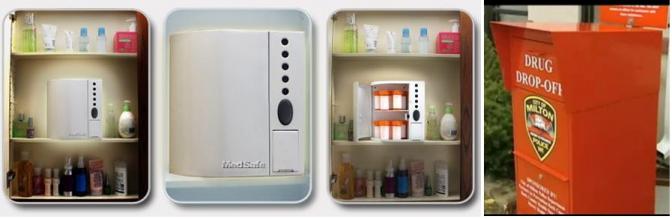
Increasing numbers of police stations are installing prescription drug drop boxes, where community members can safely dispose of unwanted prescription medications. Typically, the drop box is located inside the station, requiring the station to be open and staffed, but some stations place boxes in their outside entryways. Dane County, Wisconsin, has 10 drug drop box locations in police stations with year-round accessibility. Additionally, police in some jurisdictions are working with residents, schools, and community groups to promote and distribute home medicine safes. Officers can promote the use of such safes during calls for service involving prescription drugs, school events, and community meetings.
Figure 5. An example of a home medicine safe and drug drop box
These take-back programs may be seen as similar to the popular, but ineffective,† "gun buy-back" programs of the 1990s. While there are similarities in that people are voluntarily turning in something that may be illegal, with no questions asked, they are different in that no money, vouchers, or goods are being given in exchange. Other possible similarities include that people dispose of their old, uninteresting drugs much in the same way that the majority of firearms turned in are antique and inoperable. Anecdotal evidence from the Reno Police Department suggests that drug take-back programs increased awareness of the dangers of prescription drugs and their potential misuse, but the medicines collected were not high on the list of misused or fraudulently obtained prescription drugs. Regardless, encouraging and facilitating drug disposal should theoretically reduce some share of accidental overdoses and decrease the availability of some dangerous pills to children, teenagers, and burglars who rummage through medicine cabinets.
† See Problem-Specific Guide No. 23, Gun Violence Among Serious Young Offenders, for further information.
9. Maintaining a Prescription Monitoring Program and Cross-State Data Exchange. Prescription Monitoring Programs (PMP) entail varying methods of tracking and monitoring certain prescription drugs. The general goals of the programs are to educate and inform prescribers, pharmacists, and the public about specific prescription drugs; use information for public-health initiatives and for early intervention and prevention; and assist in investigations and enforcement. Underlying this is the need to protect patient confidentiality. Recently, the National Association of Boards of Pharmacy instituted PMP InterConnect, a secure communications exchange platform through which PMPs can share data. Although only a handful of states are currently using it, 20 more have agreed to start within a year. There is also a PMP Information Exchange Program (PMIX), funded by the U.S. Bureau of Justice Assistance, which provides an infrastructure and network for states that include data sharing in their legislation.‡ The Office of the National Coordinator for Health Information Technology is currently implementing a series of workgroups to develop guidance and conduct pilot studies on real-time data exchange and integration of PMPs with existing electronic records systems.
‡ More information on PMP InterConnect can be found on the National Association of Boards of Pharmacy website. Sample memoranda of understanding and related guidance can be found on the Alliance of States with Prescription Monitoring Programs website.
As noted in Appendix B, state programs vary regarding the type of monitoring used (almost all are now electronic), the schedule of drugs covered (all cover Schedule II controlled substances, but many do not cover Schedule V), and the type of agency administering them. In addition, every state program decides who may request patient information (it varies across prescribers, pharmacists, police, licensing boards, and patients) and whether its goal is "proactive" (analyzing data to identify patterns and trends) or "reactive" (using the data to investigative questionable prescribers or patients).† The accompanying map in Appendix B depicts each state's status in sharing program information with others.
† According to the National Alliance for Model State Drug Laws (NAMSDL), as of May 2012, 47 states have some provision in their PMP law regarding police access. Ten states require showing probable cause, and 16 states allow access only with a court order. Detailed information by state can be found on the NAMSDL website.
Several studies and publications have addressed how PMPs affect diversion and medical practice, the preliminary findings of which show positive results.72 Although PMPs have shown to be successful in identifying and preventing drug diversion, they still may have some negative impact on medical practice.73 In addition, requirements regarding usage of and awareness of PMPs vary widely by state and by type of doctor.74 Although states mandate that pharmacies use PMPs, they do not necessarily require physicians to use them. One study of Ohio physicians concluded that medical specialty drove awareness and use of PMP data.75
An extensive study of Maine's PMP found that prescribers have used PMP data to confirm doctor shopping, and make referrals for substance abuse. It also found that "a chilling effect has not occurred."76 Michigan found that its electronic system reduced handling time and did not increase cost,77 and a satisfaction survey conducted in Kentucky revealed that "nearly 90 percent of prescribers have used a Kentucky All Schedule Prescription Electronic Reporting (KASPER) report to help with the decision to deny medication to patients" and 94 percent of police strongly or somewhat agree that KASPER is an effective tool for obtaining evidence in the investigative process.78
Although some PMP and licensing boards are either unwilling or legally restricted from sharing data on habitual-offending patterns (both of patients and health professionals), police might nonetheless encourage those boards to conduct their own analyses to identify potential abusers. Alternatively, the boards might allow police to analyze data with the identifying information removed: police could then just report back that pharmacist X or doctor Y is suspicious and merits closer scrutiny. In order for PMPs' promise to be fully known, it is imperative that physicians use the data to make prescribing decisions.‡
‡ The state of New York is proposing mandatory use of the PMP by physicians as part of a comprehensive package of legislation to address the prescription drug abuse and diversion epidemic. Details of this proposal can be found on the website of the New York State Office of the Attorney General.
Addressing Prescription Drug Abuse in Reno, Nevada†
In spring 2009, the Reno Police Department was contacted by Join Together Northern Nevada (a non-profit substance abuse coalition) and asked to meet with the parents of a teenager who had died of a methadone overdose. After that meeting, Reno police decided to design a multi-faceted prevention plan, applying for and receiving funding through the U.S. Department of Justice Bureau of Justice Assistance's Smart Policing Initiative, to do so.
The program's goal since January 2010 has been to reduce the abuse of prescription drugs, especially among youth by 1) decreasing the availability of prescription drugs; 2) educating healthcare professionals and the public about prescription abuse and diversion; and 3) enforcing prescription fraud and diversion laws. In addition to Join Together Northern Nevada, other partners include Truckee Meadows Water Authority and Waste Management, Retail Association of Nevada, pharmacy retailers, the State Boards of Pharmacy and Medical Examiners, and the Washoe County School District.
The project team's strategies include "Drug Round Up" events; distributing MedSafe locking medicine cabinets; educating the public with a pharmacy bag sticker campaign; training healthcare professionals and patrol officers; educating middle school and high school students using a tailor-made video; and targeting prescription fraud investigations and enforcement. In addition, the team has met with the Pharmacy Board about collecting and analyzing data from the state's PMP.
To date, surveys were completed for the training and teen video distribution, and an outside researcher is currently evaluating all aspects of the program.
† This information is based on e-mail correspondence with Reno Police Department personnel during August 2011, as well as from a presentation at the Problem-Oriented Policing Conference in October 2011. For further information on the Reno initiative, see the BJA Strategies for Police Innovation website.
Reducing Rewards to Offenders
10. Curbing distribution. Specific efforts have been made to limit the dosage or distribution of a particular drug in a target population or region. For instance, Florida and four other states limit OxyContin prescriptions to 120 pills per month per patient.79 Besides dosage, the number of refills could be limited. When prescribers do not specify a refill number, patients can illegally add one. Another method is to limit distribution via a specialized dispensing machine. One example is the "Automated Dispensing System" which is provided by pharmacies to long-term care facilities in several states.80 These types of electronic pill dispensers also allow physicians to monitor usage.
11. Re-formulating drugs. Several drug manufacturers have altered their drug formulation in order to reduce the potential for misuse. Two ways of creating misuse-deterrent formulations are via a pharmacological barrier or a physical barrier. Examples of this include Purdue Pharma's re-formulation of OxyContin, which, when crushed, can no longer be inhaled or put in a syringe, and Alpharma's Embeda®, which contains naltrexone that passes through the gastrointestinal tract if used properly, but if chewed or crushed, releases and blocks euphoria caused by the opioid. AcelRx Pharmaceuticals is working on a drug that retains its dose even when crushed.
Removing Excuses
12. Facilitating compliance with the law. There are currently three main approaches to facilitating drug offenders' compliance with the law: drug treatment/rehabilitation, Narcotics Anonymous, and Drug Court.† Although all have been evaluated extensively, none has been evaluated specifically for prescription fraud offenders, and only one study targeted pharmaceutical misusers.81 Yet a recent multi-site evaluation revealed that Drug Court (in conjunction with Narcotics Anonymous, attendance of which is a requirement) has a significant and cost-beneficial impact on substance abuse and crime.82 One distinct advantage of Drug Court over jail is that, upon successful completion, the charges are expunged from the offender's record. This is especially important to first-time offenders who do not want a black mark on their records. Because of the high number of prescription fraud offenders who are professionals (many in the healthcare field), police investigators believe this is an important factor in an effective response. Similar to the Drug Court concept is Nevada's Pre-Criminal Intervention Program where an intervention officer from the Board of Pharmacy works with prescription drug users who have a high potential for misuse and fraud. Candidates are identified through PMP data and doctor-shopping criteria. A study of the program showed a large reduction in the average number of prescribers, dispensers, and prescriptions filled.83
† Additional information about Drug Court is available from the National Association of Drug Court Professionals and from the Center for Court Innovation.
Responses with Limited Effectiveness
Because many of the responses discussed here have not been evaluated, it is difficult to determine which ones have limited effectiveness. It is possible that the existing state monitoring systems, although effective, would be even more so if all states had such programs and the databases were nationally linked. Some progress in linking PMPs has been made through a pilot project called PMIX.84, †
† In response to a survey of all 32 states with PMPs, 64 percent reported they would like a hub to screen requests. Review of data in Kentucky, Maine, and Massachusetts revealed that prescriptions collected in those states had originated in all 50 states, the District of Columbia, and the U.S. territories. A pilot collaboration between California and Nevada is producing guidelines and lessons learned.
13. Conducting enforcement crackdowns. Enforcement crackdowns usually yield an immediate but limited impact and often do not produce long-term results. A police or medical-board crackdown on a specific doctor, pain clinic, or pharmacy prone to prescription fraud and misuse may put that doctor, pain clinic, or pharmacy out of commission, but prescription drug misusers will simply move on to the next doctor or pharmacy that does not have sufficient prevention measures in place. Given the inadequate amount of resources devoted to crackdowns on prescription fraud, the practice cannot be sustained as a means to prevent or reduce the problem.‡
‡ See Response Guide No. 1, The Benefits and Consequences of Police Crackdowns, for further information.
14. Creating a pharmacy-based prescription database. Many pharmacies maintain a database of their customers. These "patient profiles" track previous prescriptions filled and provide information that aids in filling current ones. Although a pharmacist may note a customer's repeat prescriptions at his or her pharmacy, the customer's attempts to get prescriptions filled at other pharmacies go undetected. Only a limited number of chain pharmacies share a common database, and we are not aware of any database shared among all pharmacies in a jurisdiction for the purpose of preventing prescription fraud.§ Detecting a customer who is getting a high number of prescriptions filled at multiple pharmacies in one city is much more efficient through a jurisdiction-wide prescription database. The Internet would be an easy means to share such information.
§ Some Canadian provinces have some form of a pharmacy network. Most of these connect pharmacies to provincial drug programs; four have systems that provide complete drug profiles to pharmacists; and some are connected to hospitals and physician offices.
15. Monitoring Internet sites.There is still some question about the amount of fraud occurring through Internet sites. With that said, some Internet sites may have lax requirements regarding purchasers' proof of prescriptions, and others may require no prescription at all. Many of these sites operate outside of the United States and require an international drug policy and regulatory response.85


Free Bound Copies of the Problem Guides
You may order free bound copies in any of three ways:
Online: Department of Justice COPS Response Center
Email: askCopsRC@usdoj.gov
Phone: 800-421-6770 or 202-307-1480
Allow several days for delivery.
Email sent. Thank you.
Prescription Fraud
Send an e-mail with a link to this guide.
* required
Error sending email. Please review your enteries below.
- To *
Separate multiple addresses with commas (,)
- Your Name *
- Your E-mail *
Copy me
- Note: (200 character limit; no HTML)
Please limit your note to 200 characters.