

Center for Problem-Oriented Policing


Responses to the Problem of Juvenile Runaways
Your analysis of your local problem should give you a better understanding of the factors contributing to it. Once you have analyzed your local problem and established a baseline for measuring effectiveness, you should consider possible responses to address that problem.
The following response strategies provide a foundation of ideas for addressing your particular problem. These strategies are drawn from a variety of research studies and police reports. Several of these strategies may apply to your community’s problems. It is critical that you tailor responses to local circumstances and that you can justify each response based on reliable analysis. In most cases, an effective strategy will involve implementing several different responses. Law enforcement responses alone are seldom effective in reducing or solving the problem. Do not limit yourself to considering what police can do: Carefully consider whether others in your community share responsibility for helping to deal with the problem and can help police better respond to it.
General considerations for an effective response strategy
Although more likely to focus on minimizing the harms that come to or are caused by runaway youth while they are absent from home, police can also be effective advocates in efforts to address the reasons young people run away (e.g., physical and sexual abuse) and to improve the quality of services designed to respond to them upon their return (e.g., family mediation and preservation). Most researchers and practitioners agree that social service providers, rather than police, are the best suited to addressing this problem. Therefore, part of the police response may be to enlist other agencies better equipped to render services to runaways and their families.*
* Refer to Response Guide No. 3, Shifting and Sharing Responsibility for Public Safety Problems, for more information.
That said, police have a legitimate role in locating young people reported missing and in ensuring runaways’ safety when they spend time on the street.63 Police receive missing persons reports from parents, foster care providers, and group home staff. Further, their 24-hour street presence means they are the officials most likely to encounter runaways, whether reported missing or not. Police should partner with other agencies to address the problem effectively, and a variety of agency-level responses will be required.
1. Appointing a local runaway coordinator. Given the overlap in responsibility between the police department and social service providers, some state, local, and tribal jurisdictions have found it helpful to appoint a runaway coordinator. The coordinator convenes interagency meetings, plans and coordinates services, manages service delivery contracts, and monitors outcomes. Although they may or may not craft formal interagency protocols, the coordinators build bridges for these agreements to evolve. The Lancashire (United Kingdom) Constabulary assigned police constables as liaisons to each juvenile care facility to address chronic and repeat runaway problems.64
2. Collaborating with social service agencies. Although police may locate and secure the return of juveniles who have run away, collaborating with other agencies can reduce the amount of police time spent on runaways and can ensure young people receive appropriate services. A framework should be developed for each agency’s response to reported runaway episodes, along with procedures for assisting runaways who are identified through other means. Such collaborations have helped jurisdictions comply with federal guidelines regarding the secure detention of those who commit status offenses. Involving social service agencies in returning runaways to their homes or placements can also defuse potentially volatile domestic situations.
These agreements should be formalized into memoranda of understanding between police and social service agencies. In addition to specific protocols for transporting youth and providing services, these agreements can also create specific protections for confidentiality and privacy, when appropriate. Special consideration should be given to minimizing the length of time it takes for police to transfer custody of the runaway youth to social workers. Formalizing these agreements will also promote sustainability so the interagency relationships and protocols are not dependent on the individuals who created them.
3. Developing joint protocols with foster care providers and group homes. Those providing substitute care are sometimes quick to contact police when young people have not returned to the facility by a specified time. Many times, young people are simply late rather than missing. Further, staff may not assess young people’s level of risk before identifying the event as an emergency. To avoid overwhelming police resources, some jurisdictions use protocols specifying a threshold for police contact when young people do not return to the facility as expected (e.g., call police only after midnight, only when young people have left the center without permission, or only after staff have failed to locate them). The protocol should categorize the various types of absences and state required procedures for each situation.65 The circumstances surrounding the absences should be monitored and recategorized as necessary. Enacted in 2014, the Preventing Sex Trafficking and Strengthening Families Act mandates that state agencies “report immediately, and in no case later than 24 hours” information about each missing or abducted child both to law enforcement and to the National Center for Missing and Exploited Children (NCMEC).66
Linking foster care providers and group home staff with community police officers also has benefits:67
Police get to know the young people informally and may have more leverage in encouraging them to stay in their placement.
Police develop a greater appreciation for the types of issues young people and staff face.
Police respond to requests for assistance more consistently and follow up more meaningfully.
4. Cross-training staff from multiple agencies. Impacting the trajectory of what caused a youth to run away—the triggers, the departure, the potential risks, and the return—will involve coordinated interaction between police and social service providers. This interaction should rest on mutual understanding and respect for each agency’s objectives and core philosophy. Multidisciplinary training sessions help staff understand the complexity of the issue and the need for a partnership to address it. Training topics should include the following:68
Reasons why young people may run away from home and substitute care
Police investigative techniques and available tools
Child abuse reporting laws
Policies surrounding confidentiality
Situations when secure detention may be required to protect the young people from harm
Juvenile-centered treatment philosophy and advocacy
Locally available resources and services
Procedures for interagency communication
5. Sharing information. Agencies must share relevant information about the young people, their precipitating factors for running away, and their associates and companions for an effective response. Interagency agreements should specify the types of information needed to ensure the safety of young people who have run away and should develop procedures for efficient interagency communication. These interagency agreements can be difficult to negotiate when agency partners have different confidentiality standards.
Parents are important partners in information sharing. They have the right to access information that agency staff may not be able to obtain. Some jurisdictions obtain parents’ written consent to access records from schools, social services, and other agencies.*
* Takas and Bass (1996) provide a sample parental consent form that features clear, simple language and specifies the types of records police may use. Police should work with local agencies to ensure the form meets their requirements for accessing information. Guidelines for approaching agency staff to request information are also provided.
6. Assessing risk. If the primary role of police is to reduce the harm that comes to or is caused by runaways, they need a reliable way to assess the risks facing young people who are absent from home or substitute care. Cases should not be classified solely by age or where the young person stays but rather by a set of locally defined conditions that, when met, will trigger a priority police response. Common risk factors include the following:
Aged 13 or younger. Children ages 13 and younger have less sophisticated decision- making skills and cannot protect themselves from exploitation by older teenagers or adults.69
Out of safety zone. This zone will vary depending on the young people’s characteristics. Youth with cognitive impairments may have difficulty communicating their needs and providing information required to access help; they are particularly at risk of exploitation.
Alcohol or drug dependent. Substance use compromises judgment and the ability to protect oneself from harm.
At risk of foul play or sexual exploitation. The risk level will depend on the types of illegal activity occurring in the community, where the young people are believed to be staying, and the young people’s past experiences and maturity level.
Believed to be in life-threatening situation. This assessment will vary depending on the places the young people frequent and their experiences during past runaway episodes.
Absent more than 24 hours before reported to police. A delay in reporting may indicate parental neglect but could simply be a misunderstanding of the law. Many parents believe missing persons reports require a waiting period.
In the company of dangerous companions. Some young people stay with adults who may exploit their vulnerability; others associate with peers who use drugs or are involved in criminal activity.
Inconsistent with normal behavior patterns. An out-of-character departure may signal acute distress or the possibility of foul play.
Classifying runaways accordingly enables police to focus their resources on those young people at highest risk of being harmed and those most likely to commit crime while absent from home or care. Agreement from local partners about the types of cases to which police will dedicate resources also helps to promote a positive police image.
7. Encouraging prompt reporting of runaways. Because the chances of locating a runaway and keeping them safe from harm declines with the passing of time, police agencies should actively encourage caretakers to promptly report runaways to police. The public service message should emphasize the following:
There is no mandatory waiting period before reporting a missing person.
Running away is not a criminal offense for which the young person will be punished.
Police and other organizations can and will assist in locating and protecting runaways.
Running away can put the young person at risk of serious harm.
8. Developing Tribal Community Response Plans (TCRP). To create a TCRP, the tribe will first need to plan the drafting process. A U.S. Department of Justice– issued guidance document, Guide to Developing a Tribal Community Response Plan for Missing Person Cases (https://www.justice.gov/tribal/mmip/tribal-community-response-plans), will give you steps to consider in drafting an implementation outline—the roadmap to developing your tribe’s plan. Remember, this is your community’s response plan, and you may choose to follow all, some, or none of the recommendations contained in these guidance documents. This guidance document covers six sections:
Inventory of a Missing Person Policy
Review of the Guidance Documents
Development and Implementation of a Working Group
Procedural Recommendations
Compiling the Final Response Plan
Post-Development Processes.
Prior to or during the development process, it is recommended that you bring together a group of tribal and community leaders, both governmental and nongovernmental, to learn about the response plan process and the four guidance documents:
Developing Law Enforcement Agency Response Guidelines
Developing Victim Services Response Guidelines
Developing Media and Public Communications Response Guidelines
Developing Community Outreach Response Guidelines70
Specific responses to reduce runaway episodes
Before they run
9. Providing prevention materials when responding to calls for service. Analyzing local call-for-service data may reveal that certain families have high levels of parent- child conflict. Responding officers can provide these families with information on conflict resolution strategies and resources for additional parent and youth support.71 Referrals should include parent support services, advice and counseling programs and school-based support for young people, and family preservation and mediation services. The officer who responds to missing persons reports can provide similar information, along with guidance to help parents locate their children. Police efforts to generate awareness can be supplemented by school-based information campaigns designed to reach the larger audience of families whose children may run away but for whom police contact is not initiated.
10. Using respite care. Runaway episodes may be triggered by escalating conflict at home that could be resolved if the family members were temporarily separated. If available, police could transport young people to a respite care facility (e.g., a host home or small respite center).72 During a short stay (a few days to a few weeks), young people and their parents participate in counseling to begin to resolve the source of conflict and prevent future crises. Because of the short length of stay, respite care is considerably more cost effective than placement in other juvenile institutions.73
When they run
11. Using “Missing from Care” forms. When laws* and local protocols dictate that young people’s absences from care be reported to police (see response 3), substitute-care staff can provide police with information designed to help locate the young people and to highlight relevant risk factors. Relevant information includes the following:74
Physical description
Recent photograph
Distinguishing scars, marks, tattoos, or piercings
Date and time last seen
Suspected location, destination, and companions (perhaps from the youth’s social media postings)
Address of family and other known contacts
Pertinent details from previous times they have gone missing
Other relevant risk factors
* Federal law in the United States (42 U.S.C. 671(a)(35)(B)) requires state child welfare agencies to report within 24 hours to law enforcement agencies and to NCMEC a child who has run away from a care facility. You should consult legal counsel for other relevant local, state, and federal laws governing reporting runaways.
12. Enlisting the public in locating runaways. As is the case with all missing persons, advertising that they are missing increases the chances that strangers will see them and notify authorities of their whereabouts. Especially in cases where it is believed the young person has left their home area, creative approaches are needed to extend the advertising more widely. The Washington State Patrol developed a partnership with commercial trucking firms to advertise select missing young people on the sides of trucks, thereby reaching viewers across the nation.75
13. Determining whether absences are voluntary or involuntary. Sometimes it is not clear whether young people’s departures from home or care were voluntary, whether they were abducted, or whether an injury or accident prevented them from returning home when expected. Some departments require police to assume young people are in jeopardy until they can confirm significant facts to the contrary.76 A variety of investigation techniques can be used to determine whether voluntary departures are consistent with children’s behavioral patterns.* This classification allows police to respond to cases with an appropriate level of urgency.
* See Simons and Willie 2000 and Steidel 2000 for detailed discussions of investigation techniques useful for making this determination.
14. Diverting cases to a community-based organization. Following a missing persons report, police can refer parents to a program that provides support during runaway episodes and that negotiates the young people’s return when appropriate. Using contact information provided by police, program staff initiate contact with parents. Twenty- four-hour availability and free services may encourage parents to use the resource.77 Similarly, when runaways are located, police can escort them to the program facility and notify the parents. Program staff receive the young people, await the parents’ arrival, and negotiate the return and follow-up care, allowing police to return to duty.
While they are absent from home or care
15. Referring young people to appropriate social service providers. Police encounter young people who have run away from home or care under many conditions. Those living on the street are at particular risk of harm and should be encouraged to access a variety of services to address their immediate and long-term needs. Outreach efforts should inform young people about the range of available services, which should include the following:
- Short-term shelter programs that provide safe overnight accommodations
- Drop-in services that provide food, clothing, crisis counseling, and medical attention
- Services that help young people contact their parents, if desired
- Counseling services for issues such as pregnancy, substance abuse,78 mental illness, and other special circumstances
- Long-term counseling for family mediation and reunification
- Independent living programs for young people who cannot or do not want to return home
Young people who have run away from home or care often do not trust adults and authority figures and may be easily deterred from seeking the services they need. Therefore, program credibility is essential and can be enhanced by79
- involving young people in the design and operation of programs;
- ensuring staff honor their commitments to young people;
- making young people aware of the risks of running away and challenging them to take greater responsibility for avoiding those risks;
ensuring confidentiality;
avoiding labeling and blaming young people.
16. Implementing specialized patrol. Runaways who spend time on the streets are generally at higher risk than their peers of victimization and criminal involvement. Increasing the visibility of patrol in locations where young people congregate may deter criminal activity and also create an opportunity for police to contact and refer them to services as needed. Specialized runaway units can also handle runaways contacted by other officers who lack the training or resources to intervene effectively.80 Further, specialized officers can coordinate with other units investigating those who seek to exploit runaways.
17. Providing safe locations for young people. Local agencies and businesses (such as fire departments, libraries, community centers, convenience stores, and restaurants) can provide a temporary safe location for runaways who want to escape the street and other dangerous situations. A quiet and secure place to make contact with local services can mitigate the harms young people face while on their own.
18. Using secure placement when appropriate. In a limited number of circumstances, secure placement may be needed to protect young people at immediate risk of serious harm. Suicidal young people or those engaging in high-risk behaviors (e.g., sex work, drug use) may benefit from short-term secure placements until appropriate long-term services can be mobilized. Secure placements can be found in the juvenile justice (e.g., juvenile detention center) and mental health (e.g., hospital) systems and should be extremely time limited.
When or if they return
19. Using transportation aides and free transportation services. Police can conserve valuable time and resources by using civilian volunteers to transport young people to runaway shelters and other services. These resources are most useful when volunteers are on call 24 hours a day and when multiple volunteers located throughout the jurisdiction are on call at any given time.81 A few national airlines and bus companies offer free tickets to runaways from out of state who want to return home but cannot afford to do so.*
* Greyhound’s Home Free program operates in partnership with the National Runaway Safeline. Homeless and runaway youth access the services by calling the toll-free switchboard, where staff coordinate issuing the ticket. See https://www.1800runaway.org/youth-teens/home-free for more information.
20. Referring to aftercare services as needed. Despite the likelihood that family problems triggered the runaway episode, most young people and families do not access any services upon the young people’s return home.82 When police transport runaways home or back to care, active referrals for follow-up services can help to resolve family problems and prevent subsequent runaway episodes. Rather than depending on the families to initiate contact, police can submit families’ names to a local service provider who makes contact with families and offers services.† Parents who receive such contacts often express relief and gratitude for the offer of help.83
† The Alternative Solutions to Running Away (ASTRA) program operates in partnership with Gloucestershire (United Kingdom) Constabulary, who refer families who made missing persons reports to the local program provider. The program’s goal is to reduce the incidence of repeat runaway episodes, which is accomplished by providing confidential, individual support to young people upon their return home and creating an action plan to help resolve the underlying problems (Great Britain, Office of the Deputy Prime Minister 2002).
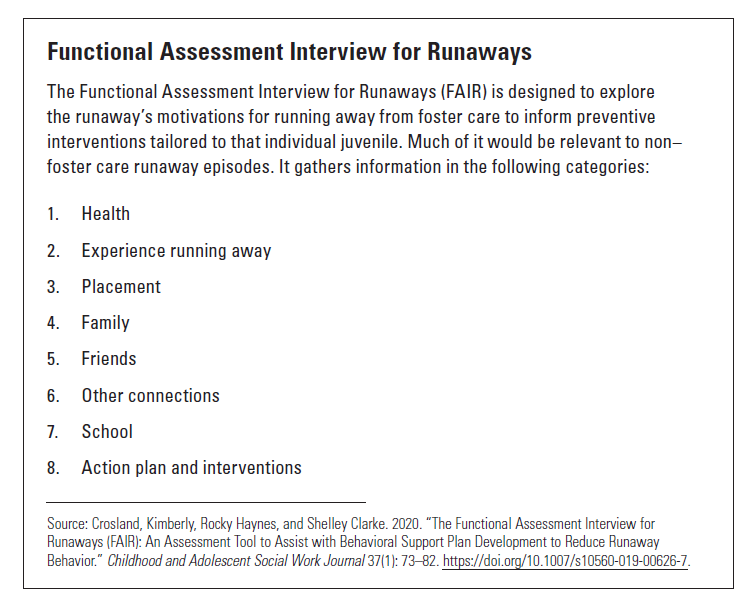
21. Interviewing juveniles upon return. Interviews with runaways upon their return can reveal important information for addressing family problems and preventing subsequent runaway episodes. Providing young people opportunities to talk and to have their feelings taken seriously sets an important example for parents about including them in making decisions. Most practitioners agree that police should not conduct these interviews.84 Young people often do not trust authority figures, may be reluctant to disclose important facts, and are unlikely to feel that police can be impartial. Staff from local runaway programs or child welfare agencies are ideally suited to fill this role.

|
22. Handling cases over the telephone. An accurate assessment of the risks involved in young people’s absences is required for a sound response. This assessment is best made in person, where access to their parents, siblings, and personal effects can help police discover the nuances of each situation.
23. Confining runaways in secure detention facilities. The Juvenile Justice and Delinquency Prevention Act of 1974 prohibits the secure confinement of those who engage in status offense behaviors, unless that behavior is found to be in violation of a prior order from the court that was directed at the young person, except in extreme circumstances to ensure their safety. Not only is the routine confinement of runaways for those who commit status offenses prohibited but it also does not address the underlying issues and can inflame tensions between the young people and their families.85 Secure detention is expensive, and bed space is limited.
24. Forcing young people to return home. Given the serious family dysfunction underlying many runaway episodes, forcing young people to return home may place them at further risk of harm and subsequent runaway episodes. Professionals agree that reunification is realistic for only a portion of runaways.86 Blanket policies requiring young people to be returned to their homes can be dangerous.* Their absence from home is not necessarily their most serious or important problem, and an exclusive focus on reunification may conceal their real needs.87
* U.S. states laws vary on police obligations regarding the return of runaways to care facilities or to their parents’ custody (National Law Center on Homelessness and Poverty 2019).
25. Restricting privileges upon return. Responding to a runaway episode with harsh restrictions and punishment is likely to exacerbate the problem, particularly among those who run away from substitute care placements.88 Instead, foster care parents and group home staff should negotiate new boundaries and privileges (e.g., additional weekend home passes) that address the issues underlying the runaway episode (e.g., desire to maintain ties with biological parents).